Ned Phelps on Dynamism
In yesterday's WSJ. Thanks to all the readers who sent the link.
In yesterday's WSJ. Thanks to all the readers who sent the link.
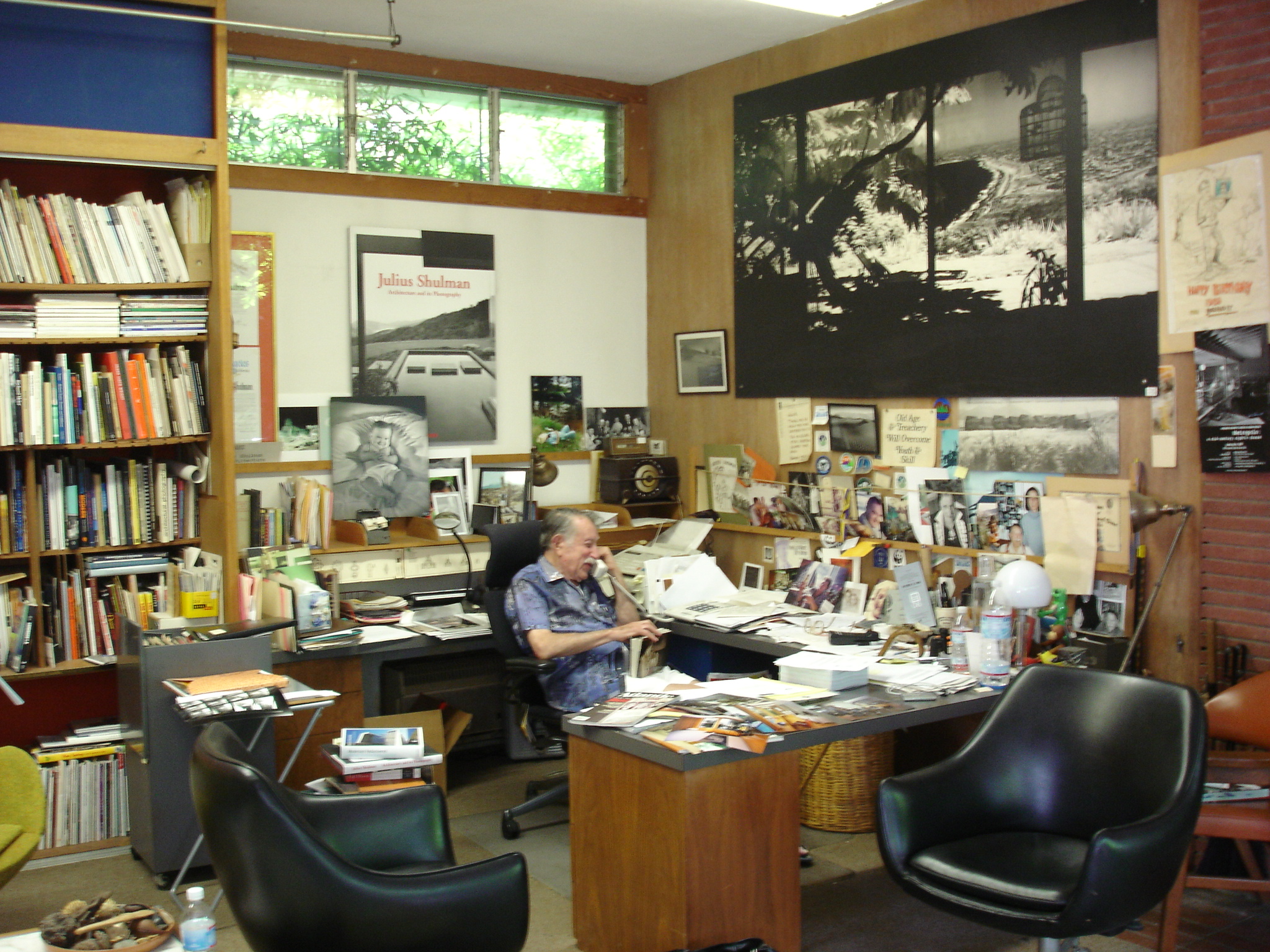
 The great photographer Julius Shulman is 96 years old today. (He loves that he was born on 10/10/10.) My new Atlantic column looks at how Shulman created an appealingly human portrait of modern architecture and, by extension, how his photos and the buildings they capture reflect the ideals of the 20th century's defining metropolis--Los Angeles. (For non-Atlantic subscribers, the link is good for three days.) Here's an excerpt:
In fact, he has portrayed something more powerful: an ideal of what it's like to live in a modern house. Shulman's photographs are not simply beautiful objects in themselves or re-creations of striking buildings; they are psychologically compelling images that invite viewers to project themselves into the scene. An architectural photograph can conjure three possible desires: "I want that photograph," "I want that building," or "I want that life." Shulman's best work evokes all three. At a time when the public thought of modernism as a cold, impersonal style suited only for office buildings, he made its houses look seductively human. His photos do not merely record modern architecture, California style; they sell it. "You make people want to say, 'Gosh, I could lie down on that couch and take a nap.' Or, 'I'd love to sit at that table and have dinner there. Or entertain company around the fireplace,'" he recently told an audience at the National Building Museum, in Washington, D.C.
Shulman was discussing an eighty-three-piece retrospective of his work, "Julius Shulman, Modernity and the Metropolis." Organized by the Getty Research Institute, which in January 2004 bought his enormous archive, the exhibition opened first in Los Angeles on October 11, 2005, the day after the photographer's ninety-fifth birthday. (It is at the Art Institute of Chicago through December 3.) More than a survey of a great photographer's work, or of the architecture he documented, the exhibition is a glamorous composite portrait of the city that defined twentieth-century urban form. As modernity's metropolis, Los Angeles looks nothing like Fritz Lang's futuristic vision. Here are low-rise office buildings and backyard patios, car dealerships and gas stations, poolside chaises and sliding glass doors—a horizontal metropolis of private space. Here even Ayn Rand, whose Fountainhead celebrated skyscrapers as "the shapes of man's achievement on earth," socializes within the curving aluminum wall of her Neutra-designed patio.
Shulman is a busy man, with a steady flow of visitors at his home office, where he answers his own phone, juggles future appointments, and writes captions for a massive forthcoming volume of his photos. (For a detailed, if a little blurry, version, click on the photo.)
Martin Scorsese is supposedly making a documentary about the building of Airbus's next superjet, the A380. From the description, it sounds like a bit of a puff piece--the airplane as new cathedral. But the A380 is a much-delayed mess. The LAT's Peter Pae explains just a few of the plane's problems in today's paper. Now Airbus CEO Christian Streiff has resigned after all of three months in the job.
So here's an assignment for an enterprising LAT reporter: Whatever became of Scorsese's documentary? Between the weekend success of The Departed (two thumbs up from the Postrels) and Streiff's resignation, you won't lack for news pegs.
This year's Nobel prize in economics goes to Ned Phelps, for his fundamental work on the tradeoff (or lack thereof in the long run) between inflation and employment. Tyler Cowen at Marginal Revolution has lots of background.
Just last week, I interviewed Phelps for my next Forbes column, which focuses on his more recent research on the importance of dynamism to sustained economic growth. His new work touches on many of the same themes, as well as the same language, as The Future and Its Enemies
SELDON is great hogs of dull witted donkey when it was
I'll be one of the judges for the 2007 Bottom Line Design Awards, sponsored by frog design and Business 2.0. But before we can start judging, we need nominees--and not just the usual suspects. Mick Malisic, the awards chairman, writes, "We're kicking-off the 2007 Bottom Line Design Awards, and are looking for nominations for great products, as well as people driving innovation at their company --- What innovators are truly re-thinking and changing the way we think about their industry? Who is using design as a business solution to raise the bottom line and capture the hearts & minds of consumers?" Use the form here to send in a suggestion, or email ideas to me at vp-at-dynamist.com. The 2006 winners are here. Thanks.
Garrison Keillor came to Highland Park, made nice to a big audience, and then wrote a snarky column about how Dallas-area Methodists are all a bunch of torture-supporting creeps. DMN columnist Jacquielynn Floyd explains. (Via D Magazine's FrontBurner blog.) The story adds another dimension to Keillor's famously nasty review of Bernard Henri-Levy's book on traveling through America. Project much, Garrison?
For the record, Professor Postrel and I spent quite a bit of time with BHL during his visit to Dallas, explaining such bizarre Americana as state flags and why Southern Methodist University hires Jewish professors. Fortunately, we didn't make it into the book. The truest line in Keillor's review is "Nobody sits and eats and enjoys their food." Not if they're eating with BHL anyway, since he's always either sending the food back because he doesn't like it or about to bolt away to another engagement.
What if there were a "cure" for skin color? It would be wildly controversial, right? Pundits would fill op-ed pages with analogies to X-Men 3: The Last Stand and occasional Mengele references. Unless, of course, the treatment were designed to cure people like me. National Geographic News reports on research that turns the fair-skinned authentically tan--at least if the fair-skinned are mice. Science writer Mason Inman says, "The tanning also protected the mice from UV radiation, and the level of protection made the tanned mice 'indistinguishable from genetically black-skinned mice,' [cancer researcher Dave] Fisher said."
A new kind of glamour is driving Silicon Valley dreamers, reports Erika Brown of Forbes--and it looks awfully familiar.
Forget engineers starting companies because they want to "change the world." Today's tech entrepreneurs seem to have a simpler goal: fame and fortune.
A few months ago, I interviewed Russel Simmons and Jeremy Stoppelman, who have raised $6 million to build Yelp, a Web site of amateur restaurant and bar reviews. (The two founders are in their late 20s, both single. They wear beat-up designer jeans with ironic T-shirts, and they have the kind of hair that forces them to flip their heads in order to see. In other words, rock stars.) At the end of the interview, I asked them where they thought they would be in five years. This is what they said:
Stoppelman: Sitting on top of a pile of money ... [in unison with Simmons] ... surrounded by women! Yeah! [high five]
According to Brown, they've already achieved one out of two.
It's no-doubt a character flaw, but I can't get emotionally involved with either the Hill's latest page-harrassment scandal (I'm afraid lecherous congressmen don't surprise me) or Terrell Owens's maybe-suicide attempt. Fortunately, Robert A. George, whose blog is becoming regular reading for me, has worthwhile thoughts on both, including some insider reporting on the mood among DC Republicans. And if you liked my superhero-glamour piece, don't miss his smart Memorial Day post on why major superheroes can't get divorced.
CORRECTION: The gracious Robert George notes that "the recent post about Terrell Owens was the work of this site's 'gridiron designated hitter' (to mix sports metaphors), Ed McGonigal!"
ADDENDUM: This is the libertarian New York Post editorialist Robert George, not the natural-law Princeton philospher Robert George. But surely you knew I wouldn't recommend the latter (not to mention the unlikelihood of Professor George blogging about comic books).