This post went out to subscribers to my Substack newsletter on January 7, 2026. Check out all the posts, including ones from the archives not reposted here, and subscribe here.
The first print edition of Works in Progress is out, with my inaugural history column. Here’s the opening:
In 1588, Galileo had not yet looked through a telescope. Microscopes, pendulum clocks, barometers, and steam pumps were decades away. Francis Bacon, a member of parliament still in his twenties, was only beginning his writing on science. Robert Boyle wouldn’t be born for another 39 years, Isaac Newton for another 55.
But a subtle shift in perspective was already taking place, heralding the ‘culture of growth’ that would blossom in the coming century. In intellectual circles, Europeans had begun to view their era not as a pale imitation of classical greatness but as a promising new world, blessed with discoveries and inventions the ancients never imagined. For all their brilliance, after all, Aristotle and Cicero knew nothing of the Americas – continents with as many and varied peoples, landscapes, flora, and fauna as Europe, Asia, or Africa. Nor did they enjoy the navigational tools that had made such discoveries possible.
In the late 1500s, in other words, Europeans started to imagine progress. ‘The first history to be written in terms of progress is [Giorgio] Vasari’s history of Renaissance art, The Lives of the Artists (1550)’, observes historian of science David Wootton. ‘It was quickly followed by Francesco Barozzi’s 1560 translation of Proclus’s commentary on the first book of Euclid, which presented the history of mathematics in terms of a series of inventions or discoveries’.
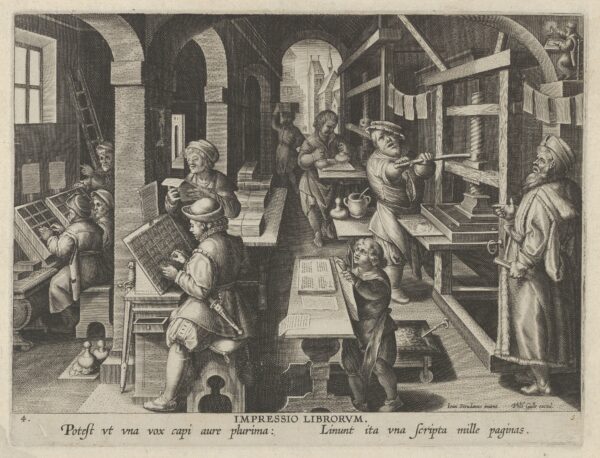
This was the environment in which two Florentines conceived Nova Reperta, whose Latin title is usually translated ‘new discoveries’. One of the earliest works promoting the new attitude – and definitely the most charming – the book is a collection of 19 engravings, each celebrating a discovery or process that was relatively new to Europeans. First published in 1588, Nova Reperta made the argument for progress by showing rather than telling.
Read the rest here. Subscribe to the WiP print edition here. It’s gorgeous!
My next two history columns will look at the early days of TV and the development of disposable diapers. I’m currently exploring a couple of ideas for the fourth entry.
Science YouTuber Hank Green read The Fabric of Civilization after being set upon by the cancel culture of online knitters. He loved it and we had a fun conversation on his show. It also sold at least 800 books in the first week—which is a lot! (It’s currently at 643K views.)
This morning I stumbled on this Reddit thread, which bemoans my appearance and condemns me as politically incorrect. (It also cites my skimpy and weird Wikipedia entry. I eagerly await the day that AI makes Wikipedia obsolete, since there’s no way to correct a bad entry.) A decidedly minority take judging from the comments on the YouTube video.
I also did a wide-ranging interview, pulling ideas from many of my books, with the entrepreneurship-oriented Double Win podcast, hosted by Joel J Miller’s wife Megan and her father Michael Hyatt.
The Cosmos Institute periodically puts together reading recommendations for “philosopher-builders” and I was honored to participate in its winter lineup, plugging a book I’ve been fairly obsessed with: David Wootten’s The Invention of Science (which got a mention in my Nova Reperta column). Check out the full lineup here
I recently discovered three hardback copies of The Power of Glamour left over from an event in 2014. I can tell because they’re signed, with a note of the date and location but no recipient’s name. I would like to give them away to three Substack subscribers.
If you’re interested, please consider the following passages from the book and leave a comment sharing an anecdote or experience showing glamour at work in everyday life. It could be an example of glamour in your own life—what you yearned for, what sparked it, how it felt, etc.—or it could be something you’ve seen in others or in a fictional medium. Although comments can’t directly include images, I encourage commenters to link to images where relevant.
I will select two winners randomly and one based on the comment I like best.
As a psychological phenomenon and rhetorical tool, glamour is like humor. It is an imaginative experience in which communication and association create a recognizably consistent emotional response. With glamour the response is an enjoyable pang of projection, admiration, and longing.
From another section:
First, glamour is an illusion, a “deceitful feeling” or “magic light” that distorts perceptions. The illusion usually begins with a stylized image—visual or mental—of a person, an object, an event, or a setting. The image is not entirely false, but it is deceptive. Its allure is created by obscuring or ignoring some details while heightening others. That selection may reflect deliberate craft. Or it may happen unconsciously, when an audience notices appealing characteristics and ignores discordant elements. In either case, glamour requires the audience’s innocence or, more often, willing suspension of disbelief.
Second, glamour does not exist independently in the glamorous object—it is not a style, personal quality, or aesthetic feature—but emerges through the interaction between object and audience. Glamour is not something you possess but something you perceive, not something you have but something you feel. It is a subjective response to a stimulus. One may strive to construct a glamorous effect, but success depends on the perceiver’s receptive imagination.
“Everyday Abundance,” the podcast
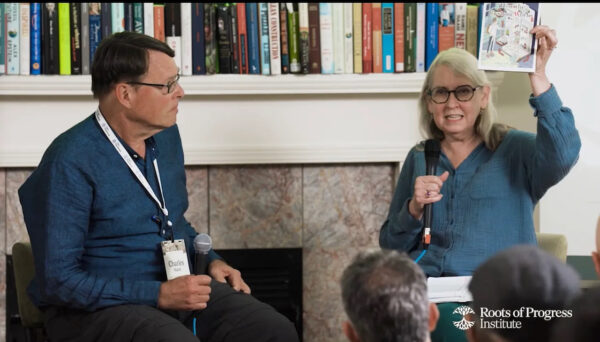
Charles Mann and I discuss his essays on “How the System Works” at the Progress Conference. Video here.
Thanks to support from the Abundance Institute, I’m delighted to announce that Charles Mann and I will soon begin recording the first season (eight episodes) of “Everyday Abundance,” a podcast exploring the hidden histories behind everyday activities and the technologies we don’t even know are technologies. Think “brushing your teeth,” “listening to music,” or, our favorite, “blowing your nose.” We expect to release the first series by early March.
I think he should be remembered most, because I’ve focused on this in my book, for the jailing of peaceful protestors who were urging him to support the Susan B. Anthony amendment at the same time he’s making speeches about democracy. These women were illegally arrested and jailed for trumped up charges of sidewalk obstruction when their only offense was silently displaying signs and banners that literally quoted Wilson’s own speech in favor of democracy. Their sentences were outrageously long for the supposed misdemeanor offense of sidewalk obstruction. Alice Paul got seven months, Lucy Burns got six months.
While they were in prison they were beaten up, some unconscious. Just unbelievable that this could happen for nothing more than pure speech. We can get into this more perhaps during the discussion, but Wilson had direct control over the jails, the police, and the prosecutors in the District of Columbia at that time because they didn’t have home rule. They were not elected leaders. Wilson ran it through a three-member commission. His appointees were journalist friends of his for many years. One of them had hired and trained Wilson’s brother Joe. So, we’ve got uniformed Navy men right outside the White House attacking suffragettes, ripping their banners, in many cases injuring the suffragettes, beating them up, dragging them through the streets and so on.
This is happening right in front of the White House. Wilson did nothing to stop it. In fact, he and his chief of staff, that was called the White House secretary in those days, authorized the arrest not of the mobs that attacked women, but of the women themselves who were silently holding these banners as, of course, they were legally entitled to do. The courts got around to sorting this out later, way too late, after all the punishment was inflicted, and after the government’s objective of stopping the speech was accomplished.
“Old School Civics,” part 1 and part 2, by my friend Jack Henneman, host of the “History of the Americans” podcast. These posts use a 1918 high school textbook to examine how people at the time thought about American citizenship. “How did our ancestors, in many cases people we or our parents knew, learn to be Americans?”
“The Value of Public Domain Day” by Eric Harbeson of Authors Alliance makes a compelling case for requiring a $100 fee and renewal application for the last 20 years of a copyright term. When such fees were required, very few authors applied for extensions, making “painfully clear how the present copyright terms are placing a staggering burden on the public’s right to a return on its investment in copyright.”
This post went out to subscribers to my Substack newsletter on February 16, 2026. Check out all the posts, including ones from the archives not reposted here, and subscribe here.
Ideogram.ai with prompt: “Create an image of J.K. Rowling writing a fan email to Virginia Postrel with a copy of The Fabric of Civilization next to her laptop. Put some Harry Potter books and memorabilia on a bookshelf in the background.”
On his Substack, Neal Stephenson recently posted the following warning: “Just a quick note to mention that I’m being impersonated by someone using the email address “contactnealstephenson (at) gmail (dot) com” and sending out emails consisting of AI slop that I wouldn’t be caught dead writing.”
He isn’t alone!
I constantly get emails purportedly from other writers. The names are usually unfamiliar but, when Googled, turn out to be those of real novelists—always novelists, never nonfiction writers like me—writing in a genre I don’t read. Here’s an example, supposedly from the Canadian YA writer E.K. Johnston, using the email [email protected]:
Hello,
I’m E. K. Johnston, a fellow storyteller with a deep passion for exploring resilience, relationships, and the strength of the human spirit through fiction. Over the years, I’ve been fortunate to share several novels that have resonated with readers, weaving together emotional depth and compelling narratives.
I’d love to learn more about your own writing journey and the stories you’ve brought to life. Please feel free to share your book link, website, Goodreads profile, or Amazon page I’d be delighted to explore your work.
Wishing you inspiration and success in your creative path. I look forward to connecting with you.
Warmly,
Emily
And then there was this one, with the subject line “Admiring The Fabric of Civilization” and more specific references to the book (or at least the description you find of it on Amazon). This email came from [email protected]:
Dear Virginia Postrel,
I hope this note finds you well. My name is J.K. Rowling, author of the Harry Potter series and other novels. I recently read your book The Fabric of Civilization: How Textiles Made the World and felt compelled to reach out to share my admiration.
What struck me most was the way you wove together archaeology, economics, and cultural history into a narrative that feels both deeply researched and beautifully accessible. The connections you draw, from the Minoans’ purple wool exports to the role of textiles in inspiring binary code, made me see how profoundly cloth has shaped not only commerce and politics but the very ways humans think.
Your work reminded me that some of civilization’s greatest leaps come from the most everyday of objects. I was especially fascinated by how you positioned textiles as both material necessity and cultural symbol. May I ask, when you began this project, did you envision it primarily as a history of technology, or as a cultural story that happened to intersect with technology?
Thank you for bringing such originality and clarity to a subject that, as your book shows, is truly the story of humanity itself. I look forward to exploring more of your work, from The Power of Glamour to your Bloomberg columns.
Warm regards, J.K. Rowling
I am not sure exactly what the scam is but I get one of these every other week or so.
I sent the “Rowling” note to Neal Stephenson, who replied: “Wild. So obviously AI generated and customized for you. If these things were being spammed out to millions of people I’d guess it was just a garden variety scam. But it’s hard to imagine what their game is sending out individualized emails to people in the literary world. The science fiction novelist in me thinks it’s something really deep and weird…”
He also shared one of the emails sent under his name, in this case to children’s book author Rebecca Stead, who gave me permission to reproduce it:
Hi Rebecca,
I wanted to write after spending time with The Lost Library. What struck me first was the warmth of the premise, a small-town mystery anchored by a little free library, and how that simple image becomes a doorway into history, memory, and the things a community chooses to keep quiet.
I especially enjoyed the shifting perspectives. Letting the story move between Evan, the ghost librarian, and Mortimer gives the book a layered sense of time and consciousness. It creates a feeling that the town itself is telling the story, not just the people who currently live there.
The connection between the old books and the buried past is handled with a lightness that still carries real emotional weight. The mystery never feels oversized for the age of the characters, but it also doesn’t talk down to them. That balance is difficult to strike, and it gives the story its quiet authority.
I’m glad I read it. It’s a book that understands how stories, and libraries, hold more than just text. They hold memory, permission, and possibility. If you ever feel like talking about how you approached writing a mystery that’s also a meditation on books and truth, I’d enjoy that conversation.
With best wishes,
Neal Stephenson
Ideogram.ai Prompt: “Create an image of science fiction writer Neal Stephenson writing a fan email to Rebecca Stead with a copy of her book The Lost Library (picture here https://rebeccasteadbooks.com/wp-content/uploads/2023/07/book-lost-290.jpg) next to his laptop.” Even when given an image of the actual book cover Ideogram invents its own.
When I asked Rebecca Stead if I could quote her “Neal Stephenson” email, she was quick to agree, writing “My inbox is a misery of false flattery these days - but I've only had two from fake writers, I think. The rest are mysterious entities who adore my work but can't sleep because my Amazon rankings are low.”
I get those too. There are two versions: people who claim to offer ways to reach large communities of readers and people who offer marketing services. It’s possible that the former are “legit,” in the sense that they run pay-to-play book clubs taking advantage of desperate, mostly self-published authors. Here’s an example, notable for its use of the Spanish edition of The Fabric of Civilization in the pitch:
Hi Virginia Postrel,
I hope you’re doing well. My name is Glory, and I run Well-Read Black Girl, a reading community of a little over 12,000 readers who genuinely love discovering and discussing meaningful books.
Your book “El tejido de la civilización” came across my radar recently, and it really struck me as the kind of story our readers connect with and talk about. Because of that, I wanted to reach out personally.
We’re currently curating our 2025 Holiday Spotlight & New Year Showcase, along with our Readers’ Choice End-of-Year Awards, and I think your book could be a great fit for what we’re building.
When we feature an author, it usually includes:
- Spotlight promotion to 12,000+ engaged readers - A written Q&A feature shared across our platforms - Christmas & New Year promotional push - Organic reader discussions, coverage, and reviews - Placement in our 2025 Readers’ Awards consideration
At the heart of it, we just try to connect good books with readers who will genuinely champion them.
If you’re open to it, I’d be happy to send you a short, straightforward overview of how it works and what it looks like on your end.
Would you like me to send that over?
Warm regards, Glory
The book marketers may also be real but are definitely using AI to churn out their emails:
Hello Author Virginia,
I want to start by saying this: every author I’ve ever spoken with whether they’ve written one book or twenty has carried the same hidden fear.
That fear is not of writing the book. It’s not even of publishing it.
It’s the fear of pouring years of passion, discipline, and sacrifice into a story only for it to sit quietly, unnoticed, and unheard in the endless ocean of new releases.
The hardest truth of publishing is this: writing the book is only half the journey. The real battle begins when it’s time to make sure your words are seen, remembered, and carried into the hearts of the readers they were written for.
Here’s the reality that no one says out loud:
If readers can’t find your book, they can’t read it.
If your brand isn’t clear, they’ll forget you the moment they scroll past.
If you’re absent from reader communities, you’ll be left out of the very conversations that create bestsellers.
That’s where I step in.
My name is Lois Goodness, and I help authors bridge the gap between simply publishing and truly being discovered. I specialize in transforming books from “just another release” into lasting brands that readers connect with, remember, and return to.
Here’s how I serve authors like you:
Amazon Global Optimization – I fine-tune your categories, keywords, and book descriptions across Amazon US, UK, Canada, India, Germany, and more so your book is not just published, but globally discoverable.
Book-to-Brand Positioning – You’re not just an author of a single book. You’re a voice, a brand, a storyteller with a message. I help position you as someone readers come back to, book after book.
Reader Community Placement – I get your work in front of readers where they already gather Goodreads, niche communities, book clubs, forums—so your name lives where the conversations happen.
Book Page & Review Enhancement – Your Amazon page should not look like a listing; it should look like a storefront that draws readers in and inspires authentic reviews. That’s what I build for you.
Sustained Visibility Strategies – Launch day is important, but what happens after? I create long-term strategies that keep your book relevant, discoverable, and selling months even years after release.
But beyond strategies and tactics, here’s what I truly believe:
Your book deserves more than to sit quietly on a digital shelf.
It deserves to be discovered.
It deserves to be read.
It deserves to be reviewed, remembered, and passed on.
So let me ask you, as honestly as I can:
Right now, is your biggest struggle visibility, reviews, or sustaining momentum?
Hit “Reply” and tell me in one line. I’ll listen first, and then I’ll show you the exact next step that can change everything for your book.
Because here’s what I know with certainty: your words were not written for silence. They were written to live loudly, to reach the people they were meant for.
And I’d be honored to help make that happen for you.
Warm regards,
Lois Goodness
Book Marketing Specialist
“She” isn’t wrong. The biggest problem for almost all authors is simply getting potential readers to know the book exists. Again, I get these emails all the time.
Someone out there thinks that a good early application of AI is to scrape the web for author emails and entice these desperate souls with admiration, fellowship, and marketing assistance. In the seductive words of an unknown AI pretending to be Lois Goodness, “Your words were not written for silence. They were written to live loudly, to reach the people they were meant for.”
It’s what we all want to hear. But just because an LLM says it doesn’t make it true.
Posted by Virginia Postrel on March 31, 2026 • Comments
This post went out to subscribers to my Substack newsletter on November 20, 2025. Check out all the posts, including ones from the archives not reposted here, and subscribe here.
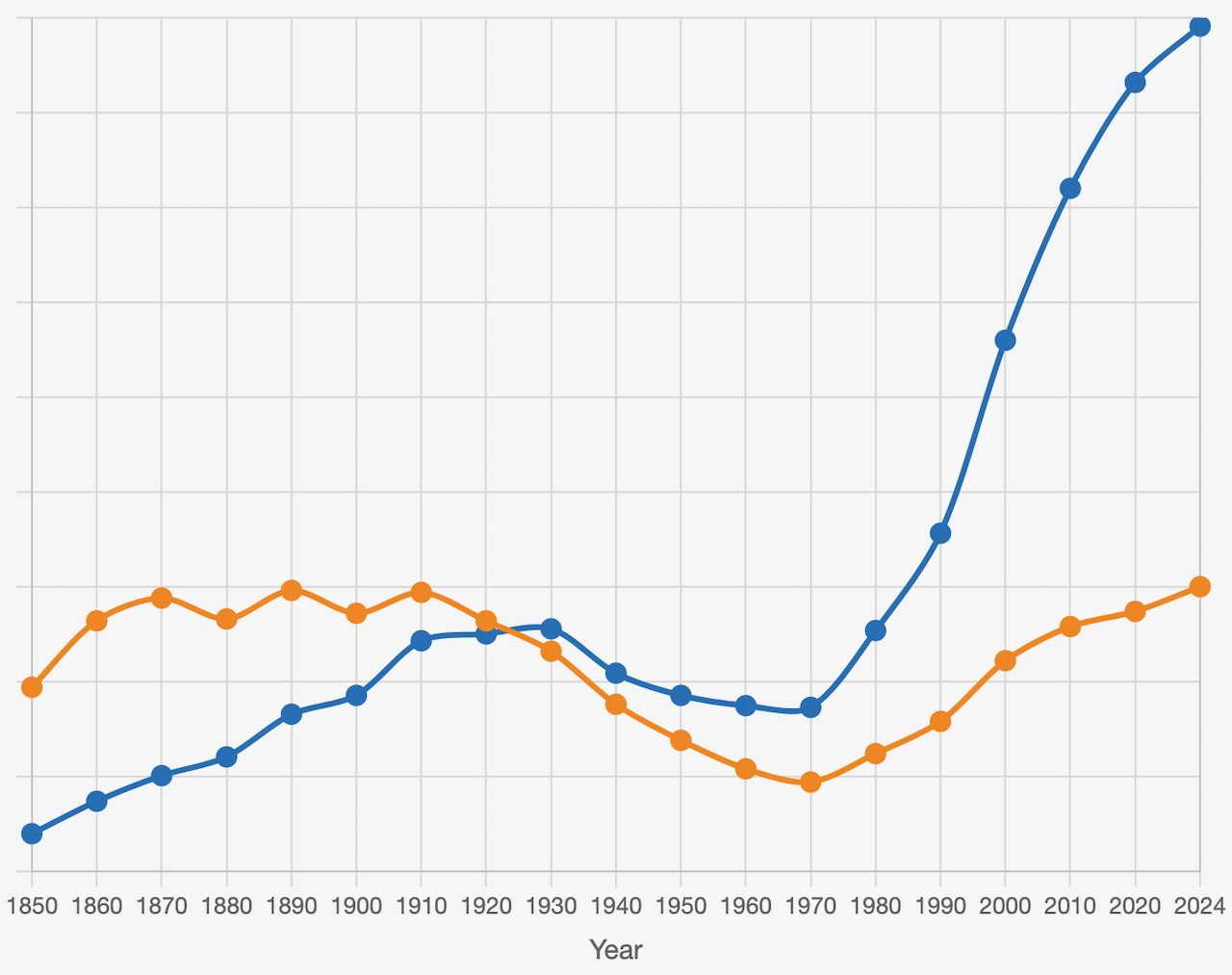
Maybe this chart explains it? Keep reading to find out what it tracks.
Roots of Progress Institute founder Jason Crawford recently hosted me at an Interintellect salon. Our topic was the relation between glamour and progress, inspired by my Works in Progress article. At one point Jason asked a provocative question: Why did the anti-Promethean backlash happen when it did? Earlier periods of technological and economic progress, he noted, had produced demands for more progress, not less. What was different about America circa 1970?
In the WiP article, I point to a combination of complacency among those who’d grown up amid postwar plenty and dissatisfaction with technocratic overreach. But why the complacency? Why not a demand for even more? My article didn’t consider that question.
Brink Lindsey, who coined the term anti-Promethean backlash, cites two possible explanations. First, “as economic security spread throughout the populace, priorities shifted from physical security and material accumulation to self-expression and quality of life.” Second, “as people acquired more, they had more to lose, and accordingly began worrying more about holding on to what they had.” The result was the backlash, defined as “the broad-based cultural turn away from those forms of technological progress that extend and amplify human mastery over the physical world.”
The first explanation entails a shift toward intangible experiences—lots of travel and dining out—and a turn away from the mass-market drive to “not bad” goods to everyone. That certainly happened. (I even wrote a book about one aspect.) But you’ll be hard pressed to detect low demand for physical security or less stuff in either election results or market trends. If anything, heightened concern for physical security, aka “safetyism,” is a major driver of the anti-Promethean backlash. As for loss-aversion, the empirical relationship to income is, as best I can tell, murky. My intuition is to think that if you’re on the material edge you’d be more loss-averse rather than less. But poor people do play the lottery more, so maybe Brink’s right. Either way, I don’t think his explanations fully explain the timing. Why 1970 instead of, say, 1950?
Megan McArdle recently took up the question from a different angle, inspired by reading Emily Post’s 1916 book about driving across America, By Motor to the Golden Gate, The condition of Post’s trip, often on heavily rutted dirt roads, were horrendous. But Megan was most struck by “the incredible optimism and wild ambition that runs through Post’s America. The Midwest, particularly, seems to be in the middle of a youthful growth spurt, with cities springing up out of the prairie full of vim and vigor and plans for the future.” (Emphasis added. I will return to this point.)
Our longing for that lost sense of optimism, Megan argues, shapes contemporary politics. On both left and right, activists “are asking why we can’t recapture the spirit of an age when America felt young and hopeful and capable of doing extraordinary things.” The reason we don’t feel that way now, she suggests, is that we’ve been too successful. Indoor plumbing is exciting when you get it, a third bathroom nice but not life-changing. The same is true for highways, bridges, railroads, and dams.1 “The political trade-offs are now harder, because we’re chasing incremental improvements, not life-altering change,” she writes. Youth, hope, and extraordinary achievement belong, in this gloomy analysis, to developing countries, China in particular.
I’m more optimistic, because Jason’s question pointed me to something I hadn’t previously considered. My first instinct, as a student of English literature, was to say that Jason was wrong. The 20th-century anti-Promethean backlash wasn’t unique. The Industrial Revolution generated one as well.
Victorian England produced many influential writers and artists, including John Ruskin, William Morris, and Augustus Pugin, who deplored modern industry and promoted an idealized medievalism. Their ideas left a permanent mark on intellectual life but had little immediate effect on the pace or direction of industrial change.2 Medievalism sold as a style but not as a political agenda.3 Its legacies were primarily aesthetic, realized in Gothic revival architecture, Arthurian poetry, pre-Raphaelite painting, and the British Arts and Crafts movement. The social criticism that actually transformed Britain demanded more for working people—political power and material abundance for the masses, not a return to feudal roles or an end to factories and machine-made goods. As long as a significant proportion of the population lived in material deprivation, the salient debates were over how to distribute the fruits of Promethean industry, not whether that industry was a good idea.
Besides, Jason wasn’t asking about the Old World. The United States lacked even Britain’s intellectual backlash. Americans who objected to industrial progress remained niche players, idealizing the ante-bellum South.4 There was plenty of dissatisfaction and conflict, of course. We had labor strife and muckrakers; socialists, anarchists, and populists; Edward Bellamy and the National Grange. But medievalism was confined to wallpaper and architecture, often installed or financed by industrial magnates. Feudalism wasn’t on the American agenda. What was different here? And what might it tell us about 1970?
As I talked to Jason, several things suddenly came together: the Old World vs. the New, multiple conversations with young people at the Progress Conference, and a passage from Willa Cather’s The Song of the Lark:
She had often heard Mrs. Kronborg say that she “believed in immigration,” and so did Thea believe in it. This earth [the midwestern prairie] seemed to her young and fresh and kindly, a place where refugees from old, sad countries were given another chance. The mere absence of rocks gave the soil a kind of amiability and generosity, and the absence of natural boundaries gave the spirit a wider range. Wire fences might mark the end of a man’s pasture, but they could not shut in his thoughts as mountains and forests can. It was over flat lands like this, stretching out to drink the sun, that the larks sang—and one’s heart sang there, too. Thea was glad that this was her country, even if one did not learn to speak elegantly there. It was, somehow, an honest country, and there was a new song in that blue air which had never been sung in the world before.
That’s the spirit of the midwestern growth spurt, of “cities springing up out of the prairie full of vim and vigor and plans for the future.”
I did some mental arithmetic and suggested a hypothesis. The young Americans who proved so receptive to anti-Promethean ideas in the 1960s and 70s—those born starting from the late 1920s onward—weren’t just richer than previous generations. They were the products of the country’s four decades of restricting immigration. Instead of an America renewed by people looking for another chance, they had grown up in a more complacent society. These immigrant-deprived generations were much more likely than earlier generations to embrace and amplify anti-Promethean ideas, providing a mass of public support.
Later, I found remarkably congruent statistics. Nineteen seventy marked was the first Earth Day.5 It was also the year in which the percentage of the U.S. population made up of immigrants reached its nadir, with the total number of immigrants at the lowest point in a century.
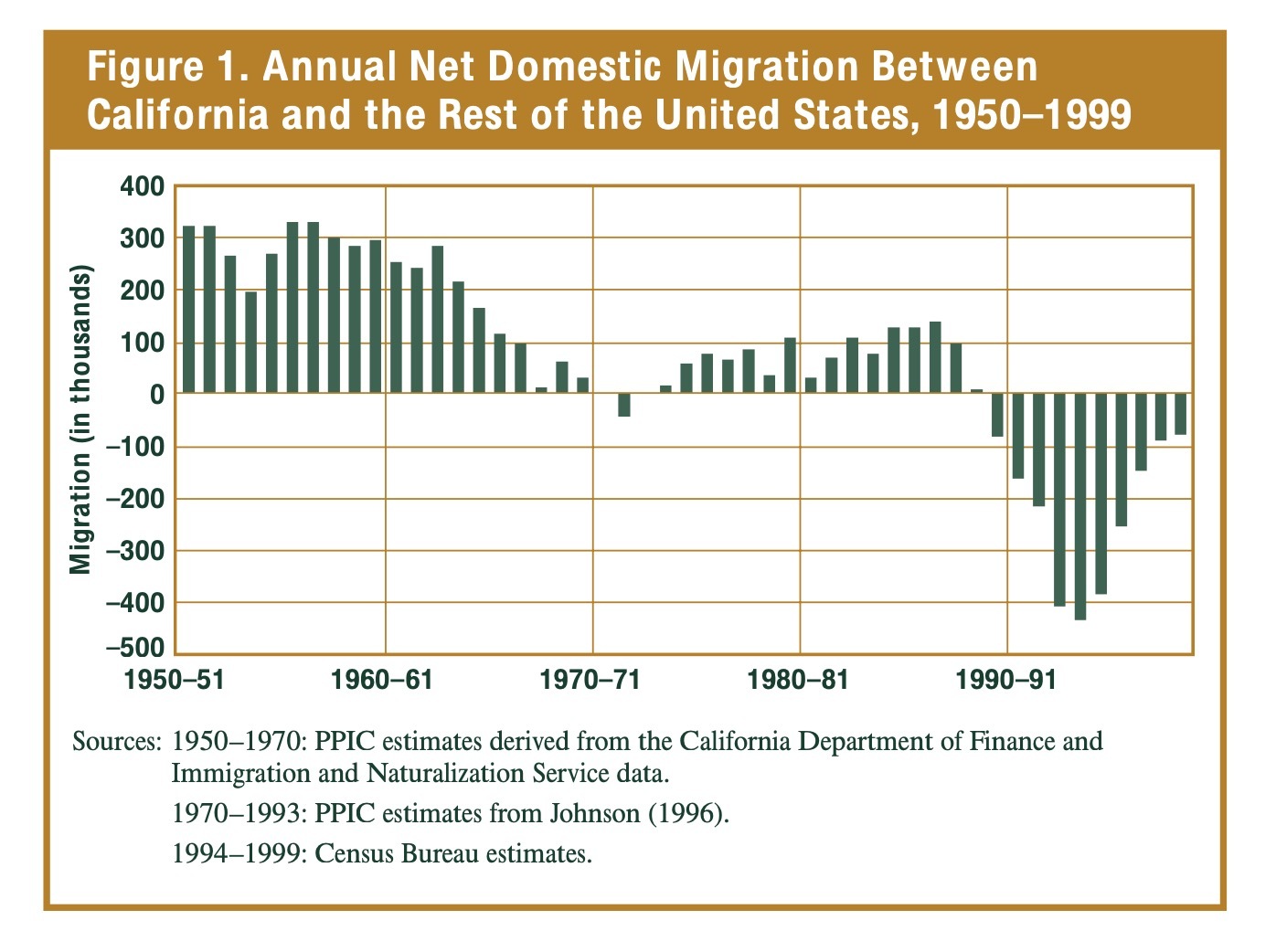
Internal migration, which surged after World War II, had declined as well. The “Second Great Migration” of blacks from the South ended around that time. Domestic migration to California, arguably the vanguard of the anti-Promethean backlash, peaked in the late 1950s, then declined significantly, occasionally turning negative. The resurgence in the 1980s, which was accompanied by large-scale international immigration, set off a “growth control” movement that resulted in new building restrictions.6
Hans P. Johnson, “Movin’ Out Domestic Migration to and from California in the 1990s,” Public Policy Institute of California, August 2000, available here.
The anti-Promethean backlash arose when America was most like a normal, settled country rather than a nation of strivers seeking a better life. It intensified when the people who accepted the more static America tried to preserve it by legally restricting “human mastery over the physical world,” from power plants to housing construction.
My unscientific observation is that the progress and abundance movement is full of the children of immigrants. We seem due for a turnaround.
Creative Frontiers: a great new Substack from historian/musician John Hardin of the Abundance Institute. This post on how Duke Ellington used the microphone to create a whole new sound is fascinating. His latest is on AI-generated music and The Chipmunks. Check it out.
“The Middle-aged Millennial,” a delightful short tale by Naomi Kanakia whose opening explains its literary inspiration: “One day Rajiv woke up and realized that he was in a Cheever story!” I haven’t read Cheever but I have a feeling I prefer Kanakia. The story’s ending is surprising, funny, and wise.
Posted by Virginia Postrel on March 28, 2026 • Comments