Glenn Reynolds is praising the Pajamas Media election coverage: "In particular, I thought the marriage of cheap digital cameras that shoot good video -- all the PJ video, except for my clip, was done with this inexpensive Canon Powershot -- with lots of people having access to YouTube really worked out well."
I'm sure he's right, for people who can't get enough talking heads. Personally, I hated the PJM election coverage, because I don't want to have to watch video online. I want to read, and PJM offered way too little written material. But with the right technology, video is much easier to provide--especially if you don't care about shaky-cam production.
Posted by Virginia Postrel on November 08, 2006 • Comments
Party labels matter most when voters know little to nothing about the candidates as individuals--not in hot Senate races like Webb versus Allen but in obscure judicial elections where only lawyers and their friends really know anything about the candidates. I don't vote in judicial elections, but a lot of people do. And in Dallas County, where an R used to guarantee a judgeship, the Democrats swept the judicial races and picked up the district attorney's post and county executive.
Posted by Virginia Postrel on November 08, 2006 • Comments
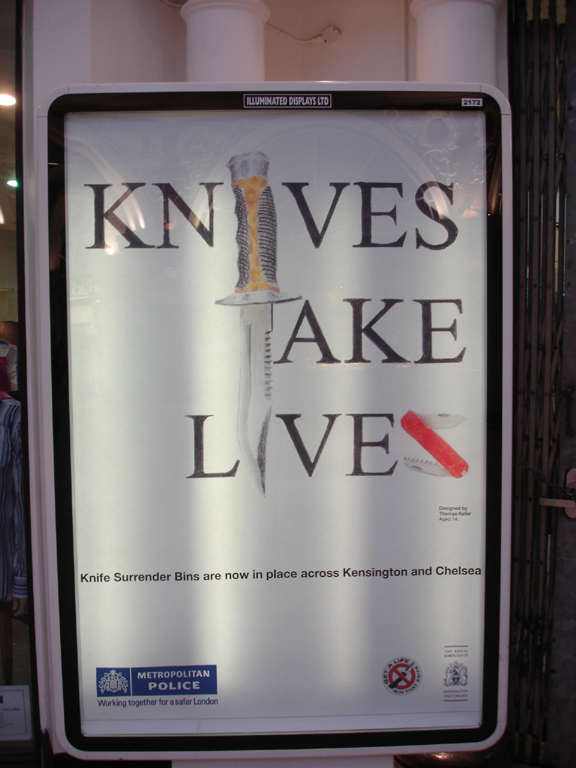
Seen in the London Underground. It's hard to tell in this small version (click here for a larger picture), but the red one is an ordinary pocket knife--not something anyone but airport security usually considers a weapon. A schoolboy won an award for designing the campaign poster.
Posted by Virginia Postrel on November 03, 2006 • Comments
British scientists have grown a penny-sized liver from umbilical cord blood stem cells. Transplantable organs are still decades away, however, say researchers. In the short term, the mini-organs can be used for drug trials.
Posted by Virginia Postrel on November 03, 2006 • Comments
Sally Satel and I have paired articles on the kidney crisis, and our personal stories, in today's USA Today. The op-ed package also includes FAQ and interesting transplant trivia. Here's the oped page link. Scroll down for the kidney package.
UPDATE: Sally's article is in the archives here, mine is here, and the sidebar is here.
Sally and I will be on C-Span's Washington Journal Friday morning at 8:00 Eastern to discuss the articles.
Posted by Virginia Postrel on October 24, 2006 • Comments
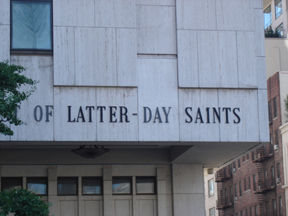
A collision of meanings: The words say LDS, but the font says WSJ.
Posted by Virginia Postrel on October 23, 2006 • Comments
Writing on Wired.com, security expert Bruce Schneier reflects how changing threats make yesterday's architecture obsolete:
The problem is that architecture tends toward permanence, while security threats change much faster. Something that seemed a good idea when a building was designed might make little sense a century--or even a decade--later. But by then it's hard to undo those architectural decisions.
When Syracuse University built a new campus in the mid-1970s, the student protests of the late 1960s were fresh on everybody's mind. So the architects designed a college without the open greens of traditional college campuses. It's now 30 years later, but Syracuse University is stuck defending itself against an obsolete threat.
Similarly, hotel entries in Montreal were elevated above street level in the 1970s, in response to security worries about Quebecois separatists. Today the threat is gone, but those older hotels continue to be maddeningly difficult to navigate.
Security isn't the only factor that dates quickly. I recently read Alastair Gordon's lively history, Naked Airport: A Cultural History of the World's Most Revolutionary Structure . Again and again, airports have been designed to solve the problems of one era, only to confront completely different problems almost as soon as construction is complete. DFW Airport is no aesthetic treasure, for instance, but it ingeniously solved the problem of its design era: how to get people from their cars to the plane without a long walk down a corridor to the gates. Then came deregulation and hub-and-spoke systems, DFW became American's major hub, and passengers had to walk Texas-size distances to change planes. What Gordon doesn't note, and couldn't given the timing of his book, is that post-9/11, DFW is again one of the nation's more efficient airports, at least for passengers originating here. Its many entries allow security checkpoints to be spread closer to the gates, instead of routing passengers through a few chokepoints and then forcing them to travel long distances to their gates.
Posted by Virginia Postrel on October 22, 2006 • Comments
Megan McArdle imagines the things journalists should disclose but don't.
Posted by Virginia Postrel on October 22, 2006 • Comments
Randall Stross has a nice column in today's NYT on why Silicon Valley persists as the nation's startup center, despite perennial predictions that money and talent will disperse to cheaper regions. I particularly liked this point, which gets beyond the obvious explanation that venture capitalists don't like to travel:
Entrepreneurs who live in Silicon Valley also find the technical talent they need faster than they can in any other place; they pay more for that talent, but speed is the sine qua non for success. Seth J. Sternberg, the chief executive of Meebo, an instant-messaging company in Palo Alto that is backed by Sequoia, described Silicon Valley with the fervent appreciation of a recent transplant from New York, where he had suffered three separate bad experiences with start-ups, none of which had attracted venture funding.
The ecosystem in Silicon Valley, Mr. Sternberg said, includes "incredible techies, who live here because this is the epicenter, where they can find the most interesting projects to work on." The ecosystem also includes real estate agents, accountants, head hunters and lawyers who understand an entrepreneur's situation--that is, emptied bank accounts and maxed-out credit cards.
As it happens, last night Professor Postrel read me Paul Graham's excellent essay, "How to Make Wealth", whose emphasis on speed complements the Stross piece. For those who prefer their essays in bound form, I recommend Graham's Hackers and Painters, which is definitely not of interest only to geeks. My mother (a sometime painter, but mostly a literary writer) picked it up on a visit to our house and, after reading a few essays, declared that they should use it in college composition classes. She should know, since she used to teach them.
Posted by Virginia Postrel on October 22, 2006 • Comments
The Saudis and Israelis, who rarely agree on anything, seem to think so. According to this report, a new Saudi "law allows nonrelative donors to receive SR50,000 ($13,333) for donating an organ or part of an organ." As I reported in an earlier post, an Israeli court decision recently set the compensation due kidney donors at roughly $13,000.
Posted by Virginia Postrel on October 20, 2006 • Comments