As John Scalzi has scathingly noted, Amazon really screwed up when they pulled all of Macmillan's titles from their site. Although I think they have the right idea about book prices, they betrayed their customers' expectations and, worse, did so without warning. They forgot that Amazon is what Professor Postrel called in this 2007 post on Organizations and Markets a "new-wave utility" and, a such, has adopted a strategy that implies a high level of reliability.
How do you get sustainable advantage in a service business today? One approach: Become a new-wave utility. Think about Google or Yahoo, eBay, Amazon, etc. on the Internet; think about UPS or FedEx, Grainger, Ryder, Public Storage in logistics; think about McDonald's, Starbucks, 7-Eleven, in convenience food consumption.
Amazon has backed down from its weekend dispute with Macmillan, agreeing to charge the publisher's higher prices for Kindle editions rather than its preferred $9.99. But the long-term questions about e-book pricing remain.
Amazon still calls Macmillan's prices--generally $12.99 to $14.99 for new books--"needlessly high." Apple, meanwhile, has made deals with publishers like the one Macmillan demanded from Amazon: higher prices for books, with Apple keeping a percentage of sales.
Who, in fact, has the better strategy? To maximize revenue, what should prices for e-books look like?
In Tears of Mermaids: The Secret Story of Pearls, Stephen G. Bloom (interviewed yesterday) provides a behind-the-scenes tour of the worldwide pearl industry. Here is the first of four installments on the Chinese freshwater pearl farms that are transforming the world of pearls.
Zhuji (pronounced SHOE-ghee), about 100 miles southwest of Shanghai in the province of Zhejiang, is the epicenter of the world's freshwater pearl market. These are cultivated pearls that don't come from oysters, but instead from large, oval-shaped mussels. China produces 99 percent of all such freshwater pearls in the world. Zhejiang province is dotted with thousands of small, family-operated pearl farms, most of them state cooperatives. Such farms are seemingly everywhere, with millions of green plastic pop bottles bobbing up and down on the surfaces of thousands of small artificial lakes, each bottle signifying another crop of fresh mussels, and each mussel containing as many as fifty pearls inside. Exactly how the Chinese have been able to cultivate mussels that produce so many pearls remains something of a mystery. These pearls don't develop around an inserted nucleus, as their counterparts in oysters do, but instead grow from multiple tiny squares of mussel mantle tissue inserted into each host mussel.
The first crop of Chinese freshwater pearls appeared in the early 1970s, and since then, pearl exports from Hyriopsis cumingii mussels have grown exponentially. At first, the pearls were miniscule. By the 1980s, their size had grown and they started coming in a variety of striking rainbow colors. These pearls were often labeled and sold as Lake Biwa or Lake Kasumigaura pearls from Japan, fetching higher prices because of the Japanese label.
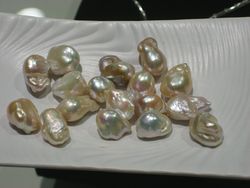
The Chinese freshwaters were a breakthrough in the fashion marketplace. Fashion-conscious women around the world started wearing pearls that weren't just white or cream-colored, and not always round. Stylish younger women gravitated to them. These pearls had four things going for them: they were colorful, they often weren't symmetrical (the baroque shapes appealed to non-traditional pearl wearers), they had the legitimacy of being real pearls, and they were downright cheap when compared to traditional pearls. As their size got larger, the Chinese freshwaters readily turned into trendy fashion items, turning into accessories fashion-forward women in their twenties and thirties from Paris to São Paulo just had to have. It didn't hurt that women like Meryl Streep, Jennifer Aniston, and eventually Michelle Obama started wearing them, too.
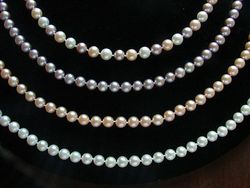
As Chinese technology got better, more and more freshwater pearls came on the global market at a fraction of the price of their international counterparts. By the late 1990s, the best of the Chinese freshwaters were virtually undetectable from increasingly scarce Japanese akoyas, and soon, the Chinese pearls were available in even larger sizes than the Japanese species would allow. Symmetrical freshwater Chinese pearls now come as large as 14 millimeters (that's as big as a marble), and are getting larger. Their skin can be flawless and comes in a multitude of colors (pink, blue, violet, orange, gold, gray), some right out of the shell, others the result of dye, chemical, and radiation treatments.
The flooding of so many Chinese pearls into the world market presented a problem for producers of more expensive pearls (just about every producer outside China). It'd be akin to the De Beers diamond syndicate discovering a competitor had come up with a new process that could create a genuine diamond, not a zirconium knockoff, but a real diamond that cost pennies to the thousands De Beers diamonds fetch. No wonder the worldwide pearl industry started screaming.
Example: A strand of medium-sized, near-perfect Chinese freshwater pearls can be bought wholesale today for under $150. Such reverse sticker shock is freaking out just about every other national producer of pearls. To make matter worse, to most consumers, such a strand is virtually identical to strands that sell for five and ten times as much (and sometimes more). Chinese freshwaters are showing up everywhere, from top-end retail jewelry boutiques like Mikimoto, Bulgari, Harry Winston, and Van Cleef & Arpel's to low-end merchandizing giants, such as Wal-Mart, JC Penney, Jeremy Shepherd's Internet sites, and cable TV's QVC. Their price-point is so low and their quality can be so high, that it's no surprise that some dealers intentionally mislabel Chinese strands as of a more expensive provenance (Japanese, Tahitian, even Australian). This can be by unscrupulous intention, but it's often just an uninformed mistake. Chinese pearls can look so good they fool wholesalers and retailers alike.
Inexpensive high-quality Chinese pearls are out there, and out there in a big way, and because of their proliferation, the global pearl industry is undergoing the same cataclysmic changes it faced in the 1930s, when Japanese cultured pearls were introduced to world markets. The rapid abundance of cultured pearls devastated and soon destroyed the natural-pearl market. Some dealers say today that the same could happen with Chinese freshwater pearls, ultimately replacing their much more expensive seawater counterparts from around the world. I wanted to see how the Chinese were going to make this happen.
Next installment here: Zhuji and visiting a pearl farm
[Pearl farm and baroque pearls photos by Stephen G. Bloom. Freshwater pearl necklaces fromYiwu Disa Jewelry Co., Ltd.]
That vertical city of the future we know now is, to put it mildly, highly improbable. Even in New York and Chicago, where the pressure on the central sites is exceptionally great, it is only the central office and entertainment region that soars and excavates. And the same centripetal pressure that leads to the utmost exploitation of site values at the centre leads also to the driving out of industrialism and labour from the population center to cheaper areas, and of residential life to more open and airy surroundings. That was all discussed and written about before 1900. Somewhere about 1930 the geniuses of Ufa studios will come up to a book of Anticipations which was written more than a quarter of a century ago. The British census returns of 1901 proved clearly that city populations were becoming centrifugal, and that every increase in horizontal traffic facilities produced a further distribution. This vertical social stratification is stale old stuff. So far from being 'a hundred years hence,' Metropolis, in its forms and shapes, is already, as a possibility, a third of a century out of date.
People are still refusing to believe those 1901 census results: "Real" cities look like Metropolis, not London.
ADDENDUM: Reader William Krause of LikeTelevision sends this link to an online version of Metropolis. He also notes that "HG Wells made his own end of the world, life sux movie...called Things to Come...with Sir Ralph Richardson," available here.
Posted by Virginia Postrel on January 21, 2010 • Comments
Exactly what do the NYT's ethics rules cover? The New York Observer refers to "freelancers who accept freebies/payment from the people they cover." Last Sunday's NYT Public Editor column, which was devoted to letters from readers and responses from management, included this statement from Bill Keller, the paper's executive editor, says:
We can't afford to put everyone who writes a book review or a travel article on full-time staff. If we stopped using freelancers to supplement our staff reporting we would deprive our readers of much interesting material (and deprive freelancers of both income and a prestigious outlet). And if we let freelancers take freebies from people they write about, we would compromise the integrity that people demand of The Times.
This suggests a rather narrow policy: Don't take any money from someone you write about in the Times and don't write about anyone you've taken money from. But the "ethics" rules, at least as a lot of current, former, and potential contributors--and employees--understand them, are much broader. And they have exactly the effect Keller fears. They "deprive [NYT] readers of much interesting material."
As laid out in the author's questionnaire that is appended to the contract that in turn subsumes the paper's ethics guidelines, the rules control a lot more than what you write for the Times or how you behave when representing the paper. A frequent contributor tells me that the current contract requires a yes/no answer to a question asking whether the writer "at any time in the past, in any context" accepted, in the writer's paraphrase, "any form of reimbursement, expenses or compensation from basically anyone I might in the future have any reason to write about." If you choose to leave the question blank, you do not get paid. This writer and I assume that a "yes" answer would be disqualifying.
So if a travel writer let a hotel comp him a room, even 20 years ago, at a place he'd never write about for the Times, he cannot write for the paper at all. Or if I once gave a paid speech at Target or P&G (and I have), I'm disqualified from writing about business for the paper, even if my articles have nothing to do with any of my speaking clients. (Would the paper also care that I've been paid to speak at Princeton or the University of North Texas?)
This is the Mike Albo standard, as explained in Clark Hoyt's earlier column: "The paper's rules apply even for work done for others."
This is crazy and, as I told Hoyt, borderline unethical. Like any good publication, the Times should know about, disclose, and possibly forbid, any relationship between the sources and subjects of Times articles and the writers of those articles. But in any normal system, that control would be exercised over the articles, not over the lives of the writers outside their work for the paper. Treating the article, not the freelancer, as the locus of oversight would also force the kinds of conversations between editors and writers that aren't currently taking place.
But until the NYT adopts such a reasonable policy, could we stop pretending it merely forbids taking money from "people you cover"?
Posted by Virginia Postrel on January 15, 2010 • Comments
Nick Paumgarten's New Yorker profile of John Mackey offers a couple of interesting observations about the secrets to Whole Foods' success. In short, the chain thrived by understanding that it is selling pleasure, not virtue.
On the store's early days:
[I]in 1980, the four of them opened the first Whole Foods, in a former night club. It was ten thousand square feet. They stocked not just lentils and granola but, in contravention of the co-op ethos, indulgences like meat, beer, and wine; there were aisles full of five-gallon bottles of distilled water, to avoid the embarrassment of empty shelf space. The idea was to go beyond the movement's old tofu severity, the air of judgment and self-abnegation. Their version of decadence seems Spartan now, but at the time it represented a cultural shift.
and, later
A grocer, typically, wants to hide what goes on in back. A grocery store is a theatrical production, designed to dazzle the customer, and to disguise the artifice and hard work behind the scenes. Over the years, grocers have helped keep their customers happily ignorant of the food's origins--of the horrors of the slaughterhouse, the miseries of the onion fields, and the absurdities contained in a can of soda or a bag of chips. Our interface with the food chain ended with the stock boy and his sticker gun in Aisle 6.
Whole Foods sought to change that. It began to sell information and narrative, along with the food. It told stories about where the food came from, putting up displays by the seafood counter with photographs and descriptions of the real fishermen who had caught it all--a genre that Michael Pollan, in The Omnivore's Dilemma, called "supermarket pastoral."
The profusion of provender--the array of colors and shapes, the gleaming fruits, fishes, and meats, the grains and cakes and ranges of artisanal cheeses and beers--is as much an apotheosis of America's abundance and reach as it is any kind of refutation of it. Whole Foods may aim to be a rebuke to the excess that comes of petrochemical might, unconscious gluttony, and corn-bloated immoderation. But it is also an imperial presentation of progress's spoils, like a king's Christmas feasts. The business depends on it, even if the brand image does not. The layout encourages impulse purchases. This is how a weekend grocery bill there can easily run to four hundred bucks.
As an aside, I like the way The New Yorker's site automatically gives you the URL when you cut and paste text from one of its articles.
Posted by Virginia Postrel on January 11, 2010 • Comments
Amazon is having a huge DVD sale. Highlights include complete episodes of The Prisoner on Blu-ray and, specially recommended for me, the complete series of M.A.N.T.I.S., which I did enjoy when it was originally on TV. Carl Lumbly plays a genius superhero inventor with remarkably conservative political attitudes--a sort of Thomas Sowell-Iron Man mashup.
Posted by Virginia Postrel on January 10, 2010 • Comments
Celebrity Attorney seeks Writer that can compose and SUCCESSFULLY post a Wikipedia Entry including links etc. Attorney has appeared on all major national television networks and worked on well known and publicized cases.
Compensation will be cash or personal check written out to writer who can post entry WITHOUT it getting DELETED by Wikipedia.
Payment is $50.00 or more based on length and quality of work as well as more work opportunities to follow.
Given the state of the freelance market, they'll probably get some takers. From Wednesday's LAT:
The list of freelance writing gigs on Craigslist goes on and on.
Trails.com will pay $15 for articles about the outdoors. Livestrong.com wants 500-word pieces on health for $30, or less. In this mix, the 16 cents a word offered by Green Business Quarterly ends up sounding almost bounteous, amounting to more than $100 per submission.
Other publishers pitch the grand opportunities they provide to "extend your personal brand" or to "showcase your work, influence others." That means working for nothing, just like the sailing magazine that offers its next editor-writer not a single doubloon but, instead, the opportunity to "participate in regattas all over the country."
What's sailing away, a decade into the 21st century, is the common conception that writing is a profession -- or at least a skilled craft that should come not only with psychic rewards but with something resembling a living wage.
Read the whole thing. (No, I was not interviewed for this story and, in fact, did not even see it until my kidney-donating Internet friend Tom Simon sent me the link.)
Posted by Virginia Postrel on January 08, 2010 • Comments
 , which uses a tour of the pearl industry as a microcosm of the global economy. Here's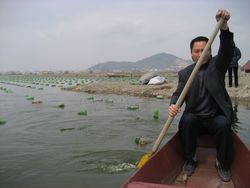
 , called "supermarket pastoral."
 . Highlights include complete episodes of
  and, specially recommended for me, the complete series of
  , which I did enjoy when it was originally on TV. Carl Lumbly plays a genius superhero inventor with remarkably conservative political attitudes--a sort of Thomas Sowell-Iron Man mashup.