 In response to my article on Ray Bradbury, my Internet friend Steve Warhaftig, who is now an industrial designer, sends the following story:
I used to be in the comic book business, and recall this story you may like, The great EC comic book company (surviving as Mad) did a terrific version of the 1st Martian Chronicles. As theft. Bradbury penned a letter complimenting the rendition and mentioned that they had inadvertently forgot his royalty, (invoice enclosed). They promptly paid and worked with Ray on the entire series, now classics of the genre.
Steve sent the image here, which is one of the subsequent issues.
Gregory Benford has a good remembrance of Bradbury here. Excerpt:
It's telling that we read Bradbury for his short stories. They are stylish glimpses at possibilities, meant for contemplation. The most important thing about writers is how they exist in our memories. Having read Bradbury is like having seen a striking glimpse out of a car window and then being whisked away.
Often reprinted in high school texts, he became a poet of the expanding world view of the 20th century. He coupled the American love of machines to the love of frontiers. Elton John's hit "Rocket Man" is an homage to Bradbury's Mars.
Roger L. Simon recalls sharing a book-signing table with him here: "I sold more books that day, several hundred in my memory, than I ever have at any signing before or since (or am ever likely to)."
Posted by Virginia Postrel on June 08, 2012 • Comments
After hitting the LA Times paywall one too many times, I decided I should invest in a subscription. I was signing up for Sunday delivery, which comes with digital access but costs $1.99 a week compared to $3.99 a week for digital-only access. (You can see the advertising model at work in those prices.) But as I filled out the form, I noticed the following below the required phone number:
By giving your phone number here, you agree the Los Angeles Times may call you about marketing, sales or promotional events, and may use an automatic dialer, text message or prerecorded voice to do so.
You can't subscribe without giving them your phone number and permission to harass you with unwanted telemarketing calls. So that's why the LAT lost this potential subscriber.
Posted by Virginia Postrel on June 08, 2012 • Comments
Ray Bradbury has died at 91. His most famous book, Fahrenheit 451 , is about book-burning in a world where entertainment on wall-size screens ("parlor walls") has replaced reading. Published in 1953, it's a dystopia woven from a fear of television.
Its redemptive ending establishes another theme: the power of memory. The books aren't gone. Their texts have been preserved in the memories of people who read them and will keep them alive until it's safe to write them down again. One man has Plato's "Republic," another "Gulliver's Travels," another the book of Ecclesiastes. Books aren't physical objects. They're words that resonate and linger in the mind.
When I was in high school, I chose a passage from "Fahrenheit 451" to memorize and recite as a literary interpretation exercise in a speech class. Nearly four decades later, only fragments remain. The most important is this one:
Everyone must leave something behind when he dies, my grandfather said. A child or a book or a painting or a house or a wall built or a pair of shoes made. Or a garden planted. Something your hand touched some way so your soul has somewhere to go when you die, and when people look at that tree or that flower you planted, you're there.
Although I enjoy both science fiction and beautiful prose, I never read much of Bradbury's work, at least not once I was old enough to understand or appreciate it. (Sometime in elementary school I tried The Martian Chronicles without realizing it was a series of short stories and not a novel.) But he exercised an enormous influence on my life through that one passage in "Fahrenheit 451."
Read the rest at Bloomberg View.
Posted by Virginia Postrel on June 06, 2012 • Comments
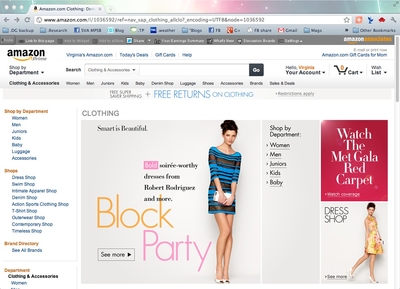 My latest Bloomberg View column suggests some ways Amazon might overcome fashionista skepticism about its plans to move beyond its traditional apparel offerings into higher-end fashion. Here's the opening:
When I caught Jeff Bezos's eye at the press preview for the Metropolitan Museum of Art's new Costume Institute exhibit, which Amazon.com Inc. sponsored, his face burst into an enormous smile. I'd like to think this was because the Amazon chief executive officer likes me so much. (We see each other socially on rare occasions.)
But I suspect he was mostly glad to see anyone he recognized. We were probably the only two people in the room who could tell you who Linus Torvalds is, or Myron Scholes: two nerds, however grown-up and pulled together, in a crowd of fashionistas.
Amazon is an unlikely sponsor for a Costume Institute event, and Bezos an exceedingly unlikely fashion advocate. "Before we got involved, this event wasn't on my radar at all," he said of the museum's celebrity-filled annual gala.
But his company is trying to get into high-end fashion retailing, and sponsoring the Met exhibit and the fashion world's party of the year is a good way to get attention. If nothing else, it gets Bezos and Vogue Editor-in-Chief Anna Wintour speaking on a first-name basis.
A cultural gap remains, however. "It could never be cool to shop for fashion at Amazon.com. Geek cooties will come attached to your clothes," an early commenter said about Monday's New York Times story on Amazon's foray into fine fashion. Another wrote, "Do you want to be cool or pay the lowest price? Your decision." The Times story ended with a jab at Bezos for not knowing the brand of his own shirt or shoes -- and for letting a tacky ID badge dangle from his Prada jeans.
Net-a-Porter has already demonstrated that you don't have to be a flash-sale site to sell high fashion online. So have the websites of department stores such as Neiman Marcus and Saks Fifth Avenue. In the specialized vintage market, so has 1stDibs. The problems of presentation and fit can be overcome.
The real question is the cultural one: How can a middle- brow company like Amazon become a credible source of fashion rather than merely apparel? Here are a few ideas the company might consider:
Read the rest on Bloomberg View.
Posted by Virginia Postrel on May 14, 2012 • Comments
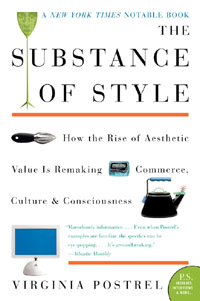 The first week's results are in, and the $2.99 e-book sale on The Substance of Style
 has been so successful that it's going to last until the end of the month (but no longer!). The publisher reports that we sold more than 900 copies in a week, compared to the usual two or so. Prices do matter. So does giving people "an excuse and a deadline." And so does the publicity.
Thanks particularly to InstaPundit, Tyler Cowen at Marginal Revolution (who also has a substantial review of the book on the Amazon site), Nick Gillespie at Reason, and Manolo the Shoeblogger for spreading the word. And thanks to everyone who follows me on Twitter for your patience with my repeated tweets on the subject.
Here's the Amazon link. Here's the Nook link. I believe it is also on sale in the Apple store.
Posted by Virginia Postrel on May 08, 2012 • Comments
 My new Bloomberg View column looks at the false economy of recycling eyeglasses. Here's the lead:
One of the public libraries I use regularly has a box where people can donate their old eyeglasses. Whenever I see it, I regret having nothing to contribute. That's because I've let my personal experience trump my economic good sense.
I have a special appreciation for just how valuable glasses can be when you can't see.
I spent the third grade borrowing glasses from the girls who sat on either side of me. The ophthalmologist had advised my parents to wait to get me glasses, because my eyes were bound to change and they'd just have to buy a second pair. (We were not poor -- my father was an engineer -- but the doctor was a paternalist of the old school.) By the time I got my first pair of glasses, the only thing I could read on the eye chart was the big E.
I've long since had my myopia surgically corrected -- the proverbial miracle of modern medicine -- and now stash cheap over-the-counter reading glasses in every room of my house. Still, I remember what it was like to need glasses and not be able to get them. So I sympathize with charities that collect eyeglasses to distribute to people who can't otherwise afford them.
But such efforts turn out to be a terrible waste, for reasons that are completely logical once you think about them. The case of recycled eyeglasses illustrates how easy it is to fool ourselves when we think about thrift, waste and charity. We overestimate the importance of the physical things we can see and forget about the real costs of time and attention, as well as the importance of intangible values like aesthetics to the people we're trying to help.
Read the whole thing here.
In response, my friend (and Bloomberg View colleague) Adam Minter, who does great reporting on the scrap business in China and is writing a book on the subject, emails:
One of the themes that I'm hitting very hard in my book is that recycling is a fundamentally economic activity. Nobody sorts somebody else's garbage for free. Most of the developing world understands that, while the developed world - the EU and US, in particular - seems intent on seeing recycling as a moral activity (and a means of tribal identity) above all else. Unfortunately, when people view waste and recycling in moral terms, rather than economic ones, they have an unerring tendency to demand local governments set up recycling programs that are destined to lose money from the get-go (like curbside recycling in spread-out Houston). Meanwhile, the folks who know how to make money from recycling, like scrap yards, are denigrated and often subjected to totally unreasonable barriers to entry (and exit). Seems like similar dynamics at play in the glasses trade (with some obvious differences).
It's interesting, too, how much of your piece reflects the overall dynamics of the global recycling trade. Shipping and sorting costs are THE determining factors for whether and where something is recycled - whether it be a bale of old cardboard, or pieces of shredded American automobiles (bound for China). Nice reminder for me how the rules of the road, if you will, are uniform up and down the waste trade.
(Check out Adam's new Bloomberg View column on Chinese microbloggers' reactions to the Chen case here.)
Posted by Virginia Postrel on May 03, 2012 • Comments
 When I saw this ad on the NYT website, I thought it had to be some kind of satire. But I clicked through and it looks legit. Here's where it goes. Am I missing the joke?
Posted by Virginia Postrel on April 30, 2012 • Comments
One of my pet peeves is the way book publishers appear to ignore price elasticity when they decide what to charge for e-books. (See my articles here and here.) For my Twitter feed, I've taken to combing Amazon's monthly list of heavily discounted Kindle editions and posting a couple of titles especially likely to interest people who follow me on Twitter. Through this process, I noticed that HarperCollins had run a sale on Neal Stephenson's Anathem (big thumbs up, but it's back to full price.) So I asked if they'd also run a special on The Substance of Style. They immediately said yes, and the Kindle edition is now on sale for $2.99--for one week. Here's the link.
UPDATE: The Nook version is also on sale for $2.99. Here's that link.
Posted by Virginia Postrel on April 30, 2012 • Comments
It certainly looks like it, as I discuss in my latest Bloomberg View column. Here's the opening:
When I saw that Delta Air Lines Inc. (DAL) is negotiating to buy an idled Pennsylvania oil refinery in hopes of saving money on its fuel bill, I had a flashback to July 7, 1981.
Back then, I was an intern in the now-defunct Philadelphia bureau of the Wall Street Journal, and DuPont Co. had just announced its agreement to buy Conoco Inc. for about $7 billion in cash and stock. At the time, it was the largest corporate merger in history.
Our little bureau mobilized to cover the story and, as the least knowledgeable of the crew, I was given the simplest job: Call a bunch of Wall Street analysts and ask them what they thought. It was an especially easy assignment, because they all said the same thing. Buying an oil company was a clever idea, they told me. It would give DuPont (DD) a reliable supply of oil for its petrochemicals and protect the company from price increases.
The market disagreed -- DuPont's stock price went down on the news -- and the conventional wisdom soon changed. (DuPont finally spun off its Conoco division in 1999.) But in those early hours, everybody I talked to thought the merger was a smart move. And, because I was a naive intern, I believed them.
Vertical integration fools a lot of people.
Read the rest at Bloomberg View.
Posted by Virginia Postrel on April 19, 2012 • Comments
 I've written columns for Bloomberg and TheAtlantic.com taking issue, in different ways, with publishers' stubborn refusal to recognize price elasticity when deciding how to price their e-books. In recent months, however, I've noticed that, unlike most publishers, HarperCollins gets it and, in particular, understands how price elasticity interacts with short-term sales on books whose authors have big fan bases. In short, if you give them a low enough price, a lot of fans will buy electronic copies of books they already own and also recommend them to new readers. If you follow my Twitter feed, you might have noticed, for instance, the $1.99 sale they ran on the Kindle version Neil Gaiman's American Gods (now back to $9.99
 ) and a later one for his Neverwhere.
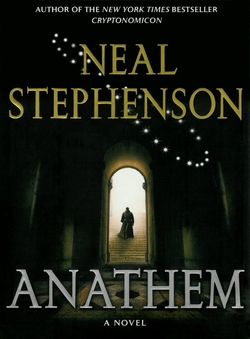
The latest example is a similar $1.99 sale on the Kindle edition of Neal Stephenson's excellent novel Anathem, which I coincidentally just listened to on CDs (28 of them--it's fat). I already own the Kindle edition--which came in handy when a CD was scratched at the most famous line in the book (about a protractor), and I had to do a search to find out what I missed. But if you don't and you like science fiction with vivid settings and big ideas, this is a great deal. And for $1.99, it's so cheap you don't have to feel obligated to tackle it any time soon. Here's the Amazon link. And here's an article I wrote on why short-term sales are a good idea. HarperCollins seems to up the urgency by not saying when the sale ends--but "soon" is a good guess. I wonder if they'd be up for a sale on The Substance of Style...
UPDATE: HarperCollins has agreed to a Kindle sale on TSOS, starting May 1. Watch this space, Twitter, or Facebook for details.
Posted by Virginia Postrel on March 31, 2012 • Comments