In The Future and Its Enemies, I use contact lenses to exemplify open-ended progress. By the 1950s, the basic problem had been solved: to correct vision without damaging the eye. But that wasn't the end of innovation. Instead we got soft lenses, extended wear lenses, bifocal lenses, lenses to block UV rays, lenses to change eye color, and a host of incremental improvements. There's no such thing as a perfect contact lens, and the same lens won't suit everyone. "The future perfect can only be a tense, not a thing," to quote the great Henry Petroski
But what happens when a competing technology--laser surgery--makes your product obsolete, or at least seriously cuts into its market? For contact lenses (as for dentistry when cavities were largely defeated), the obvious strategy is to go for cosmetic enhancement, whether extreme or more subtle. Next comes performance enhancement, as Wired.com's Gretchen Cuda reports:
[Nike] has teamed up with contact lens maker Bausch and Lomb to create performance-enhancing contact lenses called MaxSight. They're a tinted version of daily disposal lenses for athletes that reduce glare and improve visual acuity.
They block nearly all the sun's damaging UVA and UVB rays just like sunglasses, but their optics can also give athletic performance a boost....
The lenses come in amber for sports like baseball and tennis where the wearer must separate fast moving objects from the background, and grey-green for sports like golf, where the background environment is what's visually important. Both colors filter out a significant amount of overall light, but they also sharpen and improve contrast, so they have a brightening effect, says Alan Reichow, who invented the lenses and is a sports vision consultant for Nike.
The amber lenses also turn the wearer's eye's an unsettling shade of red. But when Nike asked players if they'd like to create a version that created less of an evil eye, the answer was an overwhelming "no."
"They felt it gave them a more intimidating look," Reichow said, "and thus an edge over the competition."
Also on the optical beat, Wired.com's Sam Jaffe reports on an opthamologist-turned-inventor/entrepreneur's plans for "supervision," (that's super vision, not oversight) using adaptive optics techniques borrowed from astronomy:
PixelOptics of Roanoke, Virginia, just won a $3.5 million Department of Defense grant to refine its "supervision" technology, which Blum claims could double the quality of a person's eyesight. "Theoretically, this should be able to double the distance that a person can see clearly," he says.
At the heart of PixelOptics' technology are tiny, electronically-controlled pixels embedded within a traditional eyeglass lens. Technicians scan the eyeball with an aberrometer -- a device that measures aberrations that can impede vision -- and then the pixels are programmed to correct the irregularities.
Traditional glasses correct lower-order aberrations like nearsightedness, farsightedness and astigmatisms. PixelOptics' lenses handle higher-order aberrations that are much more difficult to detect and correct.
Thanks to technologies created for astronomical telescopes and spy satellites, aberrometers can map a person's eye with extreme accuracy. Lasers bounce off the back of the eyeball, and structures in the eye scatter the resulting beam of light.
Now that Lasik has cured my near-sightedness, could someone do something about my growing need for reading glasses?
Posted by Virginia Postrel on February 15, 2006 • Comments
I've never been a Cheney hater. In fact, back before he disappeared from public view, I actually liked the guy. Unlike his boss, he was both straight-talking and articulate, and he had small-government instincts on social and economic policy.
But, honestly, shooting your elderly hunting buddy in the chest? It's not a crime (not paying a $7 quail-hunting stamp fee is less serious than speeding), but it's an embarrassment: to the office, the administration, and the United States. The vice president should be more careful with guns. I can't make a rational policy case for it, but my gut says he should resign.
UPDATE: A reader raises an interesting question: "Why should you consider your gut a reliable guide in this case? Is it because guns are a hot-button issue? Guns can kill, but so can cars, and I wouldn't trust my gut if it told me that resignation was the appropriate penalty in an auto accident unless I knew recklessness or drunkeness was involved. And we don't know if either are a factor here. The assumption seems to be that any firearm mishap is a result of wanton recklessness, but you being the sensible libertarian that you are know better. Right?"
The car accident hypothetical is a good one. I assume presidents and vice presidents don't actually drive themselves anywhere, but suppose Dick Cheney had hit a jaywalking pedestrian, causing serious injuries. Assume the vice president was neither reckless nor impaired but could have been paying closer attention. Yes, I'd probably have the same reaction. Guns aren't the issue. Life-threatening mistakes are. Mistakes have consequences, including professional ones. Unfortunately, the vice president of the United States can't simply take a discrete but official leave of absence. It's all or nothing.
Posted by Virginia Postrel on February 15, 2006 • Comments
After my January post on what I'd been reading, a lot of readers asked for more. Some people read science fiction to immerse themselves in other worlds. I read history and old books (and, occasionally, science fiction too). Here are some recent selections:
Theodore Dreiser's The Color of a Great City is a collection of sketches--short essays and actual drawings--of New York City life between 1900 and around 1915. To Dreiser, the essays demonstrate that "the city...was more varied and arresting and, after its fashion, poetic and even idealistic than it is now," where "now" is 1923. Since the young Dreiser had little money, he spent most of his time wandering around the city's poorer quarters and observing the lives not only of struggling immigrants but of "beggars and bums and idlers and crooks in the Bowery and elsewhere." The book provides a lively reminder of a point William Easterly makes in The Elusive Quest for Growth, which I highlighted last month: "When those of us from rich countries look at poor countires today, we see our own past poverty. We are all the descendents of poverty. In the long run, we all come from the lower class." New York City at the turn of the last century was as squalid and crowded and dangerous and dynamic as any Third World City today.
At the other end of the social spectrum, Sally Bedell Smith's Grace and Power: The Private World of the Kennedy White House demonstrates just how different, and by bourgeois standards decadent, the lives of the rich and powerful were in the early 1960s. Forget the heavy drinking, the secret medical treatments, and the compulsive adultery. Can you imagine a First Lady today jetting off to Europe to spend the summer with her titled sister on a Greek shipping tycoon's yacht? A First Lady who publicly modeled herself on Madame de Pompadour and aspired "to do Versailles in America."
In late January, I ran a Liberty Fund conference on "Liberty, Responsibility, and Luxury," with readings ranging from Aquinas to The New Yorker on Viking ranges--and lots of David Hume, Adam Smith, and Grant McCracken (that's pretty heady company, Grant). A number of the readings came from Commerce, Culture, and Liberty: Readings on Capitalism Before Adam Smith, edited by Hank Clark, the conference's discussion leader. Many of the book's selections seem extremely contemporary in their concerns, if not their language. Indeed, the selection we read from Veblen's Theory of the Leisure Class, published in 1905, felt far more dated than the 18th-century readings. Many selections from CC&L can be downloaded from this Liberty Fund page. Here's a podcast interview with Hank about the book.
Posted by Virginia Postrel on February 06, 2006 • Comments
I've long believed that economic statistics dramatically mismeasure actual well-being, understating real gains in the standard of living. (Examples here, here, and here.) For understandable reasons, government statisticians put a premium on consistency over time. But the economy has an annoying habit of changing.
Dan Drezner has a bunch of recent posts on the problem of "dark matter" in measuring how well the economy is doing.
Posted by Virginia Postrel on February 05, 2006 • Comments
In the new issue of Cato Unbound, Theodore Dalrymple considers the question, with some insights into how stasis feeds more stasis. Replies will follow from Charles Kupchan, Timothy B. Smith, and Anne Applebaum.
What exactly is it that Europeans fear, given that their decline has been accompanied by an unprecedented increase in absolute material well-being? An open economy holds out more threat to them than promise: they believe that the outside world will bring them not trade and wealth, but unemployment and a loss of comfort. They therefore are inclined to retire into their shell and succumb to protectionist temptation, both internally with regard to the job market, and externally with regard to other nations. And the more those other nations advance relative to themselves, the more necessary does protection seem to them. A vicious circle is thus set up.
This is the third issue of Cato Unbound, edited by the very smart Brink Lindsey and Will Wilkinson. The previous issue featured a provocative, multifaceted essay by Jaron Lanier about the "Anti-goras" and "Semi-goras" that typify Internet commerce and the fundamentally cultural nature of the Net. If it were easy to summarize, it wouldn't be so valuable to read. If, like me, you missed it a month ago, check it out now.
Cato Unbound's format is an interesting experiment with fostering serious thought in a web-based publication and a refreshing alternative to the snarky quick bites so common in print and online. I look forward to reading more.
Posted by Virginia Postrel on February 05, 2006 • Comments
I suspect this WaPost article was planted by FDA employees looking for a bigger budget, but it raises an interesting issue: Why is it taking so long to approve generic drugs? Marc Kaufman reports that the current backlog, more than 800 applications, is an all-time high. Unfortunately, he doesn't explain what the approval process entails--How much testing does a generic require anyway?--or what it's supposed to achieve.
Posted by Virginia Postrel on February 05, 2006 • Comments
According to this LAT report by Seema Mehta, kids aren't learning penmanship anymore:
Educators say the days of primary school students hunched over desks and painstakingly copying rows of cursive letters are waning. There are many culprits: computers, a rejection of repetitive drills as a teaching tool, and government testing that determines a school's worth based on core subjects such as reading and math.
"Handwriting and cursive have been pushed aside," said Joe Mueller, principal of Litel Elementary School in Chino Hills. "When you have a student struggling and you have to pick an area to focus on, reading versus penmanship, reading [will prevail]. The plate is full."
Unfortunately, you can't always type, and test-taking in particular often requires legible writing.
But penmanship remains crucial to a student's success, [Vanderbilt professor Steve] Graham said. A prime example is the SAT's new timed essay section, which must be handwritten.
Though SAT graders are instructed not to let legibility influence how essays are scored, at least 10 studies have concluded that that's impossible, Graham said. A 1992 study of graders who had been so trained found that neatly written essays received the equivalent of a 2.5-point benefit on a 100-point scale. Among untrained graders, the advantage grew to more than four points.
The last time Professor Postrel was grading exams, I actually "translated" one particularly illegible one into writing he could read, saving an hour or so of grading time--and a lot of aggravation. Instead of cursive, however, why not teach kids to print neatly, ideally as precisely as architects?
Posted by Virginia Postrel on February 05, 2006 • Comments
A new site for obsessed authors and their loved ones. (Thanks to reader Jeremy Bencken.)
Posted by Virginia Postrel on February 03, 2006 • Comments
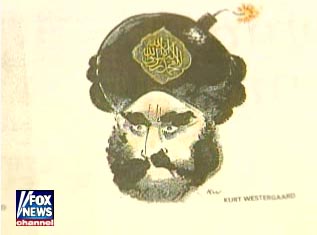 My response to this nonsense is to wonder why Muslims don't grow up. If your co-religionists are going to take political stands, and blow up innocent people in the name of Islam, political cartoonists are going to occasionally take satirical swipes at your religion. Those swipes may not be nuanced, but they're what you can expect when you live in a free society, where you, too, can hold views others find offensive. If you don't like it, move to Saudi Arabia. Or just try to peacefully convert people to Islam. As Fred Barnes points out, the current cover of Rolling Stone is offensive to (hypersensitive, paranoid, publicity-seeking) Christians, but they aren't threatening anyone with physical violence. (Here's an article on that.)
All of which is really just a lead-in to a plug for Jonathan Rauch's excellent book Kindly Inquisitors. Read it.
The Fox News report from which the image above is taken is here.
Posted by Virginia Postrel on February 02, 2006 • Comments
Reader Eric Akawie writes in response to the item below:
I think another, somewhat unconscious motive behind Scrapbooking is the deprecation of the physical status of photographs. I remember as a child, photographs were absolutely sacred — we never threw away or cut up a photo, no matter how bad it was. But now, with photos printed at home, and so cheap individually, throwing photographs away is not a big deal (although I always feel a pang and sense my mother's disapproving glare.)
Scrapbooking returns that sense of specialness to the photos included, and with the amount of work (and money!) that goes into an individual page, acts as a bulwark against the photos being discarded during some cleaning/purging/simplifying binge.
The scrapbooking phenomenon reminds me of an observation made by Rose Wilder Lane in The Woman's Day Book of American Needlework, published in 1963. Lane, an important mid-century libertarian writer, is best known as the daughter of Laura Ingalls Wilder, whose Little House books she edited. Her needlework book combines some how-to advice with what would now be called feminist cultural studies. Her chapter on quilting emphasizes that "women created this rich needlework art who had not a penny to spend or a half-inch bit of cloth to waste." By contrast, the following chapter, on appliqué, highlights Hawaiian quilts which, like scrapbooking, were the product not of poverty but of unprecedented abundance: islanders with a kind climate and ample food who suddenly had access to steel pins and needles and mass-produced bolts of cloth. "You'd know that [Hawaiian appliqué] is up to date and then some, if you knew only one thing about it: it wastes cloth, lavishly," wrote Lane. "It wastes new cloth." When necessity ceases to be the mother of invention, as with patchwork quilts, the drive to create develops arts for their own sake.
Posted by Virginia Postrel on February 02, 2006 • Comments
