Word Clouds
Proof that InstaPundit is all about the links.
They'll turn your word cloud into a T-shirt for $18.
Proof that InstaPundit is all about the links.
They'll turn your word cloud into a T-shirt for $18.
Daniel Weintraub considers the extreme weirdness of employer-provided health insurance.
In the world of cubicles, iPods have become invisible office doors.
Bravo to Dan Drezner, for his eminently sane post on the current fuss over letting a Dubai-owned company manage pieces of U.S. ports. And kudos to President Bush for standing up for commercial freedom and sound foreign policy. Dubai is a U.S. ally and a rare island of semi-freedom in the Gulf.
On this issue, my friend Glenn Reynolds has again demonstrated his disturbing tendency to congratulate himself for spotting, but not opposing. new expressions of American xenophobia. He has, however, partly redeemed himself by demonstrating that he'll at least consider rational arguments. I don't think bloggers, even big shots like InstaPundit, have a responsibility to comment on every issue. But if you're going to bring them up, Glenn, take a stand. Don't just pander to populist fears under the cover of doing horse-race-style analysis (i.e., "it's a political loser"). You wouldn't take the cheap way out if the issue involved technology.
PowerBooks are great-looking, but they also all look the same. In fact, the last time I went through LAX security, I almost stole Lee Ann Womack's PowerBook and wound up stuck with a bunch of country music files. (I only knew who she because I saw her driver's license, though the sunglasses and guitar should have been a tip-off to another LAX celebrity encounter.) I can only imagine what she would have done with all those NBER working papers on my hard drive.
If only we'd had one of these PowerBook tattoos. Maybe the Apple Stores should consider adding personalization. (Via Design Observer.)
Some of you may recall that I used an iBook. When it developed problems late last year, I bought a PowerBook for $850 on EBay, sent the iBook to the Apple hospital, and now have the iBook as a backup.
I'm still getting email about my last NYT column, specifically the question about bats and balls: "A bat and a ball cost $1.10 in total. The bat costs $1 more than the ball. How much does the ball cost?" The answer if 5 cents. If you don't believe it, consider two equations: 1.05+.05=1.10 and 1.05-.05=1.00
In related news, here's a clarification from Shane Frederick, who raises the concern that some readers may misunderstand the article's ending. (I understood his point, but may not have qualified it sufficiently, especially for quick readers.)
One of the major findings of decision theorists is that subtle, normatively irrelevant, wording changes can dramatically influence preferences -- something often termed "framing effects." Postrel's article may be interpreted as suggesting that such effects can typically be explained by differences in intellectual ability. This is certainly false, since assignment to conditions is typically randomized. However, researchers do sometimes also attempt to account for "cross-study" framing effects, which arise when different researchers coincidentally or deliberately use different procedures or wordings or response formats. An issue raised, but not discussed, in the JEP article is that if those researchers are located at two universities whose students differ markedly in intellectual abilities, it could be this, rather than the difference in procedure, that accounts for the difference in results. To use a fanciful example, suppose two different researchers asked an identical question (e.g., How much would you be willing to pay for a coin flip which pays $100 if "HEADS" falls?) to students at the University of Toledo and at Princeton, but each happened to or chose to print them on different colored paper. Someone who noted the methodological details, but ignored the fact that they were conducted at different universities might conclude (probably falsely) that the color of paper somehow affects risk preferences. The interpretational confound could be easily eliminated by making paper color or whatever an experimental variable. But this, of course, is rarely done in practice, and, thus, the problem remains for those looking across multiple studies conducted at different institutions.
Now it's time to work on my next column, which will be published Thursday.
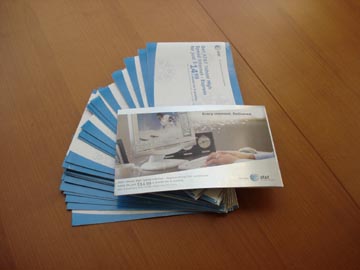
I got 31 identical brochures from AT&T in the mail on the same day.
Southern Methodist University (where Prof. Postrel teaches) is the front-runner for the GW Bush presidential library, much to the chagrin of short-sighted faculty who don't like the president. In fact, a presidential library would be a huge research coup for the school, which is not exactly Stanford (which refused, foolishly IMHO, the Reagan library). The proximity to the Clinton Library in Little Rock would be a great help to scholars of the period.
Now comes word in the New York Sun that SMU is in trouble over trying to use eminent domain to obtain the library land. The headline on Meghan Clyne's article, which reflects the text, is "Lawsuit Over Eminent Domain Could Snarl Bush Library Plans." There is indeed a lawsuit, and it could indeed snarl those plans. But it has nothing to do with eminent domain. Clyne is missing a rather important public-private distinction.
What SMU did was buy up condos in a complex adjacent to the university. Over time, the university came to control the board. Disgruntled owners, some of whom are suing, alleged that the SMU-controlled board deliberately let the place run down so that owners would sell and give the university further control. (My memory of Dallas Morning News coverage is a little hazy, but I believe general expansion, not a presidential library, was the original reason for the university's alleged tactics.)
SMU's actions may or may not be legal, but they don't constitute "eminent domain" or justify a context paragraph about "increasing outrage among Republicans over the use of eminent domain and other coercive measures to obtain private property for public projects." The government is only involved here as an enforcer and interpreter of contracts. The real issue is what a private developer can do to acquire land currently occupied by condos, governed by a homeowners' association, rather than an apartment building or a bunch of independently controlled private homes.
Aside from my local connection, I find this question interesting because I sometimes wonder whether a bad condo complex--there are a few in my otherwise nice Dallas neighborhood--is, long-term, the worst aesthetic blight a neighborhood can have. An ugly house or apartment building will eventually get bought and torn down or remodeled, but condo complexes, because of their fragmented ownership, are much harder to change. When I originally read about SMU's tactics, I thought, Aha, there's the answer. You buy up condos in the complex until you have a controlling interest, in most cases a supermajority. But maybe that doesn't work. Interesting questions here. [Via D Magazine's FrontBurner.]
Contrary to what many Muslims believe, Islam has not universally prohibited portraits of Muhammed. In fact, classic art from the Muslim world includes respectful portraits of the prophet. Unlike the devotional images of Christian, Buddhist, or Hindu art, however, these images weren't intended for public display. Many were book illustrations, available only to the courtly elite. Today, many of these works are in Western museums. In a nicely detailed article, the LAT's Christopher Reynold reports on the dilemmas faced by curators of Islamic art:
While lethal riots persist in the Middle East and American cartoonists and editors wring their hands over what it means to publish pictures of Muhammad, the Western world's curators of Islamic art whisper and wonder.
As they understand it, the Koran does not forbid representations of Muhammad, though other revered texts have led millions of Muslims to scorn the idea. They know that many Islamic artists have taken on the subject. And they know that pictures of Muhammad — not caricatures, but respectful representations, executed by and for Muslims, sometimes with the prophet's face shrouded by a veil, sometimes not — can be found in museums throughout Europe and North America.
The Los Angeles County Museum of Art's collection includes two portrayals of Muhammad and one "verbal portrait" full of ornate calligraphy and rich colors. The Metropolitan Museum of Art in New York has three. The Smithsonian's Freer Gallery of Art has four. The largest collection of such images, experts say, is probably that of the Topkapi Museum in Istanbul.
By happenstance, curators say, none of the artworks at LACMA, the Freer or the Met were on public display when protests erupted late last year following publication in Denmark of a dozen newspaper cartoons lampooning Muhammad. But most of the museum-held portrayals of Muhammad can be accessed through the museums' Internet sites, along with some explanatory text.
This, curators acknowledge, could be a "teachable moment," a chance for museums to help visitors better understand the history and variety of Islamic culture and Muhammad's role in it. But as the toll of dead and wounded in the Middle East, Asia and Africa continues to mount, who wants to stand before the blackboard? And how will this lesson go?
There's much more, including a couple of photos, here.
Dallas blogger Alan K. Henderson reports first-hand. American Airlines and/or DFW Airport must be getting desperate.