In a fascinating bit of reporting, Kathleen Pender of the SF Chronicle traces a huge chunk of the state's recent fiscal good fortune back to a single source:
California took in a record $11.3 billion in personal income tax receipts in April, $4.3 billion more than it collected last April. It's almost certain that a significant chunk of April's haul came from Google employees -- perhaps one-eighth or more of the tax receipt gain.
The fact that a single high-flying Silicon Valley company is giving such a big boost to the state treasury can be determined by examining insider stock trading information filed with the Securities and Exchange Commission.
Fourteen of Google's top executives and directors sold $4.4 billion worth of stock last year, according to Thomson Financial. That includes founders Sergey Brin and Larry Page, each of whom sold about $1.3 billion worth of stock.
Assuming the 14 insiders had acquired the shares at very low cost and that all were in the top 10.3 percent state-tax bracket, they could have owed the state close to $450 million in capital gains tax on their stock sales.
It's just the latest illustration of two remarkable California facts: that the state is incredibly dependent on a few rich people for its tax revenue and that those rich people haven't all left for Nevada, where there's no state income tax. How skewed are tax payments in California? Pender reports:
California's tax structure is highly progressive, which makes it highly volatile. For the 2004 tax year, 38,000 California tax returns reported more than $1 million in income. They represented just 0.2 percent of all state-tax returns, yet they accounted for 14 percent of total adjusted gross income and about 30 percent of the total personal tax.
The top 3 percent of the returns, those with incomes exceeding $200,000, paid about 60 percent of all state taxes.
"What happens to the top 1 percent is of great interest to the Department of Finance," says David Hitchcock, a debt analyst with Standard & Poor's.
(Via Good Morning Silicon Valley.)
Posted by Virginia Postrel on May 12, 2006 • Comments
Wal-Mart is pushing organic food, while Whole Foods boasts about low prices.
Posted by Virginia Postrel on May 11, 2006 • Comments
I'm back from France, which should give Dan Brown some kind of award for his tremendous contributions to the economy. I'm mostly sorting through my enormous piles of virtual and physical mail but am making an attempt to resume blogging. Hence, there are a couple of new posts below. More to come later.
Posted by Virginia Postrel on May 11, 2006 • Comments
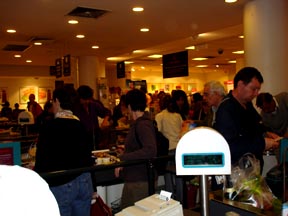 From the sluggish checkout procedures in Paris grocery stores, you'd never know that a French company, Carrefour, is the most efficient, productive supermarket chain in the world. You might guess, however, that most of its success has occurred outside France. (By way of background, see this NYT column I wrote on Bill Lewis's terrific book The Power of Productivity and download this Lewis article.)
Posted by Virginia Postrel on May 11, 2006 • Comments
Dave Demerjian of Wired News reports on how airlines are using math to expedite boarding. The article is well worth a full read, but here's an excerpt:
America West Airlines, which became US Airways after a recent merger, has led the way in rethinking passenger boarding, working with engineers at Arizona State University to develop a system that speeds the process by reducing interference between passengers.
According to Tim Lindemann, US Airways' managing director of airport services, streamlining the boarding process was one part of a larger effort to reduce turnaround times at what was then America West. "We were looking at every possible way to shave time off the process," he says.
Convinced that there was a statistical solution to the problem, Lindemann approached Arizona State University's industrial engineering department. "We have a great university in our backyard, and hoped they could help," he says. "The engineers there immediately understood the problem we were trying to solve, because they had witnessed it themselves. They had been on our flights."
Professor René Villalobos and graduate student Menkes van den Briel began reviewing boarding systems used by other airlines. "The conventional wisdom was that boarding from back to front was most effective," says van den Briel. The engineers looked at an inside-out strategy that boards planes from window to aisle, and also examined a 2002 simulation study that claimed calling passengers individually by seat number was the fastest way to load an aircraft.
The two then developed a mathematical formula that measured the number of times passengers were likely to get in each other's way during boarding. "We knew that boarding time was negatively impacted by passengers interfering with one another," explains van den Briel. "So we built a model to calculate these incidents."
Villalobos and van den Briel looked at interference resulting from passengers obstructing the aisle, as well as that caused by seated passengers blocking a window or middle seat. They applied the equation to eight different boarding scenarios, looking at both front-to-back and outside-in systems. "Ultimately, the issue America West needed to address was time," explains van den Briel. "We figured a system that reduced interference between passengers would also cut boarding time."
I'm sure the operations research is good, but airlines have some tough behavioral issues to deal with too. Passengers all want to board first. Some flout the rules, knowing that most airlines ignore line cutting. (A confrontation slows the boarding process.) And, at least on some flights, most passengers are actually entitled to early boarding, thanks to their--our--illustrious frequent flyer status.
Posted by Virginia Postrel on May 09, 2006 • Comments
It's the political economy, stupid. (Nasty phrase, that.) Texas has no income tax, which means public services are funded by sales and property taxes. Everyone, regardless of income or legal status, pays sales and property taxes, either directly or indirectly through rent. California, by contrast, relies heavily on a very progressive income tax that doesn't fall on people who are paid off the books or who don't earn much money in the first place. Liberals who support immigration should rethink their love of progressive income taxes.
Posted by Virginia Postrel on May 01, 2006 • Comments
Reliable sources inform me that the NYT's absurd disclosure form for freelancers no longer applies to the Book Review or magazine.
I have no problem with editors asking lots of questions about possible conflicts as, indeed, the Book Review editors do. But most conflicts won't be caught by a one-time form, because they're either unanticipated or new. And expecting a freelancer to disclose every connection under the sun just to do a single article is ridiculous. (Is it relevant to a book review on development economics that I once gave a speech at Target? It is relevant, of course, if the author of the book is a close friend, but the form doesn't ask you to list everyone you know.) The whole venture strikes me as a way for editors to cover themselves--"Well, he didn't mention it on his disclosure form"--when scandal erupts.
Posted by Virginia Postrel on May 01, 2006 • Comments
I'm off to Paris, to speak at the design school Créapole and give my mom a Parisian visit for her 70th birthday. In a bon voyage email, a friend sent us this link to a great panoramic view of the city.
Posted by Virginia Postrel on May 01, 2006 • Comments
Science magazine has a mini-profile of Sally Satel, with news of how her experience seeking a kidney transplant "awakened her to the 'horribly broken' state of organ transplantation rules in the United States."
Sally is planning a mini-conference at the American Enterprise Institute, focusing on solutions to the organ shortage. "We will not debate whether there should be market mechanisms," she explains. "We are stipulating that they are in order. We will go from there to discuss ways to design them and overcome barriers." The conference is scheduled for June 12 at AEI and will be open to the public. I'll be participating, along with people who are actually experts on the subject. Here's the lineup:
Buy Or Die: Market Mechanisms to Remedy the Organ Shortage
Lloyd Cohen, George Mason University School of Law
Mark Cherry, St. Edward's University, Department of Philosophy, author of Kidney for Sale by Owner: Human Organs, Transplantation and The Market (Georgetown U Press)
Newt Gingrich, AEI
Michele Goodwin, De Paul University College of Law, author of Black Markets: The Supply and Demand of Body Parts (Cambridge University Press)
Benjamin Hippen, nephrologist and UNOS advisory committee member
Virginia Postrel, The Atlantic, author, The Future and Its Enemies
Sally Satel, AEI
Posted by Virginia Postrel on May 01, 2006 • Comments
At $3.50/gallon Mickey Kaus is channeling an observation I made when L.A. gas crossed the $2.00 mark: "After a week in L.A., with a car for a few trips downtown, I'm starting to feel pretty friendly toward high gas prices. Having to pay more than $2 a gallon does wonders for the traffic."
Posted by Virginia Postrel on April 29, 2006 • Comments