My latest Forbes column looks at why official statistics seem to understate the increase in living standards--and why people are so eager to believe in economic stagnation. (The headline is unfortunate.)
If you would like to receive my articles by email, send a message to postrel-list-subscribe-at-yahoogroups.com.
Posted by Virginia Postrel on August 21, 2006 • Comments
Rudi Stern, who is widely credited with saving neon in the 1970s, has died. He was hospitalized for lung cancer shortly after I interviewed him for my Atlantic column on neon signs. "I wanted to turn people on to the beauty of it," he said of neon, "to the creative, expressive possibilities of it."
Posted by Virginia Postrel on August 20, 2006 • Comments
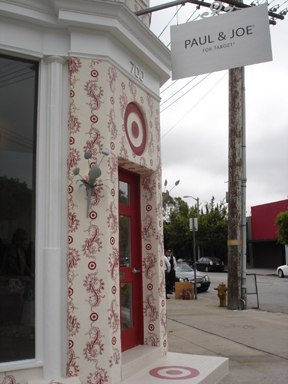
Target is, of course, well known for persuading designers to turn their skills--and publicity-generating ability--to its mass market. The latest twist, as explained in this report is to open full-blown, but temporary, boutiques like this "pop up" Paul & Joe store on Melrose Place in L.A. My niece Rachel and I hit it on July 29, the day Moore's story ran, and it was packed with women eager to buy discount-priced clothes in a non-discount environment. Many didn't want to wait in the long lines for dressing rooms and turned the anteroom to the curtained-off changing spaced into a sort of Lohmann's communal dressing area.
Is paying for temporary retail space worth it? That depends on the cost, of course, and also on whether the promise of a boutique helps sign the designer in the first place. The prices aren't any higher in the special space, and the Paul & Joe boutique doesn't sell the everyday items that account for most of Target's revenue (and to which its designer products drive traffic). The Melrose Place store certainly helped generate publicity in Los Angeles, but everything else I've seen on the Paul & Joe line emphasized the options available everywhere else--ordinary Target stores and the GO International section of the Target website
Posted by Virginia Postrel on August 20, 2006 • Comments
Talk about economist-as-rock-star: The Freakonomics tour is coming to Dallas (OK, really to Grand Prairie), and you can buy tickets on Ticketmaster.
Posted by Virginia Postrel on August 20, 2006 • Comments
LAT media critic Tim Rutten, not a man known for his love of blogs, calls on mainstream news organizations to provide much tougher scrutiny of the photos coming out of the Middle East--and credits bloggers (notably Charles Johnson) for uncovering widespread fakery.
There are, however, two problems here, and they're the reason this controversy shouldn't be allowed to sputter to its inglorious conclusion just yet: One of these has to do with the scope of what strongly appears to be wider fabrication in the photojournalism Reuters and other news agencies are obtaining from their freelancers in Lebanon. The other is the U.S. news media's grudging response to the revelation of Hajj's misconduct and its utter lack of interest in exploring whether his is a unique or representative case.
Thus far, only a handful of relatively brief stories on this affair have appeared in major American papers. The Times picked up one from the Washington Post, which focused mainly on the politics of Johnson's website. The New York Times, which ran one of Hajj's photos on its front page Saturday, reported that it has published eight of his pictures since 2003, but none were altered. It then went on to quote other papers about steps they take to detect fraudulent images. No paper has taken up the challenge of determining whether there's anything dodgy about the flow of freelance photos Reuters and other news agencies-- including the Associated Press, which also transmitted images made by Hajj--are sending out of tormented Lebanon.
Johnson is co-founder with mystery novelist and screenwriter Roger L. Simon of another online site, www.pajamas media.com. It aggregates mostly right wing blogs from around the world and has ambitions as a politically inflected alternative news source. It's worth taking the time to go there and to click on the link giddily labeled "Reutersgate." Make what you will of the analysis, much of which is feverish, sneering and tending toward the mechanistically conspiratorial. What's hard to imagine is how anybody can look at the photos and not conclude that they're riddled with journalistic deceit.
Many, including grisly images from the Qana tragedy, clearly are posed for maximum dramatic effect. There is an entire series of photos of children's stuffed toys poised atop mounds of rubble. All are miraculously pristinely clean and apparently untouched by the devastation they purportedly survived. (Reuters might want to check its freelancers' expenses for unexplained Toys R Us purchases.) In some cases, the bloggers seem to have uncovered the same photographer using more than one identity. There's an improbable photo by Hajj of a Koran burning atop the rubble of a building supposedly destroyed by an Israeli aircraft hours before. Nothing else in sight is alight. (With photos, as in life, when something seems too perfect to be true, it's almost always because it is.) In other photos, the same wrecked building is portrayed multiple times with the same older woman--one supposes she ought to be called a model---either lamenting its destruction or passing by in different costumes.
There's more, and it's worth your time to take a look. That's one of the undeniable strengths of the Internet and of the blogosphere, and the fact that it is being employed to help keep journalism honest ultimately is to everybody's benefit.
Is anyone listening? (Does anyone east of Silver Lake read the LAT?)
Posted by Virginia Postrel on August 13, 2006 • Comments
I've always walked on my toes, and I can't stand clothing tags touching my neck. Does that mean I have some form of autism? Or does it just mean people don't recognize perfectly normal behavior when it isn't normal for their genetic family?
Posted by Virginia Postrel on August 12, 2006 • Comments
Jonathan Rauch files a depressing report from St. Bernard Parish, Louisiana, a community completely wrecked by Katrina. Contrary to most disasters (the Northridge earthquake comes to mind), where TV footage often makes concentrated damage look widespread, here you never turn the corner and find the untouched area. Making matters worse are the many, many regulations written without true emergencies in mind. Jonathan writes:
Back in St. Bernard many people, presented with such arguments, will concede that every rule has its reasons. When a fire marshal told Voitier, the school superintendent, that she could not use an urgently needed mobile classroom because the doors were too close together, he was following a rule that may well make sense in normal times.
The trouble is that nothing -- not anything -- is normal in St. Bernard. The collective effect of all the rules and procedures has been to slow recovery in the early stages, when momentum was critical. Still more damaging, perhaps, is the psychological toll, a gooey mixture of anger and demoralization that drains energy and amplifies despair. It amounts to bureaucracy fatigue. Most welfare mothers know this feeling well, and many become used to it (or learn to game the system), but St. Bernard had always cherished its sense of independence. The parish was stunned by the hurricane, and then was stunned again to be pitched into a blizzard of pettifoggery, precisely when it felt too prostrate to cope.
"It just irritates my soul," says Joseph Di Fatta Jr., a parish council member. "There has to be a balance of the laws and the lives of the people. Right now, the emotional distress people are suffering is greater than the harm of inappropriately burying a can of spray paint."
Read the whole thing and the policy-oriented sidebar.
Posted by Virginia Postrel on August 12, 2006 • Comments
Urban critic Karrie Jacobs (no relation) finally gets around to reading The Death and Life of Great American Cities and finds that Jane Jacobs's classic doesn't say what people think. Her column in Metropolis is well worth a read. Here's an excerpt:
Like many people, I'd made plenty of assumptions based on second- or thirdhand readings. For instance, because Jacobs is repeatedly cited in Suburban Nation, the New Urbanist tract by Andres Duany, Elizabeth Plater-Zyberk, and Jeff Speck, I assumed that she would have been a willing accomplice to that movement. It seems logical that Jacobs--with her reputation for advocating "close-grained" detail and mixed use--would support the calibrated street life meted out by Duany and his ilk. But as I read Jacobs it became clear that she never intended her ideas to be applied to smaller suburban settlements. She was writing only about big cities, with all their native grit and mess. Moreover, she consistently ridiculed the Garden City movement of the nineteenth century, the clearest precursor to New Urbanism, attributing to it the notion of "harmony and order imposed and frozen by authoritarian planning."
The Jacobs I thought I knew--an advocate for small-scale thinking and an opponent of large-scale projects--is not the one I discovered when I actually began to read her text. Her main argument was quite different: she used the example of her own Greenwich Village neighborhood to make the case that all planning and development should "generate city diversity"; but she did so to contrast the rich detail of urban life with the bold strokes then typical of planners. "The main responsibility of city planning and design should be to develop--insofar as public policy and action can do so--cities that are congenial places for this great range of unofficial plans, ideas, and opportunities to flourish, along with the flourishing of the public enterprises," Jacobs wrote.
Karrie Jacobs concludes on a note that echoes The Future and Its Enemies (which cites Jane Jacobs):
The mistake made by Jacobs's detractors and acolytes alike is to regard her as a champion of stasis--to believe she was advocating the world's cities be built as simulacra of the West Village circa 1960. Admirers and opponents have routinely taken her arguments for complexity and turned them into formulas. But the book I just read was an inspiration to move forward without losing sight that cities are powerful, dynamic, ever-changing entities made up of myriad gestures big and small. The real notion is to build in a way that honors and nurtures complexity. And that's an idea impossible to outgrow.
Speaking of classics on urban dynamism, I've finally gotten around to reading Reynar Banham's brilliant Los Angeles: The Architecture of Four Ecologies. Written in 1971, when Los Angeles was still a notably mobile city, it's somewhat dated but still relevant to thinking about L.A. in particular and 20th-century urban forms in general. (L.A. is the quintessential 20th-century city. As for this century, who knows?) And it's full of great insights--how the vernacular of Spanish Colonial Revival architecture supports modernism, for instance--and set pieces. Here's a riff on Disneyland:
The greatest of these ironies has to do with transportation, and this underlies the brothel comparison. Set in the middle of a city obsessed with mobility, a city whose most characteristic festival is the Rose Parade in Pasadena, fantastically sculptured Pop inventions entirely surfaced with live flowers rolling slowly down Colorado Boulevard every New Year's Day--in this city Disneyland offers illicit pleasures of mobility. Ensconced in a sea of giant parking-lots in a city devoted to the automobile, it provides transportation that does not exist outside--steam trains, monorails, people-movers, tram-trains, travelators, ropeways, not to mention pure transport fantasies such as simulated space-trips and submarine rides. Under-age children, too young for driver's licences, enjoy the licence of driving on their own freeway system and adults can step off the pavement and mingle with the buses and trams on Main Street in a manner that would lead to sudden death or prosecution outside.
But more than this, the sheer concentration of different forms of mechanical movement means that Disneyland is almost the only place where East Coast town-planning snobs, determined that their cities shall never suffer the automotive 'fate' of Los Angeles, can bring their students or their city councilors to see how the alternative might work in the flesh and metal--to this blatantly commercial fun-fair in the city they hate. And seeing how well it all worked, I began to understand the wisdom of Ray Bradbury in proposing that Walt Disney was the only man who could make rapid transit a success in Los Angeles. All the skill, cunning, salesmanship, and technical proficiency are there.
They are also at diametrical variance with the special brand of 'innocence' that underlies the purely personal fantasies of Los Angeles. Innocence is a word to use cautiously in this context, because it must be understood as not comprising either simplicity or ingenuousness. Deeply imbued with standard myths of the Natural Man and the Noble Savage, as in other parts of the US, this innocence grows and flourishes as an assumed right in the Southern California sun, an ingenious and technically proficient cult of private and harmless gratifications that is symbolized by the surfer's secret smile of intense concentration and the immensely sophisticated and highly decorated plastic surf-board he needs to conduct his private communion with the sea.
Aside from teaching me new things about a city I love, Banham made me want to reread The Martian Chronicles, which I didn't get at all the first time--when I was maybe 9 years old.
Posted by Virginia Postrel on August 10, 2006 • Comments
I flew from LAX to Portland, Oregon, this morning. After learning at 8:10 that super-security measures were in effect, I left early for my 11:00 flight. No problems, and the lines weren't especially long, though that could be because I was traveling Alaska Airlines rather than one of the big carriers. I did check my micro-suitcase rather than hassle with security, only to discover that my fluids would have passed, thanks to travel-size packaging. At LAX at least, they're using a four-ounce cutoff for liquids and gels.
As someone who travels all the time, I'm acutely aware that even thwarted terrorist plots are costing us basic freedoms of travel. Five years from now, iPods and laptops may be as rare on airplanes as lit cigarettes. On the bright side, I guess that will be good for book sales.
Posted by Virginia Postrel on August 10, 2006 • Comments
 A Tennessee man is donating a kidney to the waitress at a diner where he's a regular. Drew Harris of The Bartlett Express reports:
[Cindy] Boswell was diagnosed with polycystic kidney disease in 1996 and now her kidneys function is at only 15 percent of the normal rate. For months she has been preparing for a kidney transplant--undergoing medical tests and filling out paper work--but has not been able to find a suitable donor. That changed one morning while she was filling up Dale Paulson's coffee at the cafe.
"He was a regular customer that I had been waiting on for about eight or nine months. For the longest time, I didn't even know his name--we called him the poached egg guy because that's what he always ordered," Boswell said. "One day, I was a little down and he asked me what was wrong. So I told him about my medical problems and that I needed a kidney. He told me that he would donate me one of his."
At first Boswell was taken aback. She didn't believe the words she had just heard. After all, she and Paulson had only been on a first name basis for about two weeks.
"I told him it was not something to joke about, that it wasn't very funny," Boswell said. "And that's when he said,"No, I am serious.'"
A year and a half earlier, Paulson offered to donate his kidney to his cousin in Michigan who had kidney disease. Surgery on Paulson's foot delayed the donation, and his cousin committed suicide under excruciating pain.
That event, combined with the unexpected death of his wife in 2003, planted the desire in Paulson's heart to help those in need. During these trying times, he believes God was preparing him to help Boswell.
Paulson's ability to turn tragedy into life-saving inspiration is admirable. Too bad some medical authorities don't respect the same sympathetic impulses when they arise from Internet communication rather than poached-egg orders.
Assuming final tests go well, the transplant should take place within a few weeks. A fund has been set up to help Boswell cover her out-of-pocket costs, including $1,500 a month (presumably for immunosupressant drugs) after the surgery and had already raised $8,000 before the article ran. Donations can be made to: City of Memphis Credit Union, c/o Cindy Boswell Transplant Fund, 2608 Avery Ave., Memphis, TN 38112.
Posted by Virginia Postrel on August 03, 2006 • Comments