When the publicist for Ghost Rider offered free tickets for Dynamist readers, I asked whether there were any geographic limitations. No problem, I was told. "The tickets are valid in the United States and specific to the winner's location. There will be a specific theater for the winner to go to, corresponding to their city. The viewing will be a couple days before the release on Feb 16, 2007." That's what I repeated when I announced the contest. But it wasn't true.
Instead of movie passes, as "winner" John Tabin reported on his own blog, "FedEx...dropped off a couple of Ghost Rider hats and wallets. Yeah, I know you can hardly contain your jealousy." Sony provided no explanation either to the winners or to me. When I inquired, the publicist told me, "What happened was that it was difficult for Sony Pictures' to find a screening location in your winners' cities. Basically, their respective city did not offer any screening locations so what we did was send out Ghost Rider promotions such as shirts, caps, etc. Therefore, your winners received the products instead of the unavailable screening passes."
Both winners live in the Washington, DC, area--hardly an obscure hamlet in flyover land. The publicity firm (not to be confused with deadbeat Sony) says they'll try to send passes to the next movie they promote. That's nice of them, but not what we had in mind.
I'll give winner David Noziglia the last word: "And the gifts, if they ask, suck. Thank you for selecting me, but there should be some word out there that Sony can't be trusted. By that I mean that they lied to you."
Posted by Virginia Postrel on February 24, 2007 • Comments
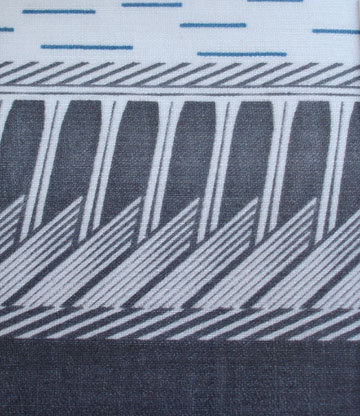 Through Sunday, the Boston Museum of Fine Arts has a small but interesting exhibit of Soviet textiles designed between 1927 and 1933. The designs were aimed at convincing a nation of peasants to embrace industrialization and, of course, the Communist revolution. Even in a centrally planned economy where the government decided what would be in the stores, the patterns proved a complete flop. "Citizens generally refused to buy or wear these propagandistic garments and household fabrics," writes Pamela Jill Kachurin in the exhibit catalog, Soviet Textiles: Designing the Modern Utopia
 . "While Soviet citizens may have tolerated the hyperbolic messages they encountered in posters, literature, and films about Soviet progress, perhaps hydroelectric dams on their pillowcases was too much to bear."
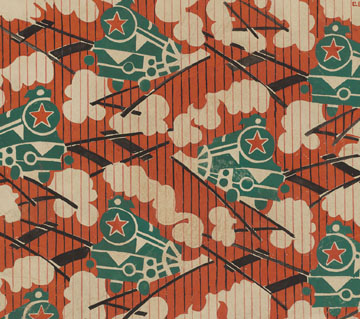
Soviet citizens did not, of course, necessarily "tolerate" the rest of that propaganda. They simply had no way to avoid it. (I shot the pillowcase design from the book, which accounts for the glare.) More likely, the propagandistic purposes undercut the graphic appeal of the designs, which are quite beautiful or at least charming, when taken out of their political context. Disconnected from central planning and totalitarian government, they might be celebratory rather than propagandistic. Hammers and sickles aside, many of them wouldn't be out of place in a mid-century American boy's bedroom. Here are a couple from the press kit, which unfortunately didn't include any of the great flight-oriented designs on display.

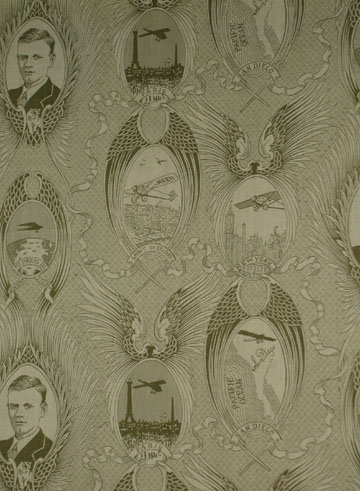
In the United States, similar designs were voluntarily produced and bought by willing consumers--who, of course, had plenty of traditionalist choices. These two examples are from an exhibit at the Museum at FIT, which gave me special permission to shoot photos for my glamour file. The top one features pictures of Charles Lindbergh.
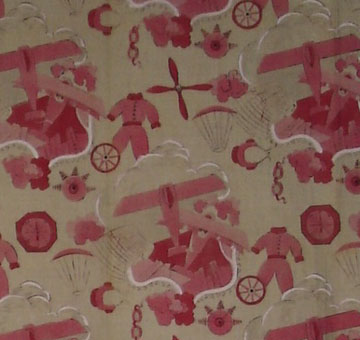
For more-geometric and multicolor patterns, you'd need to look at later textile designs, which I don't have on file. Here's an example on Ebay.
Posted by Virginia Postrel on February 23, 2007 • Comments
When David Brin published The Transparent Society in 1999, surveillance was something other people did to you. Brin made the radical argument that surveillance was technologically inevitable--a notion privacy advocates found unthinkable--and that the best protection for individuals lay not in trying to limit the right to collect data on other people but in making sure that surveillance didn't become the privilege of an unwatched elite. Everyone should be able to watch everyone, including government officials; hence, the "transparent society." People hated that argument, because it accepted surveillance.
How 1999. Another approach is simply to ignore old ideas about privacy and make your private life public. In New York magazine, Emily Nussbaum argues that today's young people are doing exactly that and, in the process, completely redefining the idea of privacy.
[W]hat we're discussing is something more radical if only because it is more ordinary: the fact that we are in the sticky center of a vast psychological experiment, one that's only just begun to show results. More young people are putting more personal information out in public than any older person ever would--and yet they seem mysteriously healthy and normal, save for an entirely different definition of privacy. From their perspective, it's the extreme caution of the earlier generation that's the narcissistic thing. Or, as Kitty put it to me, "Why not? What's the worst that's going to happen? Twenty years down the road, someone's gonna find your picture? Just make sure it's a great picture."
And after all, there is another way to look at this shift. Younger people, one could point out, are the only ones for whom it seems to have sunk in that the idea of a truly private life is already an illusion. Every street in New York has a surveillance camera. Each time you swipe your debit card at Duane Reade or use your MetroCard, that transaction is tracked. Your employer owns your e-mails. The NSA owns your phone calls. Your life is being lived in public whether you choose to acknowledge it or not.
So it may be time to consider the possibility that young people who behave as if privacy doesn't exist are actually the sane people, not the insane ones. For someone like me, who grew up sealing my diary with a literal lock, this may be tough to accept. But under current circumstances, a defiant belief in holding things close to your chest might not be high-minded. It might be an artifact--quaint and naïve, like a determined faith that virginity keeps ladies pure. Or at least that might be true for someone who has grown up "putting themselves out there" and found that the benefits of being transparent make the risks worth it....
In essence, every young person in America has become, in the literal sense, a public figure. And so they have adopted the skills that celebrities learn in order not to go crazy: enjoying the attention instead of fighting it--and doing their own publicity before somebody does it for them.
As an old fogy, I find this behavior weird. Aside from the old-fashioned notion that some parts of life don't belong in public, I don't want to live in a small town where everyone knows everyone's business, and I wouldn't want my teenage persona following me around forever. But there is a certain kind of logic here.
The problem comes not from old-fashioned embarrassment but from adult policing. As Greg Lukianoff, the president of the Foundation for Individual Rights in Education, and his colleague Officer Will Creeley write in the Boston Phoenix, colleges are using their speech codes to attack students for what they post on Facebook and other online sites:
Students, be warned: the college of your choice may be watching you, and will more than likely be keeping an eye on you once you enter the hallowed campus gates. America's institutions of higher education are increasingly monitoring students' activity online and scrutinizing profiles, not only for illegal behavior, but also for what they deem to be inappropriate speech.
Contrary to popular misconceptions, the speech codes, censorship, and double standards of the culture-wars heyday of the '80s and '90s are alive and kicking, and they are now colliding with the latest explosion of communication technology. Sites like Facebook and MySpace are becoming the largest battleground yet for student free speech. Whatever campus administrators' intentions (and they are often mixed), students need to know that online jokes, photos, and comments can get them in hot water, no matter how effusively their schools claim to respect free speech. The long arm of campus officialdom is reaching far beyond the bounds of its buildings and grounds and into the shadowy realm of cyberspace.
Like Nussbaum's New York piece, this is a must-read article full of specifics. As online communication erodes the boundary between private conversation and public speech, the repressive nature of speech codes is becoming more and more apparent. (Take a look at this scary example.) They are, in fact, designed to squelch free speech--to prevent students from saying what they think, from using irony or humor in ways that might be taken as offensive, and to police not just speech but, ultimately, thought itself. (I serve on the board of FIRE, which is a great organization that deserves your support. It's watching the watchers.)
Posted by Virginia Postrel on February 23, 2007 • Comments
Brad DeLong has a wonderful post on his two-month infatuation with Keith Tribe and, by extension, Foucault and what their errors taught him about Adam Smith. I won't try to summarize. Just read it and, if possible, read Adam Smith. (Liberty Fund has put searchable versions of The Wealth of Nations and The Theory of Moral Sentiments online, but you're better off buying the real books. Nice, inexpensive, and authoritatively edited copies are available from Liberty Fund's main site. Along with the obvious classics, I also recommend Smith's Essays on Philosophical Subjects.)
Like his friend David Hume, Smith was, as Brad says, a rare genius, and he is far too little read. You don't need P.J. O'Rourke to translate. The 18th century was a great era for English prose and while the sentences are a lot longer than contemporary conventions advise, they're a lot easier to read than plenty of academic writing--whether from postmodern theorists or neoclassical economists.
Posted by Virginia Postrel on February 21, 2007 • Comments
Australia will ban incandescent light bulbs by 2009. I guess the bulb-smuggling problem is easier if you're surrounded by water.
Posted by Virginia Postrel on February 19, 2007 • Comments
The LAT's David Colker tells the story of how the last soap factory in town has managed to survive despite low-cost competition from China. It's clear that soap-making doesn't have a big future in Los Angeles, but the story also a tribute to the ingenuity that has allowed the company to find new markets and new operating methods.
Hoping to trim one of his biggest remaining expenses, electricity, he contacted the Department of Water and Power. "They told me if I could shut down by 1 p.m., they could give me a much better rate," Shugar said. He moved the plant's starting time back to 5 a.m. to meet the cutoff time, resulting in 40% savings.
One of his most valuable assets was his mechanical engineer, Cheng Lim, who came to Shugar from Jergens when that company closed its Burbank plant in 1992. Lim could have stayed with the giant company, based in Cincinnati, but "my wife did not want to go," he said. "Too cold there."
Lim adapted the Shugar production line for use by fewer employees.
For example, a worker once stood at a conveyer belt to pick up the finished bars of soap, one by one, and turn them 90 degrees in preparation for the wrapping machine. Lim divided the belt into two strips, with one traveling slightly faster than the other. The bars thus turned without human intervention.
"Without him," Shugar said, "I would have to move to China."
Posted by Virginia Postrel on February 19, 2007 • Comments
Following Strunk & White won't make you a great writer, but it will make you a not-bad writer. This site promises to do the same for men's clothes.
Posted by Virginia Postrel on February 19, 2007 • Comments
MSNBC's Allison Linn reports, with before and after pictures: "From the wood and metallic design touches to the occasional greenery, the intent is clear: Wal-Mart wants to be thought of as a pleasant place to shop, not just a massive warehouse for snapping up bargains."
UPDATE: MSNBC reader comments suggest a lot of people think Wal-Marts need more customer service staff and more frequent cleanings.
UPDATE: Peter Hoh explains why he prefers Target. One comment that echoes those posted on the MSNBC site: "Line length at checkout is a big deal. Bigger than price, as far as I'm concerned. When a Target store has long checkout lines, I can tell that managers are trying to scramble to remedy the problem. I never get that sense at Walmart." Wal-Marts are, I suspect, traditionally organized for customers who have more time (or patience) than money. Maybe they'll change that along with the decor.
Posted by Virginia Postrel on February 15, 2007 • Comments
With a photo...
Posted by Virginia Postrel on February 14, 2007 • Comments
I personally wonder how meaningful the poll can be, even as a measure of PJM readers' attitudes, as it gets less and less new and exciting. But apparently some people think it's worth spamming for their favorite candidates. You libertarians at Boeing should find a better use for your time.
Posted by Virginia Postrel on February 13, 2007 • Comments