Writing on my Facebook page, Reason's Shikha Dalmia recalls her own May visit to the Shanghai Expo, along with some local Chinese.
They were terribly disappointed with the US exhibit and regarded its lack of seriousness almost as a slap on the face. They were really moved by the dazzling Chinese pavilion -- which suggested to me that the real reason Chinese authorities have spent $60 billion on such a white elephant, in addition to what you mention, is to keep alive a spirit of nationalism.
The U.S. pavilion, which looks like a prefab movie theater and whose main feature is the filmic equivalent of a guidance counselor poster, is famously lame. But the Chinese misunderstand why. It's not a slap at China. It's a slap at world's fairs. On a positive note, it features great, improvised performances by bilingual U.S. college students, who do things like teach the Chinese crowd to shout, "YOU...ARE...AWESOME."
Shikha's comment gives me an excuse to resurrect some material that didn't make it into my final column. An earlier draft included the following observation on the boosterism of world's fairs:
It gives visitors the same thrill Sam Hyde, a bookkeeper from Belleville, Illinois, felt upon entering the 1904 St. Louis World's Fair: the feeling "that the whole world [is] there and every nation [is] showing its best products and doing its best to please."
Here is the most peculiar aspect of world's fairs. As classic tools for city and national boosters, they combine openness to the world with a sense of (often-defensive) local superiority: We are the center of civilization, our culture its standard; that's why everyone's here. The foreign exhibits simultaneously validate the host's importance and provide a sort of petting zoo of exotic cultures. Remembering his 1904 visit, Sam Hyde noted the popularity of the Filipino military band, praising the "extraordinary talent of those little brown fellows." Today's readers cringe at his language, but the point of the sentiment is appreciation, not difference. Exoticism provides a bridge to empathy. But the locals still determine the standard of value.
That's psychologically realistic. The official ideology of international expositions may stress common humanity, but one thing human beings have in common is the tendency to divide the world between our group and others. The Chinese want to celebrate China, and Chinese fairgoers really do view all those foreigners as foreign. The deception lies in the way international expositions gloss over conflicts, portraying a world as harmonious as the International House of Pancakes. (Both "Bel-Gem waffles" and Disney's "It's a Small World" were hits in 1964.) In Shanghai, irony-minded westerners head for the North Korean and Iranian pavilions, conveniently located next to each other on the unofficial axis of evil.
And here's a photo:
Posted by Virginia Postrel on July 27, 2010 • Comments
Americans long ago consigned world's fairs to the toy box of history. Once celebrated as showcases of world cultures and windows into the future, these grand expositions lost their glamour sometime during the Johnson administration. Like Space Food Sticks and Jonny Quest, they are fondly remembered — at least by those over 50 — but a bit ridiculous: all that ethnocentricism, naive internationalism, and technological good cheer. The last one to warrant much attention was Montreal's Expo '67, from which the now-defunct baseball team took its name. (Sorry, Seville '92.) Our cynical culture is done with world's fairs.
Not so for Shanghai, where Expo 2010 opened on May 1 and runs through October. In its first two months, the Shanghai Expo attracted more than 20 million visitors, mostly from China itself. Spanning more than 1,300 acres on both sides of the Huangpu River, the fair is an ubiquitous presence throughout the city. Public gardens reproduce the logo in white flowers, subway-car TVs broadcast upbeat interviews with exhibitors and tourists, huge LED screens on downtown buildings play promotional videos, and street vendors hawk knockoffs of its squat, blue, Gumby-like mascot. Visiting Shanghai in May, I quickly discovered that the Chinese authorities haven't lost their zeal for propaganda. They've just changed their colors from revolutionary red to Expo green.
Taking place in a society that is both authoritarian and rapidly developing, the Shanghai Expo highlights the double-edged allure of world's fairs, which are both deceptive and inspiring. The Expo's cheery boosterism and sanitized reality match Lawrence R. Samuel's description of the 1964 New York World's Fair in The End of the Innocence: a "protective cocoon" where "foreign nations sang in harmony, corporations existed to produce things that made life better, and, most important, the future looked brighter than ever." Like all glamorous objects, the '64 fair was an illusion. Yet its optimistic spirit, and those of other fondly remembered world's fairs, fostered attitudes that often did produce real progress. "For the tens of millions of kids who went," writes Samuel, who was one of them, the fair "planted a seed of the possibility to achieve great things."
Read the rest on BigQuestionsOnline.com, a new website for which I'll be writing a monthly column.
[Shanghai 2030 is a still taken at the GM pavilion's video which, like GM exhibits at the 1939 and 1964 New York World's Fairs, foresees a future of self-navigating cars.]
Posted by Virginia Postrel on July 27, 2010 • Comments
In her NYTBR review of the much-needed but jargon-clotted new translation of The Second Sex, Francine du Plessix Gray writes: "I'm sorry to report that "The Second Sex," which I read with euphoric enthusiasm in my post-college years, now strikes me as being in many ways dated."
Having recently read portions of the old translation of The Second Sex, I concur. De Beauvoir was writing about another world. That's what's known as progress.
Du Plessix Gray's review also demonstrates with parallel translations just how needlessly ugly and opaque the prose employed by academic humanists (notably including academic feminists) has become.
A few instances: Writing about the aggressive nature of man's penetration of woman, [earlier translator] Parshley felicitously translates a Beauvoir phrase as "her inwardness is violated." In contrast, [new translators] Borde and Malovany- Chevallier's rendering states that woman "is like a raped interiority." And where Parshley has Beauvoir saying of woman, "It is she who defines herself by dealing with nature on her own account in her emotional life," the new translators substitute, "It is she who defines herself by reclaiming nature for herself in her affectivity." In yet another example, man's approach to woman's "dangerous magic" is seen this way in Parshley: "He sets her up as the essential, it is he who poses her as such and thus he really acts as the essential in this voluntary alienation." But in Borde and Malovany-Chevallier, "it is he who posits her, and he who realizes himself thereby as the essential in this alienation he grants." Throughout, there are truly inexcusable passages in which the translators even lack a proper sense of English syntax: "Moments women consider revelations are those where they discover they are in harmony with a reality based on peace with one's self."
Toril Moi made a similar point, and included the French, in an earlier, devastating review in the London Review of Books. Translation is always tricky, but if "affectivity" is the best you can come up with, you need a better command of English.
Posted by Virginia Postrel on May 30, 2010 • Comments
Meghan Daum's new bookLife Would Be Perfect If I Lived in That House breaks from a long-standing trend in nonfiction publishing. Instead of a clever title followed by a long explanatory subtitle, it has no subtitle at all. It doesn't need one, because the title itself so perfectly encapsulates a common, but rarely articulated longing. The book is all about the intense glamour of houses you don't have. I review it in Tuesday's Wall Street Journal. Here's the beginning of the review.
For all the esoteric talk of tranches and credit-default swaps, the recent financial meltdown began with something far more primal: house lust and its accompanying dreams and delusions. "There is no object of desire quite like a house," writes Meghan Daum, a columnist for the Los Angeles Times. "Few things in this world are capable of eliciting such urgent, even painful, yearning. Few sentiments are at once as honest and as absurd as the one that moves us to declare: 'Life would be perfect if I lived in that house.' "
The fantasy of a life transformed is what makes the ads and features in interiors magazines so enticing — no fashion or celebrity magazine glamorizes its subjects as thoroughly as Architectural Digest or Elle Decor — and what gives HGTV's low-budget shows their addictive appeal. The longing for the perfect life in the perfect environment can make real-estate listings and "For Sale" signs as evocative as novels. This domestic ideal gives today's neighborhoods of foreclosed or abandoned houses their particular emotional punch. A stock-market bubble may create financial hardship, but a housing bust breaks hearts.
Although Ms. Daum did buy a house in 2004 and watched its value rise and then fall, her self-deprecatingly funny memoir isn't a tale of real-estate speculation. Rather she uses her lifelong obsession with finding the ideal living space to probe domestic desire, a deeper restlessness than the search for quick profits.
Sheena Iyengar is the psychologist responsible for the famous jam experiment. You may have heard about it: At a luxury food store in Menlo Park, researchers set up a table offering samples of jam. Sometimes, there were six different flavors to choose from. At other times, there were 24. (In both cases, popular flavors like strawberry were left out.) Shoppers were more likely to stop by the table with more flavors. But after the taste test, those who chose from the smaller number were 10 times more likely to actually buy jam: 30 percent versus 3 percent. Having too many options, it seems, made it harder to settle on a single selection.
Wherever she goes, people tell Iyengar about her own experiment. The head of Fidelity Research explained it to her, as did a McKinsey & Company executive and a random woman sitting next to her on a plane. A colleague told her he had heard Rush Limbaugh denounce it on the radio. That rant was probably a reaction to Barry Schwartz, the author of "The Paradox of Choice" (2004), who often cites the jam study in antimarket polemics lamenting the abundance of consumer choice. In Schwartz's ideal world, stores wouldn't offer such ridiculous, brain- taxing plenitude. Who needs two dozen types of jam?
That's the opening to my review of Iyengar's The Art of Choosing in today's NYT Book Review. Read the rest here. My fullest treatment of the questions of choice appeared in this Reason article, which anticipated many points made in Iyengar's book. See more of my work on the "variety revolution" here.
Posted by Virginia Postrel on April 18, 2010 • Comments
After C-SPAN reran a 1999 BookNotes interview about my first book, I received an email from a disappointed viewer. He was chagrined to hear that I was editing a website called DeepGlamour instead of writing "more serious nonfiction." Glamour, he implied, is a trivial subject, unworthy of consideration by people who watch, much less appear on, C-SPAN.
To which I have two words of response: Barack Obama. In an era of tell-all memoirs, ubiquitous paparazzi, and reality-show exhibitionism, glamour may seem absent from Hollywood. But Obama demonstrates that its magic still exists. What a glamorous candidate he was — less a person than a persona, an idealized, self-contained figure onto whom audiences projected their own dreams, a Garbo-like "impassive receptacle of passionate hopes and impossible expectations," in the words of Time's Joe Klein. The campaign's iconography employed classically glamorous themes, with its stylized portraits of the candidate gazing into the distance and its logo of a road stretching toward the horizon. Now, of course, Obama is experiencing glamour's downside: the disillusionment that sets in when imagination meets reality. Hence James Lileks's recent quip about another contemporary object of glamour, "The Apple tablet is the Barack Obama of technology. It's whatever you want it to be, until you actually get it."
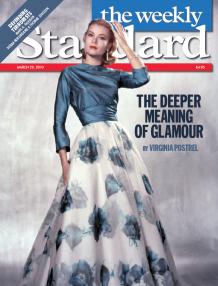
As critics who denounce movies that "glamorize violence" or "glamorize smoking" understand, glamour is much more than style. It is a potent tool of persuasion, a form of nonverbal rhetoric that heightens and focuses desire, particularly the longing for transformation (an ideal self) and escape (in a new setting). Glamour is all about hope and change. It lifts us out of everyday experience and makes our desires seem attainable. Depending on the audience, that feeling may provide momentary pleasure or life-altering inspiration. Read the rest, a longish review-essay, at The Weekly Standard.
Posted by Virginia Postrel on March 23, 2010 • Comments
As John Scalzi has scathingly noted, Amazon really screwed up when they pulled all of Macmillan's titles from their site. Although I think they have the right idea about book prices, they betrayed their customers' expectations and, worse, did so without warning. They forgot that Amazon is what Professor Postrel called in this 2007 post on Organizations and Markets a "new-wave utility" and, a such, has adopted a strategy that implies a high level of reliability.
How do you get sustainable advantage in a service business today? One approach: Become a new-wave utility. Think about Google or Yahoo, eBay, Amazon, etc. on the Internet; think about UPS or FedEx, Grainger, Ryder, Public Storage in logistics; think about McDonald's, Starbucks, 7-Eleven, in convenience food consumption.
Amazon has backed down from its weekend dispute with Macmillan, agreeing to charge the publisher's higher prices for Kindle editions rather than its preferred $9.99. But the long-term questions about e-book pricing remain.
Amazon still calls Macmillan's prices--generally $12.99 to $14.99 for new books--"needlessly high." Apple, meanwhile, has made deals with publishers like the one Macmillan demanded from Amazon: higher prices for books, with Apple keeping a percentage of sales.
Who, in fact, has the better strategy? To maximize revenue, what should prices for e-books look like?


 , Francine du Plessix Gray writes: "I'm sorry to report that "The Second Sex," which I read with euphoric enthusiasm in my post-college years, now strikes me as being in many ways dated."



 breaks from a long-standing trend in nonfiction publishing. Instead of a clever title followed by a long explanatory subtitle, it has no subtitle at all. It doesn't need one, because the title itself so perfectly encapsulates a common, but rarely articulated longing. The book is all about the intense glamour of houses you don't have. I
  " (2004), who often cites the jam study in antimarket polemics lamenting the abundance of consumer choice. In Schwartz's ideal world, stores wouldn't offer such ridiculous, brain- taxing plenitude. Who needs two dozen types of jam?
 in today's NYT Book Review. Read the rest