The New Yorker has put online James Thurber's classic 1939 short story "The Secret Life of Walter Mitty," once a favorite of elementary and middle-school literature anthologies but now largely unknown by younger people. In an earlier draft of The Power of Glamour, I included the following passage about the story, which is all about the protagonist's glamorous, but ridiculous, daydreams.
Just as a single glamorous object may evoke different desires, different objects may reflect the same underlying yearning, as illustrated in the comic 1939 short story “The Secret Life of Walter Mitty.” Author James Thurber contrasts a series of glamorous daydreams with the protagonist’s real life as an infantilized, bumbling husband. The story opens with a scene pieced together from movie clichés. Though technically ridiculous, its dialogue makes emotional sense. We meet Mitty as the brave and competent commander, respected and obeyed by his crew.
“We’re going through!” The Commander’s voice was like thin ice breaking. He wore his full-dress uniform, with the heavily braided white cap pulled down rakishly over one cold gray eye. “We can’t make it, sir. It’s spoiling for a hurricane, if you ask me.” “I’m not asking you, Lieutenant Berg,” said the Commander. “Throw on the power lights! Rev her up to 8,500! We’re going through!” The pounding of the cylinders increased: ta-pocketa-pocketa-pocketa-
pocketa-pocketa. The Commander stared at the ice forming on the pilot window. He walked over and twisted a row of complicated dials. “Switch on No. 8 auxiliary!” he shouted. “Switch on No. 8 auxiliary!” repeated Lieutenant Berg. “Full strength in No. 3 turret!” shouted the Commander. “Full strength in No. 3 turret!” The crew, bending to their various tasks in the huge, hurtling eight-engined Navy hydroplane, looked at each other and grinned. “The old man will get us through” they said to one another. “The Old Man ain’t afraid of Hell!”. . .
Suddenly Mitty’s real life breaks the reverie, as Mrs. Mitty berates her husband for driving too fast, then nags him to buy overshoes and wear his gloves. Over the course of the afternoon Mitty imagines himself as a series of glamorous masculine archetypes, with each daydream broken by some mundane, ego-deflating interruption. He’s a world-renowned surgeon operating on a millionaire banker and able, in mid-surgery, to repair a broken anesthetizer with a fountain pen. He’s a crack shot on trial for murder, shocking the court by destroying his own alibi—an injured right arm—when he declares, “With any known make of gun, I could have killed Gregory Fitzhurst at three hundred feet with my left hand.” He’s a gallant British aviator, taking his bomber up over Germany against impossible odds. Finally, he becomes a spy being led to his execution: “erect and motionless, proud and disdainful, Walter Mitty the Undefeated, inscrutable to the last.” None of these scenes has a coherent plot. They are all glamorous snapshots, portraits of yearning fulfilled. And all reveal the same longing—for competence and respect. Each allows Mitty to escape a reality in which he is constantly reminded of his failings: “He was always getting something wrong.”
As varied as these daydreams are, however, they not only express the same underlying desire but do so in a relatively narrow way. They are all masculine, and several of them are martial, not surprising in a story published in 1939. We could imagine many more archetypes with the potential to express the same longings—and to be punctured with the same glamour-deflating humor. In another era, a similar character might picture himself a sports star winning the championship with a well-placed shot, a scientist rushing to intercept an Earth-destroying asteroid, or a CEO doing multi-billion–dollar deals from his private jet. The desire for competence and respect could express itself in daydreams of Martha Stewart–style domestic perfection or in that common fantasy, the Oscar acceptance speech. Depending on their personalities, and cultural contexts, different people will respond to different glamorous objects reflecting the same desire.
The passage made the chapter drag too much, but I do like the example and am glad
The New Yorker (and the new movie) have given me an excuse to share it. Go read the story now.
Posted by Virginia Postrel on December 30, 2013 • Comments

Last night I gave a talk on The Power of Glamour at the Getty Institute, and the sponsoring organization, Zócalo Public Square, has done a fantastic job of pulling together video, audio, photos, and a writeup--all of which you can find here.
Posted by Virginia Postrel on November 21, 2013 • Comments
In this hour-long interview, Nick Gillespie and I talk about everything from David Bowie's multiple personas to Marxist critic John Berger's dessicated notion of glamour.
Posted by Virginia Postrel on November 16, 2013 • Comments
 One of the first and most interesting reviews of
The Power of Glamour is this article from The New Inquiry, where author Autumn Whitefield-Madrano applies my analysis to her own concerns about how "idealized media images of unattainable beauty" affect women. It was a pleasure to see my work intelligently applied to produced a more nuanced understanding of this controversial subject, especially since one of my quirkier examples proved key to her conceptual leap:
One of the first and most interesting reviews of
The Power of Glamour is this article from The New Inquiry, where author Autumn Whitefield-Madrano applies my analysis to her own concerns about how "idealized media images of unattainable beauty" affect women. It was a pleasure to see my work intelligently applied to produced a more nuanced understanding of this controversial subject, especially since one of my quirkier examples proved key to her conceptual leap:
Postrel cites
Star Trek as an example of something glamorous, which might strike many as absurd, given its distinct lack of glamorous tropes. But it was this example that cemented for me the relationship between glamour and the viewer—and if you had memories of your 11-year-old loner brother sitting on the couch in his Star Trek ensign uniform, staying up late to finish his own handwritten Next Generation scripts, you’d understand too. A bit of an outcast at that age but with a longing for community and quiet appreciation of the skills he had to offer the world, my brother couldn’t wholly identify with life aboard the starship Enterprise, but he saw enough of its world in himself—and he saw enough of himself in the values of that world—that it became far more than mere entertainment to him, even if he couldn’t spell out why. Star Trek wasn’t remotely glamorous to me, but it was to him.
When I think of my brother’s longing today, I’m struck by how much he yearned to truly identify with that world (even though, like all chimera of glamour, it was a world that couldn’t exist). In a certain light, his obsession with
Star Trek becomes heartbreaking: a child wanting so badly to live in a world where he’d have a place that he literally wrote it himself when the prewritten fantasy ran out. But I also see it as an indicator of the ways he was thriving. He took up trombone because that’s what Commander Riker played. He learned how to save his child’s income in order to buy entrance to Trekker conventions once my parents became exasperated with the constant ticket requests. He was writing entire hourlong performance scripts—a passion that stuck around long enough for him to host a radio theater show today. You could say Star Trek held up an unattainable ideal that he’d never be able to join—or you could say it spurred him to better himself. Both can be fallouts of glamour.
As a feminist writer who wants women to feel as emotionally whole as possible, I’ve spent my fair share of time fretting over idealized media images of unattainable beauty. But in writing about beauty and in talking to dozens of women about the role looks play in their lives, my mind-set has slowly shifted over the years. I can no longer believe that women are such passive, robotic consumers as to continue to buy women’s magazines if they just make us feel like crap—nor do I naively believe that women bathe in these images because we feel fantastic while doing so. Looking at the question of idealized images through the lens of Postrel’s articulation of glamour, there’s a more satisfying conclusion here:
We are drawn to images of idealized beauty not out of self-loathing but out of longing; we are compelled by images not only because we compare ourselves to them but because we identify with them. If we didn’t identify with those images to some degree—even a whisper of one—they would cease to have any resonance with us. Yet if we identified too much, we’d have less to strive for.
Read the rest of the review
here. Beauty Bytes blogger Meli Pennington linked to the review with her own Star Trek memories: "As a fellow Sister-to-a-Trekkie myself, I never thought of this before, but it fits in with the glamourous dream worlds that I do know: fashion, old Hollywood movies, and pop stardom. And as each of these worlds holds up a different ideal, each can inspire us (or frustrate us in our inability) to change in different ways."
Interestingly, to get a
Star Trek image that captured the glamour the show holds for fans I couldn't just use a still, since as Autumn notes the look and feel of Star Trek isn't obviously glamorous. I went instead to a fan, although one who produces digital imagery for a living. The image above, which I licensed for reproduction in the book and related materials like this post, was created by Tobias Richter of The Light Works. (You are not free to reproduce it without separate permission.)
Posted by Virginia Postrel on November 16, 2013 • Comments
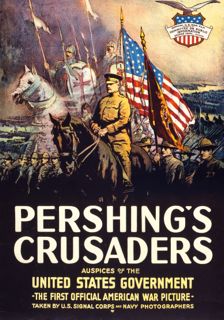 Military glamour is among the most ancient forms. From Achilles, David, and Alexander through knights, samurai, admirals, and airmen, warriors have been icons of masculine glamour, exemplifying courage, prowess, and patriotic significance.
In the half century leading up to the end of World War I, warfare was also one of the first contexts in which English speakers used the term glamour in its modern metaphorical sense. (The word originally meant a literal magic spell that made people see things that weren't there.)
“Military heroes who give up their lives in the flush and excitement and glamour of battle,” opined a U.S. congressman in 1885, “are sustained in the discharge of duty by the rush and conflict of physical forces, the hope of earthly glory and renown.” A 1917 handbook on army paperwork was “dedicated to the man behind the desk, the man who, being away from the din and glamor of battle, is usually denied popular favor, yet who clothes, feeds, pays, shelters, transports, and otherwise looks after the man behind the gun.” (Whether in warfare or business, logistics is the quintessential “unglamorous” but critical support activity.)
European nations began World War I with a glamorous vision of war, only to be psychologically shattered by the realities of the trenches. The experience changed the way people referred to the "glamour of battle," treating it no longer as a positive quality but as a dangerous illusion. In 1919, the British painter Paul Nash wrote that the purpose of The Menin Road, his bleak portrait of a desolate and blasted landscape, was “to rob war of the last shred of glory[,] the last shine of glamour.” Briefly conscripted in 1916, D. H. Lawrence lamented “this terrible glamour of camaraderie, which is the glamour of Homer and of all militarism.” An American writing in 1921 asked fellow veterans of the Great War, “Are you going to tell your children the truth about what you endured, or gild your reminiscences with glamour that will make them want to have a merry war experience of their own?” In the 1920s, pacifism, not battle, became glamorous.
In her ground-breaking 1939 book America at the Movies, Margaret Thorp recounted one example of the era's glamorous pacifism:
Deanna Durbin is a pacifist. She showed a reporter her school history book with a paragraph which she had underlined with red pencil. “It was Nicholas Murray Butler’s estimate that for the money spent on the World War every family in ten countries could have had a $2,500 house, $1,000 worth of furniture, several acres of land [and so on]. ‘Isn’t it dreadful?’ said Deanna. ‘Not so much the money, as the millions of people killed.’” Ten years ago such a statement would not have added to the glamour of a youthful star, but at least it is safely away from present conflicts.
Within a few years, Durbin was a favorite of British troops and reportedly of Winston Churchill as well. Just as World War I punctured the glamour of battle, the Nazi advance largely did away with the glamour of pacifism.
[Most of this text, except for discussion of Deanna Durbin and the glamour of pacifism, is taken from chapter one of my new book The Power of Glamour: Longing and the Art of Visual Persuasion. Pershing's Crusaders poster from Library of Congress.]
Posted by Virginia Postrel on November 11, 2013 • Comments
The Power of Glamour won't be officially released until tomorrow, but I've been busy doing interviews. This morning I talked with WNYC's John Hockenberry on The Takeaway. You can listen to that interview here.
Ed Driscoll of PJ Media also just released the podcast interview he recorded with me last week. And, in case you missed it, you can watch the PJTV interview Glenn Reynolds did with me here.
No matter how many of these you watch or listen to, however, I can assure you that there is much, much more to the book. So please buy and read it!
Posted by Virginia Postrel on November 04, 2013 • Comments
Contrary to what you may have read in the gossip columns, I dedicated
The Power of Glamour
to my husband Steven, not to Ronald Perelman. But the book's acknowledgements do conclude with a note of gratitude to everyone involved in bringing the cancer drug Herceptin to the world, including Perelman who had a big part in financing its research. Thanks to the drug, I had an excellent prognosis—a 95% chance of survival—when I was diagnosed with early but aggressive breast cancer. Here's what I wrote in the book:
In July 2007, barely a week after receiving the final signed contract
for the book, I was diagnosed with what turned out to be HER2-positive
breast cancer, a particularly aggressive form of the disease. Twenty years
earlier, I would have had only a fifty-fifty chance of survival, given the
details of my case. Today, I am officially cured. Although I underwent the
traditional treatments of surgery, chemotherapy, and radiation, what made
the crucial difference was the pathbreaking biologic drug Herceptin, first
approved by the Food and Drug Administration in 1998.
The research that led to Herceptin was funded not by the federal government or a traditional cancer charity but by money from Ronald O.
Perelman, in his role as chairman of Revlon, and by fundraising in the
1990s at a series of star-studded events called the Fire and Ice Balls. I am
deeply grateful to the many people, only one of whom I know personally,
responsible for bringing Herceptin to the world: to Dennis Slamon for his
scientific vision; Lilly Tartikoff for her fund-raising energy; my oncologist,
John Glaspy, for his persuasive eloquence; the researchers at Genentech
for development and testing; and Perelman and Revlon for their financial
contributions. In a very real way, I owe my life to the glamour of makeup
and movie stars.
The story of Herceptin, one of the few true miracle drugs in the fight against cancer, is a remarkable one. You can read more about it here.
Posted by Virginia Postrel on November 04, 2013 • Comments
Imagine the horror of entering a mall Halloween morning only to find...Christmas decorations.

What a relief to discover they were only set decorations, for an episode of Modern Family being shot at the mall.


My favorite part: Smart Phone Santa

Posted by Virginia Postrel on October 31, 2013 • Comments
One of the things I do in
The Power of Glamour is distinguish between glamour and such related concepts as charisma, spectacle, and romance. Here's the discussion of romance (not in the boy-meets-girl sense):
In concealing effort, glamour differs from romance, which often portrays hardship. Think of the training sequences in martial-arts movies, the battles in
Star Wars or Lord of the Rings, the artist’s struggling years in the garret, the entrepreneur’s office cot and diet of ramen noodles. Behind- the-scenes reality shows like Project Runway or The Rachel Zoe Project are essentially romances about the creation of glamorous moments, dramatizing the effort behind the effortless appearance of a runway show or red-carpet look. Romance does idealize reality—it omits the tedious, meaningless, and boring—but it heightens the glory of success by showing the struggle that produces it. Glamour is less narrative. It captures not a story but a scene: the dance, not the rehearsals; the still photo, not the film. Glamour and romance are closely related, but glamour is about being, not becoming. We experience the result, not the process.
The relationship between subject and audience is also different. In a romance, the audience feels a range of emotions along with the characters: excitement, fear, anger, love, grief, joy. Glamour, by contrast, remains an outside view, requiring mystery and distance. In the classic versions of the character, we don’t inhabit James Bond’s mental universe. We project ourselves into his setting and talents. He is “all façade.”We do not feel what he feels but, rather, what the idea of him makes us feel. This distanced identification is why anonymous models or even inanimate objects can be glamorous. We do not need to know them from the inside; we fill their images with our own emotions and desires.
John F. Kennedy's
moon speech is a good example of the use of romance for persuasive purposes.
We choose to go to the moon. We choose to go to the moon in this decade and do the other things, not because they are easy, but because they are hard, because that goal will serve to organize and measure the best of our energies and skills, because that challenge is one that we are willing to accept, one we are unwilling to postpone, and one which we intend to win.
The glamour-romance distinction is relevant to way the current administration sold Obamacare—to itself and to the public. Instead of portraying the program as worth the sacrifices and transition costs, its supporters largely concealed those to anyone outside what Megan McArdle calls
Expertopia. Instead of hardships in a glorious and worthwhile cause, their rhetoric encouraged people to imagine a glamorous version of their ideal health care plan, achieved effortlessly and without cost.
Posted by Virginia Postrel on October 31, 2013 • Comments
In my most recent
Bloomberg View column, I argue that a big reason for the disastrous startup problems experienced by HealthCare.gov was that even smart people who aren't I.T. pros tend fall prey to what TV Tropes calls the "magical database." It seems that the president of the United States and many around him simply have no idea how complicated the systems they were demanding would be to design. Here's an excerpt:
Looking back, it seems crazy that neither the Barack Obama administration nor the public was prepared for the startup difficulties. There’s no shortage of database experts willing to opine on the complexities of the problem. Plenty of companies have
nightmarish stories to tell about much simpler software projects. And reporting by the New York Times finds that the people involved with the system knew months ago that it was in serious trouble. “We foresee a train wreck,” one said back in February.
So why didn’t the administration realize that integrating a bunch of incompatible government databases into a seamless system with an interface just about anyone could understand was a really, really hard problem? Why was even the president seemingly taken by surprise when the system didn’t work like it might in the movies?
We have become seduced by computer glamour.
Read the whole thing here. The "nightmarish stories" link goes to this tale of the famous I.T. disaster that made Hershey almost miss Halloween in 1999.
In response, I received a number of emails from I.T. pros, adding their perspective to the argument. One of the best came from Jack Simmons of Denver (emphasis added):
Whatever the merits or demerits of the ACA, your description of the grasp of the common person regarding computer systems is spot on.
People really do think of computer systems as some sort of magic easily configured and implemented.
I think back on some of the experiences I've had trying to diagnose and correct relatively simple computer failures. In one case, it took over forty hours of effort on my part to discover a 4 had been entered in a key index definition instead of a 6. The result was a complete systems shutdown for fours days on the accounting system of a major phone company. That was a long weekend.
The Jean Luc Picard analogy was very funny because of its accuracy. I love to tease people with the phrase "make it so" whenever we're discussing the potential solution to a problem.
I really believe Obama thinks all he has to do to solve a problem is do the same thing. He has obviously never worked on a system. If he had done so, he would realize it's going to take more than a campaign speech to get these systems up and running.
To be fair, there are many managers I have met who had no grasp of what was being asked of their systems folks. It was only when their jobs were on the line they took the time to actually sit down to understand the intricacies of even a simple computer system. Some of them didn't make it.
Computers force one to really define what is to be accomplished before beginning. Most times it is not until the system is up and running that the systems analyst really understands the requirements. This is followed by the realization of how many mistakes were made in building the system and how many mistakes still reside within the system.
Anyway, excellent article.
Life is messy and so are our computer systems.
I don't think we're going to get the health care systems up and running in any sort of reasonable time frame.
I would love to work on the systems, but that is not going to happen.
Don Smallidge wrote:
As a software developer who has written similar kinds of software (knitting data from different sources to service a web application) I am well aware of the challenges the administration faced in creating this web site. Certainly I have never been involved with any project on this scale, but I think the issues and decisions required to bring such projects forth as live interactive tools is something many web developers can relate to.
I think your article caught the essence of the problem very well. The comments on the Bloomberg site were more about Obamacare and people's political opinions, not on why the website is having so much trouble (this solution to our healthcare needs has people so polarized they are generally unable to just focus on the specific technical issues at hand). Thanks for bringing this aspect of the program to light.
You can support Obamacare, in other words, and still acknowledge the problems created by the magical database fantasy—as well as the administration's downplaying of the transition costs and tradeoffs.
Posted by Virginia Postrel on October 31, 2013 • Comments