Last week, the president signed a transportation bill that included a little relief for Dallas air travelers. We can now fly from Love Field, the small, convenient airport, to Kansas City and St. Louis (and, theoretically, anywhere else in Missouri). American Airlines, which fiercely opposes any change in the Wright Amendment, the bizarre federal law that dictates where planes can go from Love, was not pleased. Southwest Airlines, which has its headquarters at Love, said, "9 states down, 41 to go" and immediately started selling tickets to KC and St. Louis, with service starting next week. American, flying out of DFW, matched its prices. American also promises to start flights from Love, where it has three unused gates.
As Fort Worth Star-Telegram business reporter Mitchell Schnurman notes on his terrific blog, American's threats don't make a whole lot of sense as anything other than a temper tantrum.
I never thought it made much sense for American to take on Southwest at Love, considering AA's efficiencies and reach at D/FW. But American says too many of its best customers would opt for Love's closer-in location.
Maybe on trips to New York, Chicago or LA, but St. Louis and KC? My gut tells me there aren't that many Highland Park Platinum members in danger of being poached on those routes.
But AA is in a box now. It's been huffing and puffing about having to go to Love, and now it has to make good on the threat, even if it's for a single state.
Can American make money on this service? No way, unless it's indirect -- if it somehow helps keep Wright in place.
Schnurman's tough-minded coverage of the issue demonstrates the great virtues of distant newspaper owners. His paper is owned by Knight Ridder, which isn't entangled in local crony capitalism. The Dallas Morning News by contrast seems terrified to even voice an opinion on the issue. (And I'm not just annoyed that they turned down this piece on the grounds that they'd already run too much on the topic. In fact, I'm delighted. D Magazine paid me twice the DMN's rate, and I like them better anyway.)
Viewed up close, the whole Wright discussion demonstrates the wisdom of my old boss Bob Poole, who has spent at least two decades arguing for airport privatization. Locally, the only thing any politico seems to care about is what's good for DFW Airport and, secondarily, for the airlines. The traveling public doesn't count--either in the political equation (too diffuse) or, apparently, in airport management. Anyone who's had the misfortune of traveling through DFW knows that, with the exception of its new Terminal D, it's hardly a comfortable or accommodating place. Neither does it seem to maximize revenue. No mall developer would use space so pathetically.
Bob Poole isn't alone. When I interviewed Brookings Institution economist Cliff Winston for this NYT article on the Wright Amendment, he denounced the pernicious effects of government-owned airports. The debate over Wright, he said,
really exposes the weakness of our current public-sector provision of airport infrastructure, where this is allowed to happen--having DFW attempt to block something that would benefit consumers because [the airport] is not set up to be an effective competitor....
What is so troubling about airports is they simply have no experience or effective relationship with their customers, airlines. It's not like they work with these guys actively and say, "What can we do to attract you? What sort of things should we be doing?" It's all political:" What can we do to keep you happy in underwriting our bonds?" And usually what keeps them happy is keeping out other people from the airport. The whole incentive for you to develop an effective relationship between an airline and an airport to become more competitive and efficient is just not there. The incentives are basically to slap each other's back, to limit competition and keep a secure source of revenue.
Our conversation took place almost exactly a year ago. This week, DFW released a study demonstrating just how completely politicized its measures of "success" are. Stores and restaurants owned by women, minorities, and disabled people account for a higher percentage of total retail sales at DFW than at any other airport, just over half. As the Star Telegram reported:
Don O'Bannon, vice president of D/FW's small and emerging business department, said D/FW's success "far exceeds other competing hubs out there."...
"The moment we start talking about moving passengers out of D/FW to Love Field, I think you'll start to see a dramatic impact on concessionaires," he said. "It speaks volumes for what's going on and how important it is."
The airport had no comments on whether the traveling public is satisfied with the rather pathetic choices it offers. Why, after all, should it care? Paying customers aren't organized enough to exert political influence. Minority concessionaires, like Democratic Congresswoman Eddie Bernice Johnson (always identified in the press as representing Love Field, where she also has concession interests), do. I share Cliff Winston's disgust.
Full disclosure: The article I'm writing on pens is for Spirit, the Southwest Airlines magazine. If that sounds like a conflict, keep in mind that the magazine is published by a subsidiary of American Airlines. Weird. My real conflict is that I'm a consumer who would benefit enormously from repeal of the Wright Amendment.
The DMN's archive of Wright coverage is here.
Posted by Virginia Postrel on December 06, 2005 • Comments
Several readers have sent email pointing out this A.P. story on Christmas lights, which quotes me on the trend toward hiring professionals to install them. Yesterday, I did another interview on the subject, with a reporter from the Milwaukee Journal Sentinel.
This burgeoning business provides a microcosm of learning and value-creation in a dynamic economy. For the full picture (and some pretty photos), see my 2003 article.
Posted by Virginia Postrel on December 06, 2005 • Comments
No, this isn't a commentary on the Bush administration. It's a help wanted ad.
The Foundation for Individual Rights in Education, on whose board I serve, does a wonderful job holding the nation's colleges and universities to their declared principles of academic freedom. After helping to transform FIRE from a startup to a professionally run organization, the current president, David French, is stepping down at the end of the year, with plans to serve his country in the JAG Corps. We're looking for a new president, and I'm on the search committee.
The job has three primary responsibilities: communicating the principles of the organization in a variety of public media; managing FIRE, including both long-term strategy and immediate tactics, personnel, etc.; and fundraising. FIRE's annual budget is about $1.2 million. A detailed job description is here. If you are interested, or know somebody who might be a good candidate, please email me.
Posted by Virginia Postrel on December 05, 2005 • Comments
The WaPost's Rick Weiss reports on the growing movement to slap more regulations on nanotechnology. Interestingly, the only reported skepticism about regulation comes from the EPA:
An estimated 700 types of nanomaterials are being manufactured at about 800 facilities in this country alone, prompting several federal agencies to focus seriously on nano safety. Yet no agency has developed safety rules specific to nanomaterials. And the approach being taken by the Environmental Protection Agency, arguably the furthest along of any regulatory body, is already facing criticism by some as inadequate.
In documents that are now being finalized for public comment, the agency calls for a "stewardship program" that would be voluntary. Manufacturers would be asked to alert officials about nanoproducts they are making and to provide information about environmental or health risks they have uncovered. But they would not be required to make such reports or to do special studies.
Although the agency may at some point feel the need to impose stricter controls, the voluntary approach has the advantage that it can be implemented more quickly, said Charles Auer, director of the EPA's Office of Pollution Prevention and Toxics. He added that the agency is not sure it understands enough about the new materials to know how best to regulate them.
"This way we can develop something, gain experience and learn more about what we're dealing with," Auer said.
I don't know whether to be glad that front-line regulators are aware of their ignorance or upset that Weiss didn't find anyone outside the government to suggest that maybe slapping controls on a nascent technology isn't the best way to proceed.
Posted by Virginia Postrel on December 05, 2005 • Comments
Forbes has a timely retrospective and slideshow, with assorted fun facts. Did you know Play-doh was originally designed to clean wallpaper?
Posted by Virginia Postrel on December 05, 2005 • Comments
The Manolo comments on the item below: "Ultimately, however, although the Virginia can point to the items of coolness, she cannot explain exactly what it is that makes them cool. This it is because the 'coolness'" is more about the emotional than the intellectual."
Coolness, like any aesthetic response, is (to quote myself in umpteen speeches) "immediate, perceptual, and emotional. It is not cognitive." Trying to make aesthetic value cognitive leads analysts of all sorts to fixate on status and exclusivity, because they're easy to understand.
That said, with enough after-the-fact cognitive effort, I think it's possible to identify elements, like flatness in electronics, that make something cool, at least at a particular moment in time. Graceful ingenuity, like that displayed in Podlowski's rings, is cool. If I work hard enough, I might even be able to articulate some of the factors that make the BCBG bags cool. But this is a blog, and I'm too lazy to make the effort. (I've spent the last year writing thousands of unpublished words analyzing glamour, another powerful, intangible quality that depends on the audience's imagination.)
What's really hard about explaining "cool" isn't analyzing an object you've already decided is cool. It's creating a cool object in the first place. You can't just mix and match known elements to solve a well-defined problem. You have to intuit what will evoke the right emotions.
Posted by Virginia Postrel on December 05, 2005 • Comments
Friday afternoon, I had an interesting phone conversation with Steven Levy, who is writing a book on the iPod. At one point, he asked why I thought the iPod had managed to stay cool even after it became ubiquitous. Doesn't a gadget have to be exclusive to be cool? No, I said. That's one kind of cool. There's another kind that depends on the intrinsic aesthetics of the product. An intrinsically cool product doesn't have to be expensive or hard to get to stay cool.
It's easy to think of cool electronics. Flat-screen TVs are cool. So is the Motorola Razr. Come to think of it, flatness is simply a cool feature in electronic products. Their cool factor doesn't depend on who owns them. That doesn't mean flatness will always seem cool. It could easily become normal and boring. (I remember when silent light switches seemed incredibly cool.) If we get used to the looks of something, if it starts to fade into the background, it loses its cool factor. But it's a mistake to confuse freshness with exclusivity.
Steven Levy asked me to name some non-electronic gadgets that are intrinsically cool. I'm terrible at answering questions like that off the top of my head, especially with no pictures. But here are some examples.
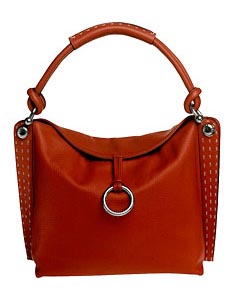
This is the BCBG Max Azria Signature bag, which comes in 16 colors and two or three different sizes. I have it in bright blue. It was just so cool that every time I saw it, whether in a store window or a magazine spread, I did a double take, as though I was seeing it for the first time. Turns out it doesn't just look good. It's also incredibly functional, with pockets for every purpose.
Lots of cars are cool. The classic Jaguar is the example I managed to come up with on the spot, undoubtedly because it's not just cool but glamorous. The Prius is cool, both technically (the hybrid engine) and aesthetically. After the initial boring model, designed to look as Camryish as possible, Toyota wisely gave the Prius a cool wrapping. Every time I see one, I think, "What a cool car. Oh yeah, it's a Prius."
For current cool at, however, it's hard to beat the Chrysler Crossfire.

The coolest thing I own is a lot smaller than a purse or a car or even my Razr. It's an amethyst ring by Polish designer Tomasz Plodowsi. It's not expensive, not exclusive, but really, really cool.

I'm enabling comments on this entry, in case you'd like to add your own. Please limit the discussion to this topic. UPDATE: I don't know why the comments link isn't showing up. I'm trying to figure out the problem. If you know Movable Type and have any theories, please let me know. I have "Allow Comments" set on "Open."
Posted by Virginia Postrel on December 04, 2005 • Comments
Few authors have a Maureen Dowd/Bill O'Reilly-style publicity machine. So the biggest obstacle to most book sales is simple ignorance. People who might like a book simply don't know it exists. The most likely way they'll find out is if a friend reads the book and recommends it. Hence the importance of buzz.
Lately, I've been fretting over The Substance of Style's respectable but unspectacular sales (roughly 18,000 copies in hardback, now out of print, and 12,000 copies so far in paperback). One problem seems to be that, while the book has enthusiastic fans, it has gotten minimal word of mouth. Why? Professor Postrel's cheery explanation: "The people who like your stuff don't have any friends."
Posted by Virginia Postrel on December 03, 2005 • Comments
 Photo blogger Rick Lee finds it. Scroll down for other abstract still lifes from his sundry shopping trips.
Posted by Virginia Postrel on December 03, 2005 • Comments
This post is a bit late, since I've been traveling without Internet access, researching the pens story (see below). But here's my new NYT column, on new research that seems to confirm the link between job hopping and Silicon Valley's innovative environment.
Posted by Virginia Postrel on December 01, 2005 • Comments