Fashion Geek
Leslie Katz of CNet News profiles Project Runway contestant Diana Eng, "a geek's geek who discovered the joys of math by second grade."
Leslie Katz of CNet News profiles Project Runway contestant Diana Eng, "a geek's geek who discovered the joys of math by second grade."
Dan Drezner explains.
"What about home schooling? You know, it's not just for scary religious people anymore."
--Buffy Summers
And it now has its own blogging Carnival, with the second edition up here. They're looking for submissions for Carnival number three.
A new Carnival of the Future is up.
Speaking of "the future," check out Wayne Curtis's fun Atlantic piece on the Las Vegas monorail: "When I read that Las Vegas had opened a new monorail system last year to whisk travelers up and down the Strip, my first thought was, Of course: all cities of the future have monorails. My second thought was, When can I ride it?"
Some years ago, an editor asked me how he could give his children an appreciation for the English language. He wanted them to write well. Since he's an evangelical Christian, I told him he should teach them Psalms from the King James translation of the Bible. My mother did that with me as a child, and it gave me an early sense of metaphor and rhythm. It taught me to appreciate, and understand, complex, beautiful English.
My friend didn't like my suggestion. After all, nobody reads the KJV anymore. Forget poetry (not to mention sensitivity to the underlying Hebrew), today's suburban Christianity is all about accessibility. It's been dumbed down.
Now I'm not a Christian, let alone an evangelical. If megachurches want to play bad-to-mediocre rock instead of great hymns, that's their business. But the spread of Christian pap does have spillovers, not the least of which is that devout Christian faith no longer brings with it a deep familiarity with what's actually in the Bible, as opposed to a few verses from the preacher's PowerPoint. Unless the person is over a certain age, Biblical literacy, when you do find it, rarely means acquaintance with great English. Forget theological or philosophical sophistication. I'd settle for the ability to comprehend complex sentences.
Throughout American history, Christian (largely Protestant) devotion has stretched people's minds and given them reason to think, if only within a closed system of belief. Religious practice has taught people to read, write, and speak. The rhythms and rhetoric of the Bible have given America its greatest political rhetoric, from Abraham Lincoln's to Martin Luther King's. Today's Christianity produces...George W. Bush.
Megachurch Christianity may hone organizational and business skills, but it isn't teaching believers to think about abstractions or communicate in higher than "everyday" language. No wonder megachurches combine their up-to-date media with fundamentalist doctrine. It fits well on PowerPoint--no paragraphs required. Leaving aside the validity of what they preach, today's most successful evangelicals are spreading pap.
While I'm ranting about the pap-ist threat, I should put in a few words about the mega-bestseller The Purpose-Driven Life
On a related note, John Lanius recently blogged on what his wife calls "Contemporary Christian Porn," and other forms of popular but debased evangelism.
Yes, all of the above could be considered an extended criticism of market-based competition. In the U.S., after all, religion is the freest market. But I'm not against the system; I'm all for it. As institutional responses to modern life, I find megachurches fascinating and productive. (I even had nice things to say about their architecture, which, while purely functional, is more interesting than its low-church Baptist predecessors.) But the most successful product is not necessarily the best on all dimensions--or on the ones I care about. And criticism is also part of the system.
Bloggers have become the favorite whipping boys of everyone who stands for Culture The Way It Was Meant to Be. In his year-end reflections the DMN's book critic Jerome Weeks lobbed such an ignorant attack that I was actually surprised: "No wonder blogospheroids still crow over the book's imminent demise — as if in revenge for ever having to read one."
Weeks is a grouchy guy--I'd be grouchy too if I had to be a book critic in Dallas--but this is the silliest attack on bloggers yet. Bloggers love books. Bloggers promote books. Bloggers write books. The InstaKing of bloggers is about to publish a book, An Army of Davids
As you may have noticed, I haven't been blogging much lately. But I have read a bunch of interesting books, all worth sharing. Since the first of the year, I've read:
The Elusive Search for Growth
An Anthropologist on Mars
Mindsight
I'm a fan of Bravo's Project Runway. In each episode, aspiring fashion designers complete a challenge, from concept to execution, sometimes solo and some in teams. Like Junkyard Wars, it's a rare spot on TV where you can see creative people solving problems. And, like the folks on Junkyard Wars, the designers demonstrate not just creativity under pressure but excellent manual skills. They typically have a day or two to design, buy materials for, drape and create patterns for, cut, and sew a dress. (At my best, three decades ago, I might have been able to complete the buying, cutting, and sewing parts in the time allotted.) Of course, like all good reality shows, it also has strong characters, artificially generated tension, and occasional surprises.
Project Runway exemplifies something I've noticed in covering design professions over the past few years: Design of all sorts, from the most engineering-oriented to the most "frivolous," is a redoubt of what Michael Barone calls "hard America". When Heidi Klum gathers a half dozen designers on the runway and tells them, "You represent the best and the worst," she isn't worrying about their feelings, or even their character, but about their work. Try talking like that to an English major or MBA student and watch your teaching ratings plummet.
As in life, however, the judgments aren't based only on one-dimensional notions of creativity or merit. What the client wants matters. Getting along with other designers matters (at least in some cases). Sometimes people survive a round just by being less bad, because they take fewer risks, than the competition. The process is basically fair, but the outcome doesn't always seem right--not a bad model for real life.
Here's the Amazon page for Michael Barone's book, Hard America, Soft America
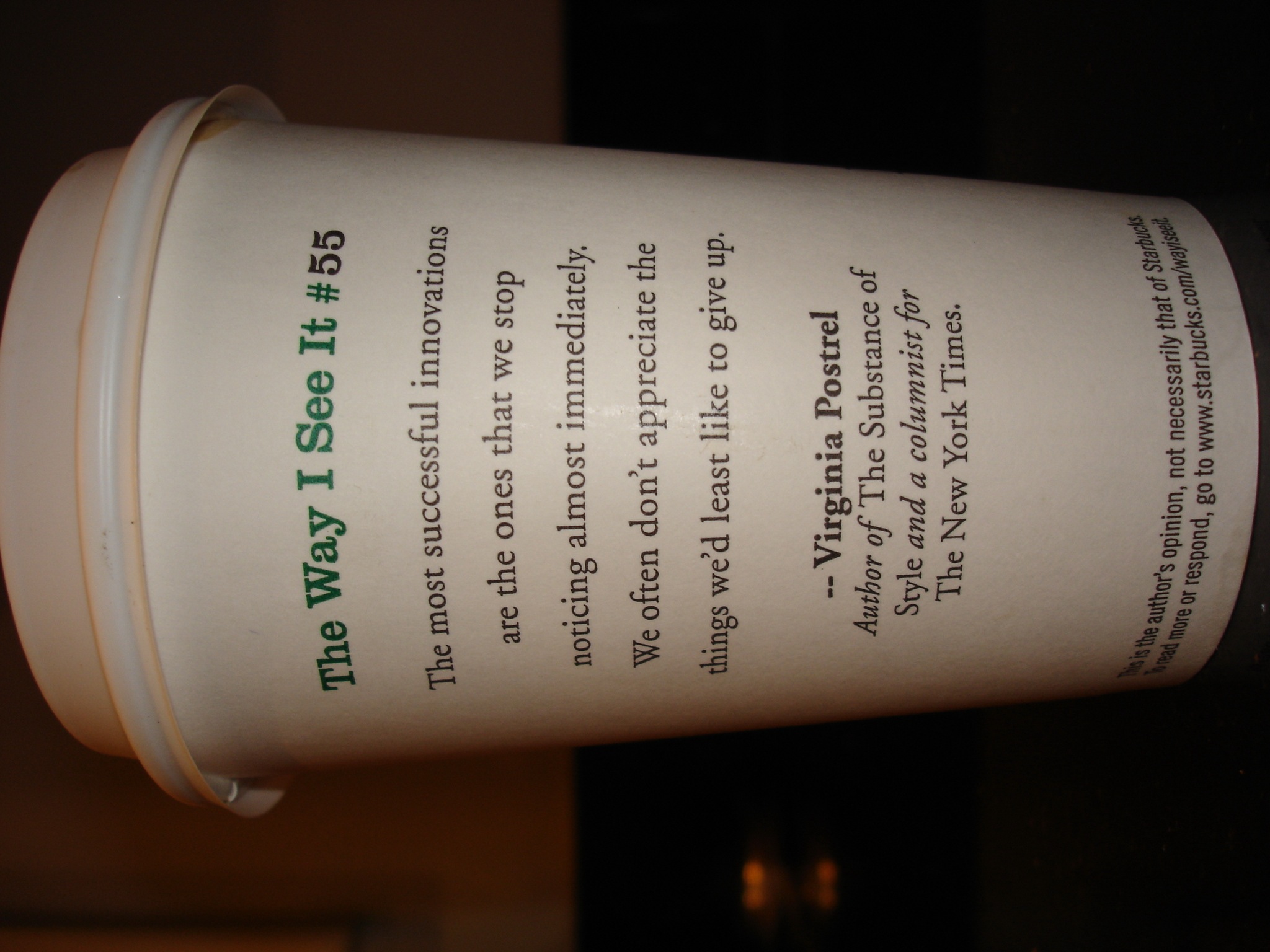
Eugene Volokh and Nick Gillespie blogged about "my" Starbucks cup back in November, but before I had a chance to see one myself, the season of the Red Cup descended on Starbucks. But the white cups are back, and I finally found one of mine. I had a little trouble, since when you actually look at a Starbucks cup it looks like this:

Starbucks went to a lot of trouble to solicit quotes from dozens of people. It designed and printed all these special cups. All the while forgetting that their cups come with a big brown cover right where the quotes go. Oops.
UPDATE: Just in case you might get the wrong idea from Dan Drezner, I didn't get paid for my Starbucks quote. Before I submitted it, however, they did send me a gift card for either $10 or $15 (I forget). I rarely drink Starbucks products--I live on Diet Coke--but it did cover some frappucinos for Professor Postrel.
Along with the setup, here's one of my favorite passages from Thomas Schelling's essay, "The Intimate Contest for Self-Control":
People behave sometimes as if they had two selves, one who wants clean lungs and long life and another who adores tobacco, one who yearns to improve himself by reading Adam Smith on self-command (in The Theory of Moral Sentiments) and another who would rather watch an old movie on television. The two are in continual contest for control.
As a boy I saw a movie about Admiral Byrd's Antarctic expedition and was impressed that as a boy he had gone outdoors in shirtsleeves to toughen himself against the cold. I resolved to go to bed at night with one blanket too few. That decision to go to bed minus one blanket was made by a warm boy. Another boy awoke cold in the night, too cold to retrieve the blanket, cursing the boy who had removed the blanket and resolving to restore it tomorrow. But the next bedtime it was the warm boy again, dreaming of Antarctica, who got to make the decision. And he always did it again.
Aside from its personal charms, this passage is great because it isn't clear which little boy we should root for. Is it good self-discipline or foolish fantasy to leave off the blanket?
Among other interesting articles, The Economist's year-end double issue includes this piece, asking how the superrich show off when luxury becomes a mass good. Is conspicuous consumptions out-of-date? I'm quoted, but the best line comes from H.L. Mencken, responding to the status-obsessed Thorstein Veblen: "Do I prefer kissing a pretty girl to kissing a charwoman because even a janitor may kiss a charwoman--or because the pretty girl looks better, smells better and kisses better?"