How to Critique Federalism Without Hysterics
Prompted by the Althouse flap, Jacob Levy addresses genuinely difficult issues of decentralization, centralization, and protection of the rights of minorities. (Via Dan Drezner.)
Prompted by the Althouse flap, Jacob Levy addresses genuinely difficult issues of decentralization, centralization, and protection of the rights of minorities. (Via Dan Drezner.)
 The LAT's Alan Zarembo tells the story of Karol Franks's determined search for a kidney donor for her daughter Jenna. (The photo shows Karol in the foreground, waiting while Jenna undergoes dialysis.) I've had some email correspondence with Karol, but I had no idea of all the ups and downs she's experienced. It's a well-written feature, worth reading in its entirety, not only for what it says about the organ crisis but also for its ultimately optimistic portrayal of what a determined mother can accomplish through the power of the Internet.
Reader Shari Hillman sends this link to a story about one of her neighbors who donated a kidney to a friend. Shari writes:
The recipient wanted to keep the whole thing private, but neighbors who learned of it thought it was wonderful and spread the news through the local email grapevine, which I suppose led to this publicity (although the recipient remains unnamed in the article).
I support your efforts to increase understanding about organ transplants and to urge reforming the system so that more people can be helped. I'm sure that privacy issues will be part of the debate.
More often, the donor is the one who wants to keep the matter private, because people make so much fuss, pro and con, about donations. That was the case with the widely reported instance of former Cowboy cornerback Everson Walls, who has volunteered a kidney to his friend and former teammate Ron Springs. The most shocking thing to me about the Walls case was that, according to the A.P. report, he had to endure a "500-question psychiatric evaluation." That's ridiculously invasive and time-consuming, and a classic example of how too many transplant centers treat living donors. An interview with a social worker is reasonable. A lengthy and deliberately daunting exam is simply calculated to discourage donors--which is, in fact, the point of the process in way too many places. Donors deserve respect, not infantilization. Although it was accidentally disclosed, I applaud Walls and Springs for telling their story. People need to know that the need is there and that donation is not an inconceivable act.
While the huge waiting list for a cadaver organ is horrible enough, some kidney patients don't even have that option. Here's the story of Jennifer Kates, a 29-year-old Boston-area woman who has been on dialysis for seven years and will die without a living donor. Her family members aren't compatible, and her brother has mounted a desperate publicity campaign, especially targeting the local Jewish community, to find a donor with type A or O blood. A Boston-area journalist told me about the case. For more information, see this website.
Jennifer Kates is a perfect example of why an above-board, domestic market for organs, within the legal and medical protections of our very sophisticated transplant system, would be far superior to the current "altruism-only" model. Kates cannot be helped by a deceased donor. She has a tiny family. Yet while affluent professionals can hire egg donors and surrogate mothers to undergo risky medical procedures for pay, neither her family nor an insurance company nor the hospital nor the government can legally compensate the living donor she needs to survive. It's a travesty perpetuated in the name of "justice" and "dignity."
Things could, however, be much worse than they are in the U.S. In Japan, it would have been illegal for me to give my kidney to Sally Satel, because we are not related. So Japanese kidney patients get people to pretend to be relatives, which is illegal, and money sometimes changes hands, which is also illegal. Sean Kinsell explains here. In a high-profile recent case, a couple was just convicted for paying an acquaintance to give the man a kidney, pretending to be the woman's sister. They received one-year prison terms, suspended for three years. "The couple's actions violated the spirit of the Organ Transplants Law, which represents humanity, volunteerism and fairness, and seriously eroded public trust in medical transplant procedures," said the judge. Ah, the humanity.
On a more positive note, next week the Discovery Channel will air a program on a six-person "paired donation" that enabled three people to receive compatible kidneys. Paired donation allows someone whose kidney is incompatible with a loved one in need to give that kidney to another patient who has a loved one with a kidney that's compatible for the first patient. It's a complicated barter system, but right now paired donation--which may or may not be legal under federal law--is the best hope for people with willing but incompatible living donors.
UPDATE: Happy New Year, InstaPundit readers. There is yet more Kidney Blogging on the main page.
It's eerie and expensive, but it works: Toy creators are using haptic tools to "sculpt" on the screen, with tactile feedback that makes them feel like they're handling real material. Wired.com's Alexander Gelfond reports.
LAT art critic Christopher Knight recently published an excellent piece on the false dichotomy between "high art" and "kitsch," first posited by Clement Greenberg. I'm not a huge fan of Knight, but this piece is worth reading in its entirety to get the historical context. Here's an excerpt:
The only distinction that truly matters is the one between good art and bad art, accounting for all the shades of gray in between. Jackson Pollock's paintings are better than Robert Motherwell's. "The Ernie Kovacs Show" is better television than "The Adventures of Superman." Arguing the reasons sharpens perception.
By contrast, ranking a painting against a TV show is just dumb--not to mention undemocratic. The measure of moral and intellectual status does not derive from hereditary social station, as if painting is for princes and television is for scullery maids. I'd as soon look at a "Six Feet Under" episode as a Lucian Freud painting any day.
Speaking of Clark Kent, Pop art in the 1960s turned out to be Greenberg's Kryptonite. Edward Ruscha and Andy Warhol, Depression-era babies from Omaha and Pittsburgh, brought their hardscrabble pasts with them when they high-tailed it to opposite coasts as young men. Both knew something crucial: In American art's democratic lexicon, every avant-garde idea could be represented in kitsch terms of popular entertainment.
In a famous 1943 letter to the New York Times, budding Abstract Expressionist painters Mark Rothko and Adolph Gottlieb wrote "only that subject matter is valid which is tragic and timeless." For Greenberg's avant-garde, the tragic and the timeless meant abstract painting. In Warhol's hands it would mean the numinous mystery of Marilyn Monroe's shocking suicide and the national trauma of Jackie Kennedy's widowhood, chronicled in the tabloids.
Ron Bailey breaks the polite silence to provide eyewitness account of what really happened at the Liberty Fund conference that Ann Althouse has been making such hay about lately. Hysterical tears are involved. (I didn't know any of this back story when I made my original post here and comments on Althouse's blog. Like everyone else, I assumed her account reflected reality.)
UPDATE: Jonah Goldberg, who went very easy on Althouse in a recent Blogginheads.tv appearance has second thoughts: "I should say that while Ron and I have many serious ideological differences, my faith in Ron's honesty and good faith is unshakable. All I will add for now is that I had no idea about the events around the dinner table--when Althouse accused fellow conferees of racism--when I participated in my bloggingheads conversation with her or when I called her original blog post 'odd.' I would have used a different adjective." Like Jonah, I have heard privately from multiple sources confirming Ron's account. Althouse was clearly out of her intellectual depth during the discussions and vented her frustration by lashing out at fellow conferees in person--she even called one female participant who dared to disagree with her an "intellectual lightweight" and an embarrassment to women everywhere--and by using her blog to recast what happened with herself as the martyred star. Now that's a diva. Diana Ross would be jealous.
UPDATE III: After she mentioned this post, I attempted to post the following comment on Ann Althouse's blog. I hadn't planned to say more on this topic, but she's managed to push my buttons:
Since I made my views clear in a previous comment, which Ann Althouse quoted in another post, I can only assume that her question of what my views are is another dramatic pose. Sorry, Ann, you got yourself into this mess not only by blowing up in a hysterical way but by constantly harping on the subject when everyone else would have happily let it drop, with no embarrassment to you. You consistently misrepresented people's views and personalities and the nature of a Liberty Fund conversation. It's a Grande Diva pose, but has nothing to do with civil rights law or libertarian thought. As you know, your entire dinnertime meltdown started after you asked about the previous night's discussion and were told it involved Ron Bailey's vigorous defense of the 1964 Civil Rights Act. (He also noted in his blog posting that no one in the discussion around the table agreed with Meyer's position on civil rights laws.) Stop pretending you were an innocent little martyr surrounded by racist ideologues. It's b.s., albeit great for generating attention and blog hits. And, for the record, since you seem to care more about righteous preening than argument, my family was defending civil rights in the South--including Little Rock in 1957--long before it was popular. (I was just a little kid doing my part by attending integrated--25% black--public schools.)
And, yes, like Jonah I've known Ron (who, contrary to Althouse's description, is not my colleague) for years and found him to be a person of enormous integrity and good will--and a vehement supporter of civil rights. So between the diva and the rational reporter, I'll choose to believe the reporter.
While I appreciate the good intent of the folks at GayPatriot.net, I don't aspire to be a diva. It's not all about me.
To find out, you can listen to me discussing the evolution of shopping centers on Wisconsin Public Radio (8 CT, 6 PT). The LAT article I'm discussing is here. (A shorter version ran in the Christian Science Monitor, which is why the host mentions it.)
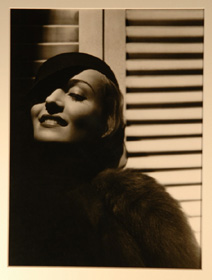 Photographer George Hurrell created the iconic style of Golden Age Hollywood glamour portraits. (For more on Hurrell, see my Slate slideshow here.) Since July, an amazing exhibition of more than 100 of his photos from the 1930s to the 1980s has been on display the Queen Mary in Long Beach. The exhibit's last day is January 1. Admission is included in several Queen Mary tour packages, or you can just go to the exhibit for $10. From now until the close of the exhibit, you also get a free copy of the beautiful catalog, with an essay by yours truly.
WindyPundit has it figured out:
I should blog more about Angelina Jolie and Brad Pitt and adoption, Janice Dickinson and car accidents, Tawny Kitaen and cocaine, whether Naomi Campbell beats her assistants, Nancy O'Dell (whoever she is), Pamela Anderson's breakup with Kid Rock, Paris Hilton and/or Lindsey Lohan (for whatever it is this time), Star Jones Reynolds' career, Tom Cruise (not that there's anything wrong with that), and because she's still getting press, Princess Diana.
Check out his update for further ideas.
UPDATE: And then there's this from Eugene Volokh:
Sex (or SexLaw) Sells -- Surprise!
Our unique visitor count Monday was 35697, and Tuesday was 38423 -- both near our historic highs. (The norm for a typical weekday is in the low 20000s.) My sense is that most of the extra visits were to the initial Ten Years in Prison for 17-Year-Old Who Had Consensual Oral Sex with 15-Year-Old post.
No, we won't be upping our blogging on SexLaw as a result. (We'd blog about it independently of visitor interest.) But it's interesting, though of course completely unsurprising, that this is indeed what many people want to read.
To get the full story, click through to Eugene's post.
Grant McCracken is back to blogging after a few weeks off.