Speech Writing and Graphic Design
Michael Bierut draws some parallels, with examples from Peggy Noonan.
Michael Bierut draws some parallels, with examples from Peggy Noonan.
Alan Wolfe concluded his Sunday NYTBR review of Dinesh D'Souza's latest hackwork with the following sentence: "I look forward to the reaction from decent conservatives and Republicans who will, if they have any sense of honor, distance themselves, quickly and cleanly, from the Rishwain research scholar at the Hoover Institution at Stanford University." I realize that the Book Review can have long lead times--I have a review coming out next Sunday that I submitted in late October--but the lag is shorter for topical books. So I have to wonder whether Wolfe has willfully overlooked the strong negative reaction to the book that has, in fact, come from "decent conservatives." He can find that reaction conveniently catalogued by Eric Scheie here and here (via InstaPundit, whom Wolfe would almost certainly consider a conservative.) Wolfe reviewed The Future and Its Enemies, along with a number of conservative works, here.
I look forward to the attention the NYTBR will lavish on such intellectually serious books as Brink Lindsey's The Age of Abundance: How Prosperity Transformed American Politics and Culture
UPDATE: Alan Wolfe emails, "There was indeed a longish lead time on the review, as you suggest. I am extremely pleased to see so many on the right expressing hostility to DD's book."
California legislators are never without new ideas for regulations and bans. The latest proposal is to make spanking children under 3 a crime, punishable by a $1,000 fine or up to a year in jail. Debra Saunders makes the basic case against the bill. Though I don't have kids, I'm not as opposed to spanking as other enlightened folk; my brothers and I were spanked occasionally (not terribly hard), with some good and no ill effects. Smacking a 2-year-old's hand as she reaches toward, say, the flame on the kitchen stove seems to me a lot more persuasive than trying to explain the dangers of fire. And, on a purely anecdotal basis, psychological punishment seems to create much more long-term resentment.
All you spanking foes and child-rearing experts don't need to write to explain what a terrible parent I'd be. Even if I had kids, my Pennsylvania-reared husband would never countenance such punishment. Spanking, like gun ownership, is one of the characteristics of southern culture that non-southerners find barbaric. It persists in diaspora, especially among those who don't assimilate into the dominant culture of, say, California. A spanking ban would therefore have a wildly disproportionate effect on conservative Christians and on blacks. With zealous enforcement, California could get the incarceration rates of black mothers up there with those of young, black men.
Pajamas Media has launched a straw poll of presidential contencers. You can vote once a week, on the reasonable assumption that people change their minds as the campaign progresses. Early results are from the network's bloggers, including me. I can only assume--or hope--that the strong showing by Dennis Kucinich reflects strategic voting by Republicans. (I voted for Bill Richardson and Mark Sanford, though I don't consider Sanford a serious contender.)
John Fund makes the case. In Arnold-speak, "taxes" are now "a loan." Hence, no new taxes.
I love these UPS commercials. Not nuts about the website, though. Would it be too much to provide a direct link to the TV spots?
UPDATE: Thanks to reader James Rait who sent this direct link to the ads and a background article. Reader John Holton, however, has a complaint about the online edition: "These UPS ads are entertaining enough, but not when they take over your computer in the form of a rollover ad and start voicing over whatever you're playing as background music...." What an obnoxious way to undercut a brilliant campaign.
I wondered who might actually buy Dinesh D'Souza's new book, which looks to be a crassly commercial attempt to pander to the worst instincts of conservative culture warriors. Then I got Lou Sheldon's latest mass email, plugging the book, with three links to Amazon and copy that looks to be straight off the jacket. So if you're wondering who out there finds the Islamist response to American "decadence" reasonable, Lou Sheldon is your man. (I suspect, though cannot prove, that D'Souza is mostly in it for the money.) I wonder what he thinks of the 1949 church dance that so shocked Sayyid Qutb.
UPDATE: Greetings Andrew Sullivan readers. I have another D'Souza-related post at the top of the main page.
UPDATE2: Here's a link to a more-restrained plug on the TVC website.
Ron Bailey examines the unintended consequences of administration policy.
The volume of spam is way up, and spammers are using graphics to get around filters. Bob Sullivan of MSNBC.com explains what's happening.
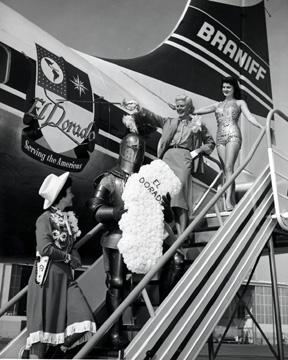 In an exchange that echoes some of the themes in my recent Atlantic column on airline glamour (link good for three days), two British writers square off in the Guardian's Observer section on the question of whether travel has lost its charm along with its hardships.
"The casual ease of travel now is a source of bewildered distress to my father's generation ('What do you mean, you're going to Bruges? For the weekend? On a whim? But you haven't even booked the ferry!')," writes Michael Bywater, who concludes "Travel is easy now. It is no longer exciting; so we have to bring our own excitement with us, in our luggage or our mind's happily deluded eye." Alexander Frater disagrees: "It is claimed too that travel has become self-delusional, that we only do it to make ourselves seem sexier, more glamorous and important. So what? All that matters is that it continues to lift the spirits and quicken the senses, and keep us alive to a world which, despite the state we've got it into, remains a place of astounding interest, beauty and variety. We're only here once, and I simply cannot understand why absolutely everyone isn't consumed by an unquenchable desire to get out there and see every last bit of it."
Since I travel constantly yet rarely leave the United States, I have none of these problems. I can go to Florence or Paris or London or Tokyo and still find plenty new to see--and those are places I've already been to at least once. At any rate, I suspect that The Guardian's audience is not as well traveled as they think they are. Outside the major cities in the United States, for instance, the only foreign tourists you usually find are Germans, who will go just about anywhere and rent RVs to do it. How many Guardian readers have driven through the desert Southwest or the Blue Ridge? And that's just the United States, which has modern conveniences and a more-or-less common language. Have they really explored all of India, China, and Brazil?
The shot above is from the Braniff archives at UT-Dallas. That's Ginger Rogers wearing the civilian clothes.