My new Atlantic column looks at the increasing prominence of fashion exhibitions in art museums. (Link good for three days.) Here's an excerpt:
Behind the criticism of fashion as an artistic medium is a highly ideological prejudice: against markets, against consumers, against the dynamism of Western commercial society. The debate is not about art but about culture and economics. Critics who decry fashion collections are less troubled by the prescribed costumes of dynastic China or the aristocratic dress of baroque France than by the past century's clothes. With its fluctuating forms and needless decoration, fashion epitomizes the supposedly unproductive waste that inspired 20th-century technocrats to dream of central planning. It exists for no good reason. But that's practically a definition of art.
Prejudice aside, it's hard to come up with objections to fashion collections that don't apply to other museum departments. Fashion is mass produced? So are prints and posters, often more so than haute couture. Ephemeral? So are works on paper. Utilitarian? So are pots and vases. Customized to an individual? So were suits of armor. As for the fickleness of fashion, the history of Western art is a story of changing styles. And however much critics may despise commerce, many undisputed masterpieces were works for hire. "Paintings were marketable goods which competed for the attention of the purchaser," writes the historian Michael North in Art and Commerce in the Dutch Golden Age. Michelangelo and Ghiberti got paid.
The real question is not whether museums are too good for fashion but whether they're good enough. Clothes are unique sculptures, dependent on a supporting human form and created to move. Yet museum mannequins stand still. Clothing is made to be seen and touched—the tactile qualities of fabric are as essential to the art as a garment's color or shape—but light and fingertips dim colors and degrade fabrics. The first rule of fashion exhibitions is Do not touch.
Any fashion exhibition is thus a compromise. But, of course, altarpieces weren't meant to be ripped from their candlelit sacred context and put up on museum walls to be admired by nonbelievers. The Elgin Marbles were supposed to be on the Parthenon. For many works of art, a museum is an artificial setting— a zoo, not a natural habitat. Some zoos, however, are worse than others.
The Atlantic's website also features a slideshow (free link) of photos from recent exhibitions, along with some audio from me. (The site's editors adeptly cut my 28 minutes of comments down to eight.)
A free archive of my past Atlantic columns is now available here.
Posted by Virginia Postrel on April 10, 2007 • Comments
That's the ingenious title the editors at The New York Post put on my latest essay, which examines the difference between glamour (Obama) and charisma (Osama). Although it is packaged as one, the piece is not in fact a review of Philip Rieff's very strange "new" book Charisma: The Gift of Grace, and How It Has Been Taken Away from Us . For that, I recommend Chris Caldwell's NYTBR piece, although it is far kinder to Rieff than I would have been. Along with an appalling writing style, the book has many analytical problems and even worse empirical shortcomings. Rieff appears completely ignorant of the contemporary existence of charismatic religious leaders and, perhaps because he wrote the book 35 years ago and stuck it in a drawer, of the substantial scholarship on religious charisma that has come out in the past two decades. What dates the book isn't its use of terms like "women's lib" and "hang loose" but its mid-century conviction that religion is dead as a lived experience and that without religious authority all hell will break loose. I had this book in mind when I wrote on Cato Unbound that "Surviving the 21st century with our sanity and civilization intact will require less Nietzsche and more Hume."
If you really want to understand charisma, I recommend the other scholarly book I cite, Prophetic Charisma: The Psychology of Revolutionary Religious Personalities by Len Oakes. It's a dispassionate yet sympathetic treatment, with insights that apply beyond purely religious leaders. (Ayn Rand and her circle kept coming to mind.)
Sharp-eyed readers will note from the author author credit on the Post piece that I've made a deal with The Free Press to write my long-delayed book on glamour. If you've got a lot of bandwidth and would like a preview, you can read the proposal here. UPDATE: Thanks to advice from reader Lawrence Rhodes, the file is now a more manageable size.
Posted by Virginia Postrel on April 08, 2007 • Comments
I am writing this from Kinko's in LA--even though I supposedly have DSL service in my condo. Verizon's service has been down for the past four days, out of the seven I've been in town. And, of course, they have no one to answer their phones.
Posted by Virginia Postrel on April 08, 2007 • Comments
Two screenwriters working over a script that features both the CIA and some kind of evil mercenary hired by...a pharmaceutical company. You can't say there's no originality in Hollywood.
Posted by Virginia Postrel on April 06, 2007 • Comments
My apologies to those of you on my Yahoo Groups list. I sent out a message today about recent articles and upcoming speeches--a single message that turned into eight or so copies once it went through Yahoo Groups. The same thing seems to be happening throughout Yahoo Groups. I also got multiple copies of a message my next door neighbor sent to our condo association's list. I'd send an apology to the list, but I'm afraid the same thing would happen to it, and I don't want to further clutter your in boxes.
Posted by Virginia Postrel on March 28, 2007 • Comments
From tables that rock (in a bad way) to mustard packets harder to open than ketchup packets, Professor Postrel wonders why there is so much obviously bad design. He's blogging at Organizations and Markets, which focuses on business strategy and, unlike this blog, takes comments. So please contribute your pet peeves and best hypotheses.
Posted by Virginia Postrel on March 28, 2007 • Comments
The Cato Unbound conversation kicked off by Brian Doherty's new book, Radicals for Capitalism, now includes not only original essays but responses and podcasts from Brink Lindsey, Tyler Cowen, Tom Palmer, and me. (My podcast will be posted tomorrow, and you can hear just how semi-articulate I can be.)
Posted by Virginia Postrel on March 28, 2007 • Comments
Bruce Caldwell's definitive edition of Friedrich Hayek's The Road to Serfdom is now out. Although clearly grounded in a specific time and circumstance, The Road to Serfdom is one of those brilliant classics that yields new, and currently relevant, insights every time you read it. Still, the context is important, and easily forgotten. One of the things Bruce did as editor of the book was to check all Hayek's sources, which meant in many cases reading long-forgotten works. I interviewed Bruce three years ago, for a Boston Globe feature on Hayek, and he had this to say about revisiting popular books of the 1930s and early '40s.
They're just amazing. To a book, they're all assuming that the age of scarcity is over. We have the potential to produce much, much more. These are things being written after eight or nine years of the Great Depression, saying we can produce much, much more, we just have to get it right and this past view of competition--that may have worked in the 19th century, but it's a new world, a brave new world. All of them were saying, Here's the way to go, and none of them were saying markets had any role in that at all.
It's almost chilling to read some of these books to the extent that they were willing to accept fairly massive interventions in the economy--directing labor, who should be working at what jobs and that kind of thing. There was a corporatist aspect to it, where some of these writers at least were saying, We'lll all be solid together. It's strange stuff to read. The Road to Serfdom today reads reasonably, most of it. You read these other books and you feel like you're on another planet.
The occasion for my Globe piece was the publication of Bruce Caldwell's excellent intellectual biography, Hayek's Challenge.
UPDATE: Jesse Walker calls my attention to this comic book version of Hayek's argument, originally published by General Motors.
Posted by Virginia Postrel on March 28, 2007 • Comments
I'm very sad to that Cathy Seipp has died of lung cancer at the age of 49. There are lots of good memories on her blog, and Amy Alkon has a wonderful remembrance, with photos.
I was a big fan of Cathy's column in the old Buzz magazine, but I had no idea she was its author--she used a pseudonyn. I only met Cathy through the blogosphere, yet another demonstration of its great value. Although by then I'd moved to Dallas, I enjoyed seeing her on trips to L.A., most recently in late December. Although weakened by her sickness, she was still her smart, feisty self. She was a delight to know and, as the many comments on her blog attest, she'll be greatly missed by many people.
Posted by Virginia Postrel on March 21, 2007 • Comments
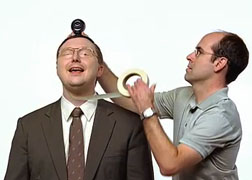 Thanks to the many readers who responded to my post about Bloggingheads. Here are a few sample responses.
On his blog, Jim Hu says no, or maybe hell no. Sample: "I find the whole thing just annoying as hell. I've never actually watched one from start to end, or even from start to middle. I'm not sure why I can't stand Bloggingheads."
Alex Massie, by contrast, likes the format: "It's a fun format--and a welcome alternative to the brain-rotting tedium of the so-called cable news channels. So, I do hope you'll be appearing again."
Ted Frank recommends the addition of transcripts: "Bloggingheads is so not worth the trouble, at least until they come up with automatic-transcription software. I read blogs precisely because I don't find it a productive use of my time to watch clever repartee on tv news shows. The comparative advantage of the blogosphere is quick-reaction-publishing, the ability to go into detail that one can't in the MSM, the ability to digest it a post in one-minute chunks while one is gathering one's thoughts, and the power of computer search engines and RSS feeds to quickly find what you want to read and ignore what you don't want to spend time on. Bloggingheads has none of those advantages. I've almost stopped reading Kaus's blog because there are so many links to bloggingheads that tell me nothing about what I'm going to hear. And I would say this even if it didn't crash my computer a third of the time."
Doug Anderson shares my own preference for audio: "I enjoyed you being on Blogging Heads, although I obviously can't evaluate whether it is worth the trouble. I seldom actually see Blogging Heads (and your episode was no exception) as I listen to the podcasts (which are audio only instead). I download the podcasts via RSS and video is not available this way."
And then there's Joseph Britt: "Honestly, Virginia, I can't think which is more absurd: the idea that you have nothing better to do with your time than spend it on internet talk video or the idea that I have nothing better to do with my time than sit motionless in front of my monitor for an hour watching you."
In the end, I wound up deciding not to do any more appearances, at least in the short term, for reasons that have nothing to do with the format. Bloggingheads can't handle Macs. The audio and video get out of sync. I decided that dealing with the technical problems wasn't worth the trouble of anyone involved. There are plenty of interesting PC-using bloggers out there. Check out the latest entries here.
Posted by Virginia Postrel on March 19, 2007 • Comments