In his new book The Age of Abundance: How Prosperity Transformed America's Politics and Culture, Brink Lindsey argues that mass prosperity (by historical standards) fundamentally altered American political and cultural debates, shifting them from arguments over wealth distribution to more cultural/spiritual concerns. The "culture wars" are, in this view, a result of prosperity. I think he's basically right.
Certainly, anyone transported from the 1920s, or even the 1960s, would think we were living in a material paradise. But memories are short, people tend to romanticize the past, and expectations increase along with the standard of living. Luxuries like air conditioning or restaurant meals, even at fast food joints, become necessities.
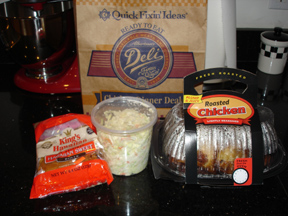
Here's what I bought at the supermarket Monday for $6.00. (The minimum wage is $5.15 an hour.)
That's dinner for a family of four, or at least it was before portion bloat, and it's already prepared. A fried chicken was even cheaper.
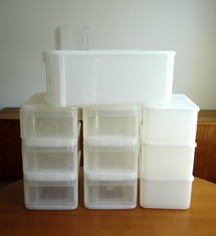
We have so much stuff you can run a wildly successful and much-admired business selling boxes to put it in. In fact, these Container Store shoe boxes are stacked up waiting for someone I met through Freecycle to pick them up. We have so much stuff, people organize self-help networks to give it away. For more on Freecycle and "unconsumption" (or, perhaps more accurately, deconsumption), check out these posts from Steve Portigal's blog. (If you found my Forbes article on self-help networks interesting, be sure to check out Steve's posts, particularly the earliest one.)
Unlike some people, I don't see abundance as problem or a sign of decadence. I think it's great. But it does pose challenges. Just because you can have "everything" (not literally) doesn't mean you'll be happier if you do. And, as the Container Store's success suggests, the problems of sorting and storage become serious. I have no problem managing the shoes and clothes, but books are another matter. I haven't counted, but it's safe to say we have thousands, very few of them disposable. In late summer, we'll be moving back to L.A., and our place there is much smaller. Even with lots of Container Store products and consulting, I have to carefully scrutinize book acquisitions. So when I tell you I'm happy to add The Age of Abundance to my library, you should consider that a strong "Buy" recommendation.
Brink has also started (actually re-started) a blog at BrinkLindsey.com.
Posted by Virginia Postrel on May 03, 2007 • Comments
Tom Simon, Chicagoland's go-to guy on kidney donation, has updated his blog, with a post explaining why signing your driver's license won't make you an organ donor in Illinois. And he's got YouTube video of his local TV appearance.
Posted by Virginia Postrel on May 03, 2007 • Comments
"Where are You Mr. Pine?," wrote a reader named Steve Winslow on the Amazon page for Mr. Pine's Purple House back in March 2000.
I'm 32 years old with a 2 year old daughter and a boy due April 10th. For some strange reason I felt the need to look to see if this book was still out there. I'm touched that this book made such an impact in others lives as well as my own. Please reprint this book whomever has the rights to it, so my children and others may hear the tale of Mr Pines determination and perserverence in the face of peer pressure.
Later that year, Winslow and other fans of Mr. Pine got their wish. Thanks to an entrepreneurial publisher, Mr. Pine's Purple House was back in print. Since fall 2000, it has sold about 12,000 copies. In a short piece on The Atlantic's website (link good for three days), I tell the story of how that happened.
Posted by Virginia Postrel on May 02, 2007 • Comments
My latest Atlantic column (link good for three days) looks at neighborhood paint wars: If people care about the looks of not just their own house but the neighborhood as a whole, what do you do about nonconformists?
It's a difficult question that I dealt with in more depth--though with less colorful examples--in chapter five of The Substance of Style, excerpted here by Reason.
Posted by Virginia Postrel on May 02, 2007 • Comments
The geniuses in the Pentagon have decided that soldiers shouldn't be allowed to send emails or post to blogs without clearing the content with a superior officer. (And we know officers in the field have nothing better to do than play editor/flack.) The link above is to BlackFive (via InstaPundit), where there's lots more, including the Wired.com report that should set off a firestorm among people on every side of the war issue. Soldiers have the strongest incentives not to reveal operational details. So why hide their points of view?
Posted by Virginia Postrel on May 02, 2007 • Comments
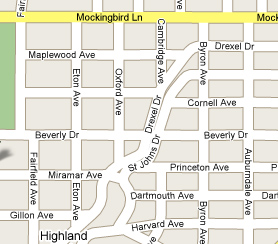
Do street names affect housing values? A fun, if unresolved, discussion on the Freakonomics blog. (The map is from Highland Park, the Beverly Hills of Dallas. The major artery north of Mockingbird Lane, back in Dallas proper, is Lovers Lane.)
Posted by Virginia Postrel on May 01, 2007 • Comments
As the vacuum cleaner remark suggests, I was suspicious of the panic over mercury in fluorescent lights--a concern in their production, perhaps, but not to the typical consumer. Reader Robert Horn writes with more information:
The information that you give on CFL safety is partially incorrect. It's amazing how hard it is to get the proper safety information through the public hysteria.
a) The mercury level in the CFL is extremely low. By comparison, one old mercury switch (like in an old thermostat) equals 1,000 CFLs. That silly woman in Maine sounds like the classic self-terrifying idiot who cannot grasp the concept of acceptable levels of toxic substances, and demanded that the government "do something".
b) The safe method of cleanup is a broom and gloves, followed by letting the room air out. The gloves are more for broken glass safety than for mercury risk. Vacuums are specifically a poor idea because they cause immediate mercury vaporization and dispersal of the mercury vapor into the room while you are there. You are probably safe even with your personal dose maximized, but why maximize it unnecessarily. Opening the windows and letting it disperse is a small step, reduces your personal dose, and still exposes the neighborhood by less than the airborne mercury emissions associated with coal powered incandescents.
As for lighting quality, there are significant variations and issues. There are a variety of phosphors used for CFLs, each of which gives a different color balance. CFLs are generally not a good choice when color is significant and must be manipulated. I personally use daylight CFLs extensively, and they give definitely different colors than incandescents. They match a north light (not a direct sunlight) very well. I determine this from a room with a good strong north light, where turning on or off the CFLs is hard to notice during the day because there is no lighting shift. With incandescents or warm-white CFLs (warm white is the most popular phosphor choice) you do see an immediate change when the lights are turned on and off.
The warm-white phosphor (and you must check the labels to get the phosphor that you want) is a reasonable match to warm-white incandescents for most purposes.
For retail color control I would stick to halogens and incandescents until LED lighting is cheaper. At the high end - where you hire a color lighting consultant and control everything about the display - LED lighting is gaining ground. LED lighting is much more expensive to install, but the lights last 50,000 hours and the color temperature can be fine tuned on a bulb by bulb basis and dynamically adjusted for daytime vs nighttime. This kind of expense is justified in some retail environments by the cost savings from the 50,000 hour lifetime (and LEDs use about 1/3 the electricity of incandescents). They never need to shut down the sales operation for bulb replacement and can put the lights anywhere the consultant wants, without much regard for the difficulty of replacing bulbs. But LED lights with color controls cost 10-20 times what a CFL costs. LED lights are still cheaper than color consultants, and their tunability reduces the color consultant time charges significantly.
In many states, however, retailers aren't free to use whichever bulbs they like. Electric bills are, of course, a major cost of operation, giving businesses plenty of incentive to cut costs. One of these days, LEDs will be affordable and people won't understand lightbulb jokes.
Posted by Virginia Postrel on May 01, 2007 • Comments
In response to the post below on light bulbs, my friend Nick Schulz of TCS Daily writes:
We recently installed the new fluorescents in the sockets in our dining room. Last night, my wife and I were sitting down to eat some sushi we'd brought home. She said, "I can't believe they gave us salmon instead of tuna." As it turned out, the new lights made the red tuna look like orange salmon. She took the sushi in the kitchen, where we have the plain old bulbs and are waiting for them to expire to put in the new ones. Sure enough, the tuna in that room looked like tuna.
Also, the new bulbs, I found out after having purchased them, are loaded with mercury. So make sure you don't break any of them. Pick your poison — reduce your carbon footprint but increase your risk of mercury poisoning.
Lastly, a relative of Edison made this point a few weeks back about warm vs. cool lighting
Speaking of mercury, reader Shaun Moore writes, "Tell this woman that CFL are better than incandescents." Hint to bulb breakers: Just get a vacuum cleaner and leave the authorities out of it. (I know mercury is poisonous, but we had so much fun as kids chasing it around the floor when the thermometer broke.)
Posted by Virginia Postrel on April 30, 2007 • Comments
The WaPost's Blaine Harden reports on wifely resistance to compact fluorescent bulbs. The article includes this classic example of technocratic obtuseness:
"There is still a big hurdle in convincing Americans that lighting-purchase decisions make a big difference in individual electricity bills and collectively for the environment," said Wendy Reed, director of the federal government's Energy Star campaign, which labels products that save energy and has been working with retailers to market CFL bulbs.
No, that is not the big hurdle. The big hurdle is convincing Americans that ugly lighting is worth the savings--as Ms. Reed herself knows.
"I have heard time and again that a husband goes out and puts the bulb into the house, thinking he is doing a good thing," Reed said. "Then, the CFL bulb is changed back out by the women. It seems that women are much more concerned with how things look. We are the nesters."
If you want to get people to use compact fluorescents, convince them that the lighting looks good--they already know it saves electricity. And show, don't tell.
Posted by Virginia Postrel on April 30, 2007 • Comments

 We have so much stuff you can run a wildly successful and much-admired business selling boxes to put it in. In fact, these Container Store shoe boxes are stacked up waiting for someone I met through Freecycle to pick them up. We have so much stuff, people organize self-help networks to give it away. For more on Freecycle and "unconsumption" (or, perhaps more accurately, deconsumption), check out these posts from Steve Portigal's blog. (If you found my Forbes article on self-help networks interesting, be sure to check out Steve's posts, particularly the earliest one.)