If a small vocabulary and the frequent use of clichés promote understanding and communal solidarity, the achievement of verbal-intellectual sophistication can have the opposite effect. The more people know and the more subtle they are at expressing what they know, the fewer listeners there will be and the more isolated individuals will feel, not only at large but also among colleagues and co-workers. Let me use an architectural metaphor to show how this can come about in academic life. Graduate students live in sparsely furnished rooms but share a house--the intellectual house of Marx, Gramschi, Foucault, or whoever the favored thinker happens to be. A warm sense of community prevails as the students encounter one another in the hallway and speak a common language, with passwords such as "capital formation," "hegemony," and "the theater of power" to establish firmly their corporate membership. Time passes. As the students mature intellectually, they move from the shared life of a house to rented apartments scattered throughout the same neighborhood. The apartments are close enough that friends still feel free to drop in for visits, and when they do the entire living space is filled with talk and laughter, recapturing as in younger days not only the bonhomie but also the tendency to embrace wholeheartedly the currently headlined doctrine. Eventually the students become professors themselves. They begin modestly to build their own houses of intellect and add to the structures as they prosper. Because each house bears witness to a scholar's achievement, it can be a source of great personal satisfaction. But the downside is, who will want to visit? And if a colleague or friend does, why should she spend time in more than one room?
Social scientists claim that a tenement building where people hang out the washing or sit on the stoop to socialize can be a warmly communal place. By contrast, a suburb with freestanding houses is cold and unfriendly. I am saying that the same may be true of intellectual life as one moves to larger houses of one's own design. Both types of move--socioeconomic and intellectual--signify success, and with both the cost to the mover can be an exacerbated feeling of isolation.
Although Tuan is talking about scholarly communities, the same phenomenon can be found in political or religious groups. There are strong communal rewards for sticking to relatively simple, widely shared language (and the simple, widely shared beliefs it implies).
Posted by Virginia Postrel on May 16, 2007 • Comments
I guess there's not much chance of turning off potential customers on the Upper West Side by turning their choice of storage facility into a political statement. But it's pretty strange.
Posted by Virginia Postrel on May 16, 2007 • Comments
In a typically delightful post, Michael Bierut considers the various reasons graphic designers choose one typeface out of the many possibilities. I'm eagerly anticipating Michael's new book, 79 Short Essays on Design, due out next week.
Speaking of typefaces, if you have a chance, be sure to see the new documentary film Helvetica, now making the festival rounds (showings listed here). Believe it or not, someone made a film about a typeface--once considered THE typeface of modernity and still ubiquitous--and it's a gem. It not only vividly tells the story of the rise and fall and rise of Helvetica but uses the typeface's story to provide insight into competing concepts of modernity and into the eternal tension between the classic and the personally expressive. Michael Bierut, whose interview gets the movie's biggest laughs, wrote about Helvetica, and reminisced about the old days when typefaces were arcane lore, here. [Update: I inadvertently omitted the very important word "about" in the original version of that sentence. Michael appears in Helvetica, but he didn't write the movie.]
Posted by Virginia Postrel on May 15, 2007 • Comments
Jim Fallows discovers a striking difference, which suggests an interesting natural experiment in human capital formation. Which approach will produce a more creative, productive generation: more attention or more autonomy?
Posted by Virginia Postrel on May 15, 2007 • Comments
Earlier this week I was the token non-scientist on a panel to discuss the future of biomedicine at the Biotechnology Industry Association's huge annual convention. (Our discussion is described semi-accurately here.) The big trend I see is the convergence of genomic information, frequent real-time monitoring of metabolic function (I got a laugh by talking about "smart toilets"), personalized pharmacology, and patient activism.
In the Manhattan Institute's online newsletter Medical Progress Today John A. Fossella writes about personalized medicine as it could affect mental health treatments. Here's an excerpt:
More recently, genomic analyses have been synthesized with brain imaging studies so that physicians and researchers might understand how genetic biomarkers that predispose individuals to mental illness can affect brain structure and function. For example, the gene for the serotonin transporter (5HTT) has for many years been shown to contribute to risk for anxiety disorders. The protein encoded by the 5HTT gene is the target of a class of effective antidepressant compounds known as selective serotonin reuptake inhibitors (SSRIs).
In 2002, the first link between variation in the 5HTT gene and brain activity was found to occur in a brain region known as the amygdala, where emotional memories are stored and relayed. Individuals who carry a type of 5HTT genetic predisposition for anxiety were found to have a more active amygdala when viewing stimuli designed to illicit [sic--vp] emotional responses. Thus, a complete synthesis between brain activity, genetic variation and pharmacotherapy has been accomplished, and it is now possible to view the effects of drug treatment through brain imaging. The implications are far reaching, but at face level, serve to match a certain biological process to more effective treatment options.
In order to better realize the promise of this basic research, the NIH Roadmap has recognized and mandated the need for translating these fundamental and highly technical findings into layman's tools that facilitate the everyday relationship between physician and patient. For instance, successful medication selection is one of the most long-standing challenges in psychiatry. Patients taking antipsychotic medication often experience side effects such as tardive dyskinesia, weight gain and diabetes.
Some of these side effects can now be addressed with genetic information; patients with certain variants of the CYP2D6 gene metabolize medications more poorly and thus experience greater risk of side effects. The FDA-approved AmpliChip® provides a clinical platform for screening of this and other metabolic genes. A number of other studies point to the dopamine D3 receptor gene as a mediator of tardive dyskinesia, while other studies have identified specific genetic variants that influence the magnitude of obesity-related side effects.
Michael Mason of Discover takes depressing look at one result of the military's remarkably effective battlefield medicine: an unprecedented number of war veterans who've survived with traumatic brain injuries.
Posted by Virginia Postrel on May 11, 2007 • Comments
WindyPundit Mark Draughn posts a significant clarification to Tom Simon's good-hearted post about changes in the Illinois rules for deceased organ donors (see below). I'm afraid the state's organ procurement organization is using Tom (and me) in a disingenuous campaign. Mark writes:
What changed in Illinois is that your consent to donate your organs on death no longer requires the permission of your next of kin. The procurement team can simply look you up in the registry and take your organs without needing to get explicit permission from your family. They expect to get more organs this way because they can't be stopped by family members who are too distraught to make a decision. (I imagine they can even take the organs over your family's vigorous objections, but my guess is they'll be reluctant to do that.) Both Meis's message and the Donate Life Illinois website explain all this. However, their explanations imply that your consent to donate is invalid until you register, and that's not true.
If you're like me and you signed up as a donor before 2006 then you didn't agree to this new way of doing things. You agreed to donate your organs only with the consent of your next of kin. That has not changed in any way. If you die without re-registering, that will still happen. The procurement team will simply approach your next of kin for permission.
As someone sympathetic to the cause of organ donation, I'm appalled yet fascinated by the ethical contortions the organ establishment goes through while preaching the evils of any compensation for donors. They want more organs, but they hate having to ask for them--whether that means dealing with living donors, getting consent from family members (as in Illinois), or getting consent at all (the "presumed consent" approach, which requires people before they die to take steps to clearly refuse donation). Aside from the ethical problems of overriding a bereaved family's wishes and essentially declaring bodies the property of the state, there's a practical problem: These steps may sound attractive in the short run, but they sow long-run distrust of the system.
I like your example of abundance--a photo of dinner.
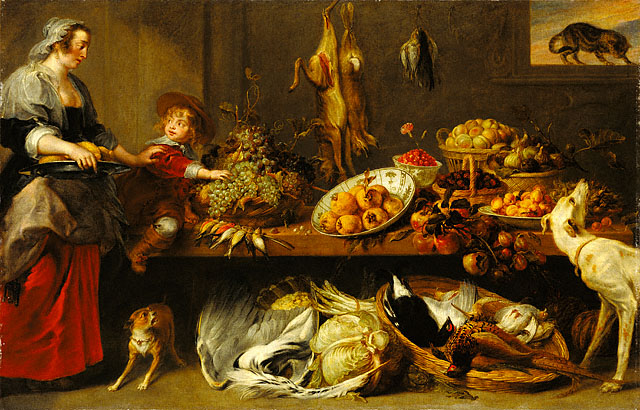
I've always liked renaissance still lifes of tables of food. Food was a natural subject for an artist--familiar, colorful, poseable (and still!), but I think those paintings conveyed a strong sense of the human-scale importance of a meal. The extravagance of commissioning an expensive, giant painting of a table overflowing with food must have been a really strong statement.
Cosmo makes a good point, one that I'll keep in mind next time I'm bored looking at slightly disgusting Dutch paintings of food. (As I mentioned earlier, I prefer architectural paintings, like this or these.)
In his new book The Age of Abundance: How Prosperity Transformed America's Politics and Culture, Brink Lindsey argues that mass prosperity (by historical standards) fundamentally altered American political and cultural debates, shifting them from arguments over wealth distribution to more cultural/spiritual concerns. The "culture wars" are, in this view, a result of prosperity. I think he's basically right.
Certainly, anyone transported from the 1920s, or even the 1960s, would think we were living in a material paradise. But memories are short, people tend to romanticize the past, and expectations increase along with the standard of living. Luxuries like air conditioning or restaurant meals, even at fast food joints, become necessities.
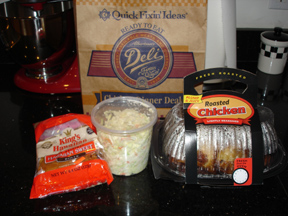
Here's what I bought at the supermarket Monday for $6.00. (The minimum wage is $5.15 an hour.)
That's dinner for a family of four, or at least it was before portion bloat, and it's already prepared. A fried chicken was even cheaper.
We have so much stuff you can run a wildly successful and much-admired business selling boxes to put it in. In fact, these Container Store shoe boxes are stacked up waiting for someone I met through Freecycle to pick them up. We have so much stuff, people organize self-help networks to give it away. For more on Freecycle and "unconsumption" (or, perhaps more accurately, deconsumption), check out these posts from Steve Portigal's blog. (If you found my Forbes article on self-help networks interesting, be sure to check out Steve's posts, particularly the earliest one.)
Unlike some people, I don't see abundance as problem or a sign of decadence. I think it's great. But it does pose challenges. Just because you can have "everything" (not literally) doesn't mean you'll be happier if you do. And, as the Container Store's success suggests, the problems of sorting and storage become serious. I have no problem managing the shoes and clothes, but books are another matter. I haven't counted, but it's safe to say we have thousands, very few of them disposable. In late summer, we'll be moving back to L.A., and our place there is much smaller. Even with lots of Container Store products and consulting, I have to carefully scrutinize book acquisitions. So when I tell you I'm happy to add The Age of Abundance to my library, you should consider that a strong "Buy" recommendation.
Brink has also started (actually re-started) a blog at BrinkLindsey.com.
Posted by Virginia Postrel on May 03, 2007 • Comments




 In 2002, the

 We have so much stuff you can run a


