My New Colleague
Megan McArdle (a.k.a. Jane Galt) has joined The Atlantic's blogging roster.
Megan McArdle (a.k.a. Jane Galt) has joined The Atlantic's blogging roster.
Following the advice in his new book, Discover Your Inner Economist
Drawing on David Hull's classic Science as a Process
Congratulations to Ball of Whacks creator Roger von Oech, who has received a patent on his invention and blogs on the process. As I've written before, Roger markets the ball as a creativity tool but that's just an adult way of saying it's a fun toy. You can order one here, or, better yet, order three and create something like this:
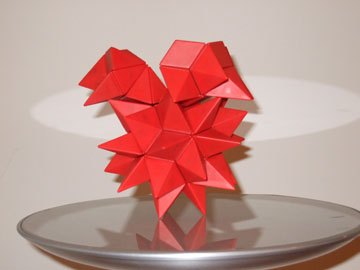
That photo was shot before the move. Our Balls of Whacks are still in a box somewhere.
If I'm in your address book, please change my address to: 2331 Westwood Blvd., #362, Los Angeles, CA 90064. Thanks.
While I've been away, kidney donor Tom Simon has been busy blogging--and defending himself and his donation against an attack in The American Spectator. (The author has apparently never heard of Google, which would have given him plenty of background on Tom.)
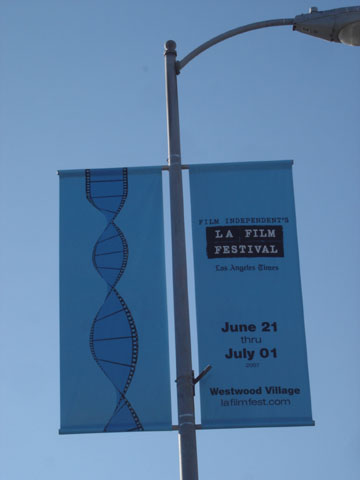 A generation ago, DNA was scary or, at best, exotic stuff. Now, thanks to CSI and its progeny, DNA seems familiar to most people. It's the mysterious substance that frees the innocent and determines the father of Anna Nicole's Smith baby. Everybody "knows" what DNA is. It has a warm, fuzzy image in the public mind.
For audiences who know a little more about it, DNA also has glamour. Understanding how it works doesn't cancel the mystery of life encoded, replicated, and wildly varying. Like a spiral staircase, the very shape of the DNA molecule suggests hidden wonders. As the photo above suggests, even Hollywood wants in on the glamour. The double helix image is bound to break out of nerd culture into more general design use. One example: Grant McCracken blogged from Poland about this woman's double-helix tattoo, complete with base pairs.
Commenter Dan Weber on a Freakonomics blog post about Restless Leg Syndrome:
The obscure diseases that I or someone close to me has are totally real.
The obscure diseases that other people have are just bupkis.
(This is meant to be read ironically.)
I'm particularly sympathetic to this point since the article he's taking issue with starts with a swipe implicitly comparing depression to ordinary sadness, which is rather like comparing the flu to sneezing because you inhaled some pepper grains. Personal interests aside, the more fundamental issue is the way we treat the term disease. If something is a "disease," it is worth treating. If it isn't a "disease," you should just live with it. But why? Why not treat a biological condition you just don't like? (I'm assuming that you are directly or indirectly paying for the treatment.) We don't have to call Restless Leg Syndrome a disease to acknowledge that it disturbs some people's sleep and that those people would like relief. Contrary to what you may have heard, the only sort of character suffering builds is the ability to suffer--a useful ability in a world where suffering is the routine nature of life but not a virtue that makes the world a better place.
 The good news is that we sold our Dallas condo last Saturday, after less than a month on the inventory-rich market. The bad news is that we have to rush to get out of here by August 6. I'm keeping Craigslist busy with ads for stuff that won't fit in our LA place. The latest entry, for the famous Bozart Kaleidoscope doll house, caught the attention of the D Home and Garden blog, which calls it the "coolest doll house ever." One of their sister publications even sent a photographer out to feature it in an upcoming real estate section. I'm rather ambivalent about losing it, so the price is high--unlike the bargain basement prices for the furniture we've been shedding. Anyone need a deal on lateral file cabinets?
In yesterday's Circuits column, the NYT's David Pogue evaluated pen scanners, a gadget I've been thinking about adding to my reporter's toolbox. Alas, they aren't all that accurate. Typical result: "Even on a crisp, perfectly clean laser print of 'The Star-Spangled Banner' lyrics, two of the eight opening lines came out garbled ('Oh say can you see by ~h dawn1s early light'). " OCRs have come a long way, but they still lack the intelligence to put the letters they see in context.
I shouldn't be surprised, given my experiences with old-fashioned optical character reading--a.k.a. reading with my eyes--as I've tried to make out various mysterious characters to enter my many Diet Coke purchases My Coke Rewards. Each bottle cap or 12-pack box has a code that you have to enter on Coke's overdesigned site. The code is long series of random letters and numerals, seemingly chosen for minimum readability and maximum ambiguity--Is that an A or an R? A G or a 6? An M or a W or an N? I routinely take two or three tries to enter the sequence correctly, especially if a bottle cap with a plastic liner is involved. But I drink so much Diet Coke, I figure it's worth it for the free movie tickets. Besides, I might get a blog post out of it.
