In chapter four of The Substance of Style, I write about "costume echoes."
Today's aesthetic imperative overturns the simplistic dichotomy between "rebellion" and "conformity," or "individual" and "mass": The result is selective conformity, an implicit or explicit drive for finer and finer gradations and the looks that identify them. Rather than choose between standing out and fitting in, we conform in some ways and diverge in others, choosing (consciously or unconsciously) a mix of meaning and pleasure, of group affiliation and individual taste. Friends develop what zoologist and author Desmond Morris calls "costume echo," adopting similar conventions of dress and carriage. Morris first identified the phenomenon when he "noticed two women walking down the street who dressed so similarly, they could have been in uniform."
Costume echoes apply to all sorts of surfaces, not just personal appearance. They can exist anywhere, including among organizations, and create new meanings through association. Consider all the late 1990s companies, particularly dot-com startups, that adopted logos with swooshes in them. "When in doubt, add one. Or two, or three," quipped a design consultant. The hopeful symbol of forward thinking even made it into the Gore-Lieberman campaign logo designed by Al Gore. Whatever its early adopters may have intended, the swoosh came to signify its era--not "the future" but "the late 1990s."
Along these lines, Justin Etheredge of CodeThinked explores the programmer dress code, part one and part two. (I had the same glasses as Dorothy Denning in the '70s. Same hairstyle, too.)
[Via Good Morning Silicon Valley.]
Posted by Virginia Postrel on December 11, 2007 • Comments
Beginning with Steven Levy's Newsweek cover story, Amazon's Kindle wireless ebook reader has attracted lots of speculation about the future of literature and lots of skepticism. Some critics hate it because it's not an iPod, others because it's not a book. I haven't seen the Kindle, much less used one, so I have no personal opinion. But Grant McCracken has bought one and has been blogging about it. Bottom line: He likes it very much. "It's a stunner," he says. He chose The Wealth of Nations as his first download, followed by Dan Pink's A Whole New Mind
 , whose price was right. (The Substance of Style
 is also available but Grant, of course, already has a hard copy.)
As the LAT's David Sarno reports, much of the resistance to the Kindle is a combination of expected weaknesses in the first edition of any new tech device--it's hard to find a specific page, for instance--with a gut reaction from people who love books.
They see the book as much more than a physical object. To many lifelong readers and writers, the book is culturally sacrosanct and even intrinsic to literature itself.
"People who care about literature care about substance and permanence," wrote novelist Jonathan Franzen, author of "The Corrections," in an e-mail. "The essence of electronics is mutability and transience. I can see travel guides and Michael Crichton novels translating into pixels easily enough. But the person who cares about Kafka wants Kafka unerasable.
"Am I fetishizing ink and paper? Sure, and I'm fetishizing truth and integrity too."
But how can truth depend on whether the words that express it are printed on an electronic page or a paper one? Are they not words in both cases? Confronted thus, Franzen remained firm.
"Yes, in theory, words are words," he replied. "But literature isn't data. The difference between Shakespeare on a BlackBerry and Shakespeare in the Arden Edition is like the difference between vows taken in a shoe store and vows taken in a cathedral."
Grant, in fact, misses the footnotes in his Kindle version of Cymbeline. But using Shakespeare as to argue that good literature must appear in printed editions is bizarre. Shakespeare presented his plays in oral form, with no footnotes and no flipping between pages. He never published his work. The folio editions came only after his death. And now they're online.
I love books too, and I wouldn't want to relinquish all those individual physical volumes for an electronic reader. But, that said, I had to give up hundreds of books when I moved back to L.A., because there just wasn't room for them all. I buy a lot fewer books than I would if I didn't have to store them (and live in fear of having them fall on my head in an earthquake). So maybe I need a Kindle after all.
Posted by Virginia Postrel on December 10, 2007 • Comments
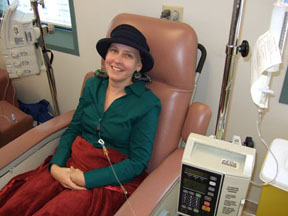
I had my fourth chemo session today, which means I'm more than halfway done. (This photo was actually taken during the third session.)
As the view from my chair demonstrates, the aesthetic imperative has not yet arrived at the UCLA Oncology suite, though the attentive nurses and slightly crowded space create an odd sense of coziness. Most of the patients, including me, sleep most of the time anyway. Intravenous Benadryl is a knockout drug.

For a future column, proposed before I knew how much first-hand experience I was in for, I'd be interested in hearing from readers with thoughts about the design and aesthetics of health care environments.
Posted by Virginia Postrel on December 10, 2007 • Comments
 Just in time for gift-giving, the Ball of Whacks now comes in blue
 .
.
There's also a a multi-color version, including red, blue, and yellow pieces, but we haven't yet cracked that package. And don't forget the red original. (For photos, see my original Ball of Whacks post here.)
Posted by Virginia Postrel on December 09, 2007 • Comments
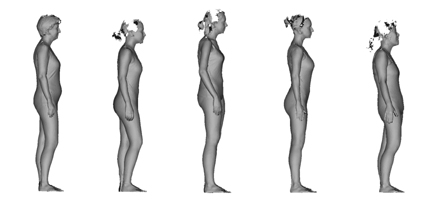
To find out, see my Atlantic column on the problem of clothing fit--now with cool body-scan video.
Posted by Virginia Postrel on December 09, 2007 • Comments


This has been a great year for works about graphic design that offer entertainment and insight for not only for designers but for the rest of us.
The most extraordinary example is Helvetica, a delightful documentary about the 20th-century's most ubiquitous typeface. It's also about modernism, postmodernism, and whatever came after--and about the eternal aesthetic tension between the classic and the expressive. The film made the festival circuit last year, including a stop in Dallas, and director Gary Huswit has been nominated for an Independent Spirit Award. The film also deserves an Oscar nod. It's now out on DVD. I'll have an interview with Hustwit on The Atlantic's website next month.
I'm also a big fan of Michael Bierut's Seventy-Nine Short Essays on Design, many of which originally appeared as longish blog postings on Design Observer. As my niece Rachel, now a design student at Carnegie Mellon, said, "He's so funny." (His moment in Helvetica brought down the house.) He's also charming and smart. Here's a passage from essay 11 that should interest plenty of readers who think they don't care about graphic design:
I just reread The Fountainhead, and I was curious to see how fifteen years of work in the real world would change my take on it. The book is viewed with, at best, kindly derision by most practicing architects and designers I know. But Roark's view toward clients still seems to describe the secret yearning harbored by most of my fellow professionals whether they care to admit it or not; they too might declare, "I don't intend to build in order to have clients. I intend to have clients in order to build."
I was also reminded again how simple the world of design was in 1943, when the book was published. In the tenth grade, when I read Roark's declaration that "A house can have integrity, just like a person, and just as seldom." I could clearly imagine the kind of house he was talking about; it looked like the pictures I had seen of Fallingwater. I had yet to read Complexity and Contradiction in Modern Architecture, which would confuse things a bit by making a fairly persuasive case for things like blue metal balconies.
What surprised me most were the descriptions of the compromises Roark was asked to make. When I read these at twenty, they seemed like impossibly grotesque caricatures: surely simpering clients didn't actually babble nonsense like, "Our conservatives simply refused to accept a queer stark building like yours. And they claim that the public won't accept it either. So we hit on a middle course. In this way, though it's not traditional architecture of course it will give the public the impression of what they're accustomed to. It adds a certain air of sound, stable dignity...." Today this sounds exactly like the kind of quite reasonable stuff I listen thoughtfully to and--God help me--acquiesce to, every day. And at this I began to feel a little depressed.
The book's version of the essay is better, but you can read the original blog post here.
Michael Bierut is one of the prominent graphic designers interviewed in How to Think Like a Great Graphic Designer by Debbie Millman, a branding consultant who hosts a weekly Internet radio program called "Design Matters." (I've been a guest.) Reading a book, I was struck by how it portrayed, through graphic designers, the life of anyone engaged in creative work, particularly those of us who tend toward the unbalanced life. You can read a review of the book here.
Posted by Virginia Postrel on December 09, 2007 • Comments
As long-time readers know, I'm on the board of the Foundation for Individual Rights in Education, better known as FIRE. FIRE's blog, The Torch, is full of good stuff, including a detailed report by FIRE president Greg Lukianoff on his appearance at University of Delaware to discuss the school's invasive residential life educational program, which featured such things as one-on-one interviews in which residential advisers demanded that freshmen give detailed answers to questions like when they first realized their sexual identities. The program got lots of negative attention from bloggers and others, leading the university to discontinue it--at least for now. To give you a sense of the reception, Greg titles his post "Taking My Licks at the University of Delaware."
Not all of FIRE's cases get as much attention--How much have you heard about Hampton University's refusal to recognize a gay and lesbian student group, in direct contradiction of the university's nondiscrimination policy?--but the very existence of the organization gives students and faculty a reliable ally to turn to when academic freedom is under attack. Take, for example, the absurd but true case at Valdosta State in which a student was expelled for peacefully protesting plans to spend $30 million in student fees to build new parking structures.
The best way, by far, to keep up with FIRE's work, and the ideas behind it, is to check out The Torch on a regular basis. And when you're making your year-end charitable donations, please support FIRE. Gifts earmarked to support FIRE's new New York satellite office will be matched by a generous donor.
UPDATE: Blogger Fritz Schrank recounts his experience with a fundraising call from the University of Delaware.
Posted by Virginia Postrel on December 09, 2007 • Comments
 This gallery of mid-century Soviet space illustrations demonstrates that the retro-future wasn't all that different behind the Iron Curtain. (Via Design Observer.)
Posted by Virginia Postrel on November 29, 2007 • Comments
Tyler Cowen calls for more anthropology, in this case of ideology. Grant McCracken, who teaches ethnographic techniques, suggests anthropology as a second career.
Posted by Virginia Postrel on November 29, 2007 • Comments
Daniel Weintraub captures the sad--and fearful--state of the presidential race. (Registration required but this site used to cost $500 a year.)
Wow.
I tuned into the CNN/YouTube Republican presidential debate Wednesday night and was surprised to see so much fear. I thought the GOP was supposed to be the "daddy" party -- all strong and manly. But these guys were quaking in their loafers about any number of threats to our safety and livelihoods. From Islamic terrorism to Chinese manufacturers, European farmers, Mexican laborers and even Canadians (yes, Canadians!), the Republicans seem to think the world is about to take us down. Their solutions vary. Some want to curl up in a little American ball to shield ourselves from attack. Others want to "stay on the offense" with the military to keep the bad guys at bay. Nobody really conveyed a sense of confidence in the future, or in the American people's ability to prosper peacefully in a more competitive world.
Of course, the Democrats are not much better. They deny that the Islamists are a threat but see even bigger monsters in the economic closet and are even more eager than the Republicans to protect us from competition and change.
The sad thing is that these candidates must know that a lot of voters share their insecurities, or they wouldn't try so hard to feed them. But doesn't anybody on the campaign trail speak for dynamism, the creative spirit, innovation, and the potential of individuals to do great things? Doesn't anybody running for president think that Americans can compete -- even thrive -- by participating in, not fleeing, a growing global economy? This is the dawn of the Information Age. The world is changing fast. Yet these folks all sound as if they think it's 1955. The Cold War and the Red scare all over again.
I work in what's commonly thought to be the 21st Century equivalent of the buggy whip industry, yet even I have a far cheerier outlook about the future than any of these guys exhibited last night. It was almost as if they were trying to channel Lou Dobbs, or they were hypnotized by that great CNN fearmonger on their way into the studio.
PS to my Republican friends: I know CNN did a lousy job picking the questions and half of them came from people with links to Democratic candidates and causes. But they didn't pick the answers. The candidates still had their say. And in two hours of yakking, I don't think I heard a single sentence expressing confidence in the ability of individuals to pursue happiness on their own. Isn't that what the Republicans are supposed to be all about?
If you prefer horse-race analysis, check out Robert A. George's debate blogging.
Posted by Virginia Postrel on November 29, 2007 • Comments