Create Your Own Font
Wired.com tells you how. (I wrote about the profusion of fonts here.)
Wired.com tells you how. (I wrote about the profusion of fonts here.)
In chapter five of The Substance of Style (excerpted here), I grappled with a fundamental problem of urban living: the conflict between establishing or preserving a neighborhood's look and feel and allowing individual homeowners to build to suit their own desires. There is no completely satisfactory solution. This Dallas Morning News article demonstrates the particular difficulties posed by trying to establish new rules, even in the best-case scenario where they're fairly general.
The signs, pro and con, have come down, and neighbors who didn't speak for months are reaching out to one another, trying to put the warfare over building restrictions behind them. Still, there are lingering bad feelings, tension as people pass each other on the sidewalks, and a question from both sides about whether the struggle was worth it.
"The ugliest McMansion in the world could be built, and it wouldn't rip neighborhoods apart like this process does," said Josh Doherty, who with his wife, Dawn, and others successfully fought the so-called Maplewood overlay.
Overlay is shorthand for what the city has officially dubbed a "neighborhood stabilization overlay," a zoning device that planners hoped would end unrest over new construction in established neighborhoods.
Instead of peace, overlays in many areas have sparked neighborhood civil wars.
Conceived in 2005, the idea was to give older, established neighborhoods a way to preserve their scale in places where lots have become more valuable than homes and giant new houses have sprouted up, dwarfing their neighbors.
But what resulted in many cases are knock-down, drag-out fights that land before the City Council with the nasty thud of neighbors at each other's throats. [Thanks to reader Tom McKendree for the tip.]
Meanwhile, in my own neighborhood, the folks who lobbied to have the duplexes across the street declared landmarks (discussed in this Atlantic column) are fighting to stop the owner of one of the buildings from adding on two new apartments. While the original plan to tear down three buildings and replace them with new condos did not require a zoning variance to alter setbacks--hence the resort to landmarking--this more-modest plan would. All my neighbors are signing petitions against the change and there's no argument I can make that would convince them the change is in their interest, because it isn't. Forbid any new construction and we preserve our nice view and keep the housing stock tight and our condo values inflated. But, of course, if the same rules and attitudes had prevailed in 1974, we'd have no condos to begin with.
Barack Obama's speech on race in America was remarkable: simultaneously honest and diplomatic, personal and historical. It was empathetic and sought to inspire empathy in its audience, not for Obama but for Other Americans. It also gave evidence, for the first time since Ronald Reagan, of a presidential candidate with an active mind and eloquent voice engaged with big questions. In the mountain of commentary that followed, I found Robert George's reaction most similar to my own. To Robert's comments on the speech's bravery, I'll add that it is most unusual to hear a Democratic politician recall that one of the great barriers to black advancement during Jim Crow was that "blacks were excluded from unions." (What's next, a denunciation of Woodrow Wilson?)
The speech was not just a meditation on race, however. It was also a campaign speech by a candidate with particular policy views, views that place him well to the left of the political spectrum. With lines like "this time we want to talk about the fact that the real problem is not that someone who doesn't look like you might take your job; it's that the corporation you work for will ship it overseas for nothing more than a profit," the speech offered no place in its vision of racial concord for Americans who support open markets, economic dynamism, and limited government. In a serious meditation on race, as opposed to a campaign speech, that's a problem. (Besides to "ship it overseas" is, in fact, just another way of letting "someone who doesn't look like you...take your job." Obama's public empathy doesn't extend to Chinese or Indians. Megan McArdle is very good on this.)
Finally, on a historical note, the speech made me think of another famous oration, Frederick Douglass's 1852 address What to the Slave Is the Fourth of July? And it made me wish that Edith Efron had lived to hear and discuss it.
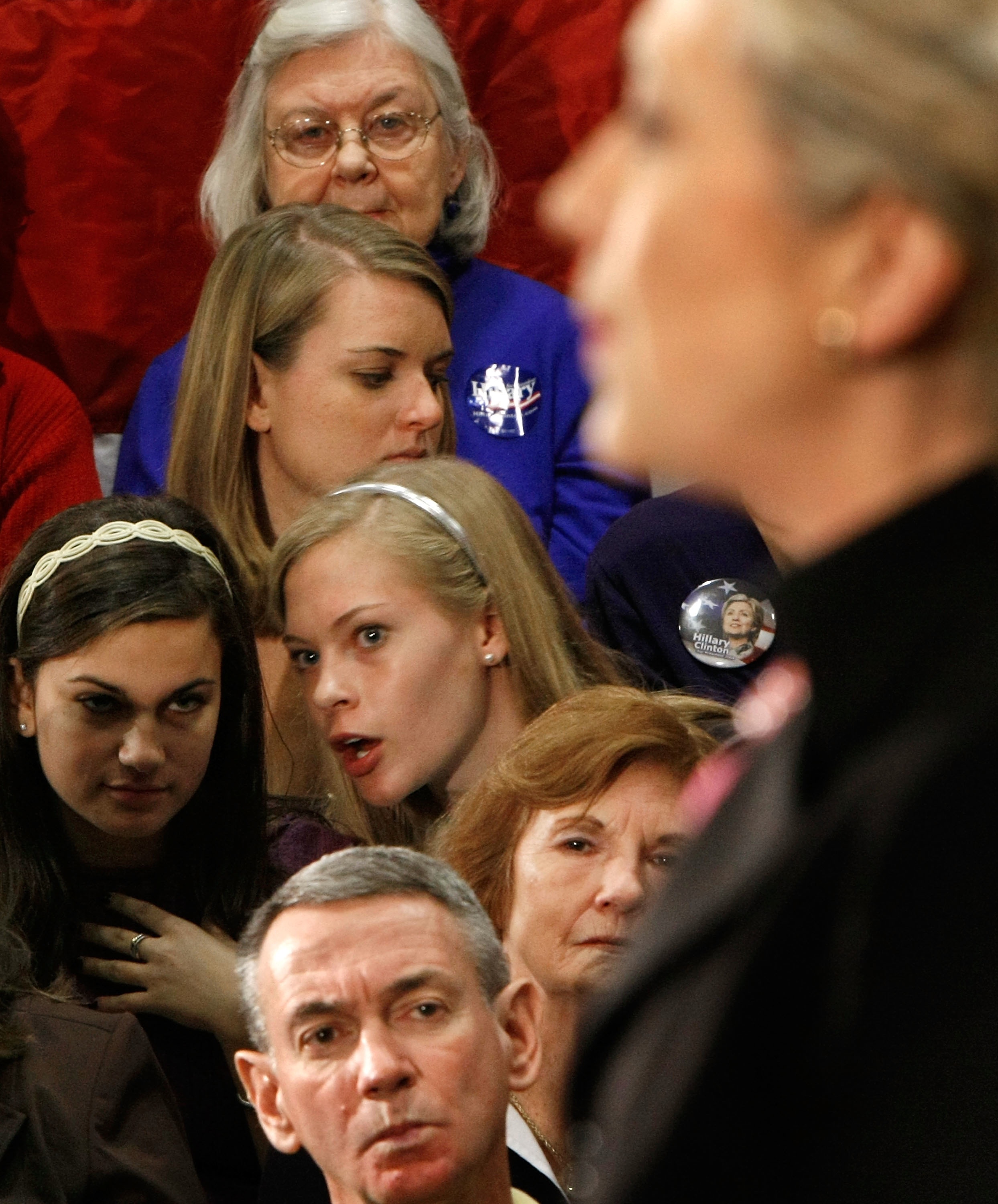 Taken at a speech in my South Carolina hometown, this photo appears in last week's issue of Newsweek, leading off a package of articles on Hillary Clinton's appeal to women. The woman in the back row is my mother. She likes Hillary and found her impressive. But she voted for Obama. [Photo: Getty Images/Win McNamee.]
And The Onion has appropriate video.
Jonathan Chait's recent TNR article masterfully traces John McCain's migration from right to left to right on economic issues.
Even though it is in the public record, McCain's voting behavior during Bush's first term is almost never mentioned in the press anymore. Yet McCain's secret history is simply astonishing. It is no exaggeration to say that, during this crucial period, McCain was the most effective advocate of the Democratic agenda in Washington.
In health care, McCain co-sponsored, with John Edwards and Ted Kennedy, a patients' bill of rights. He joined Chuck Schumer to sponsor one bill allowing the re-importation of prescription drugs and another permitting wider sale of generic alternatives. All these measures were fiercely contested by the health care industry and, consequently, by Bush and the GOP leadership. On the environment, he sponsored with John Kerry a bill raising automobile fuel-efficiency standards and another bill with Joe Lieberman imposing a cap-and-trade regime on carbon emissions. He was also one of six Republicans to vote against drilling in the Arctic National Wildlife Refuge.
McCain teamed with Carl Levin on bills closing down tax shelters, forbidding accounting firms from selling products to the firms they audited, and requiring businesses that gave out stock options as compensation to reveal the cost to their stockholders. These measures were bitterly opposed by big business and faced opposition not only from virtually the whole of the GOP but even from many Democrats as well.
McCain voted against the 2001 and 2003 Bush tax cuts. He co-sponsored bills to close the gun-show loophole, expand AmeriCorps, and federalize airport security. All these things set him against nearly the entire Republican Party....
McCain was best described as a progressive--like Teddy Roosevelt, whom he cited constantly. McCain tended to see politics as a contest between the national interest and the selfishness of private agendas, and he favored a role for government in counterbalancing the excesses of organized wealth. In 2002, for instance, he was asked about the Bush administration's view, with regard to the Enron scandal, that "[t]he company had a duty to inform its shareholders and its employees about things that were going on inside the company. That's not a federal government responsibility." McCain thundered in response, "Well, Theodore Roosevelt would not agree with at least that rhetoric....We have had regulatory agencies always to curb the abuses or potential abuses of the capitalist system."
McCain is an instinctive regulator who considers business a base pursuit. It doesn't help that the senator's personal connections with commerce are largely limited to a highly protected local industry (distributing beer) and outright corruption (the Charles Keating scandal). And he's every bit as moralistic as Hillary Clinton, our would-be national nanny. His first response to something he doesn't like--particularly something commercial he doesn't like--is to ban it. The most extreme, and effective, case of this instinct was his holy war against ultimate fighting, a peculiar cause for a boxing fan and one McCain took up when he was still in his "conservative" stage. Back in 1998, Slate's David Plotz, a fan of the sport, recounted his run-in with the senator:
When I tell people I'm an ultimate fighting fan, they invariably respond: "Don't people get killed all the time doing that?" But no one has ever been killed at the UFC--though boxers are killed every year. No one has even been seriously injured at the UFC. On the rare occasions when a bout has ended with a bloody knockout, the loser has always walked out of the ring.
But this does not impress boxing fans, who are the most vigorous opponents of extreme fighting. McCain sat ringside at a boxing match where a fighter was killed. When I asked him to explain the moral distinction between boxing and ultimate fighting, he exploded at me, "If you can't see the moral distinction, then we have nothing to talk about!" Then he cut our interview short and stormed out of his office.
And, again, I recommend Matt Welch's underrecognized book on McCain The Myth of a Maverick
In a post about Robert Nozick's "Wilt Chamberlain" argument against progressive taxation, Tyler Cowen lays out a milder version of the case, starting with this principle: "A doctor is not required to devote his entire life, or even a part of it, to helping poor kids in Africa, even if he could create greater good by doing so. Personal autonomy matters." Tyler's discussion, and the comments, are worth reading for their own sake, but I was particularly struck by how his seemingly obvious first principle has recently been contradicted--by complaints that African-born doctors are being "poached" by developed countries and should stay where they are. In the LAT, Kerry Howley examines the argument and finds, aside from the moral effrontery of it, an interesting empirical regularity: The African countries that send the most medical professionals abroad are also those that have the most medical professionals per capita.
I am not a Hillary fan, but attacking her for dropping her final g's is culturally moronic. Picking up local accents, especially ones you've spent most of your adult life around, is not a sign of "dumbing down" your speech to pander. It's only natural to speak like those around you, and there's nothing particularly ignorant-sounding about an American dropping g's. Would you attack the junior senator from New York if she used an occasional (and equally non-standard) Yiddishism? The poor woman is stuck with that horrible Midwestern screech. Cut her some slack for softening it with a little bit of drawl.
Of course, I could be a little sensitive on these things, since my native speech pattern involves droppin' g's and I haven't used my full-blown native accent for decades--so long, in fact, that I can no longer recreate the full effect. I pander to the educated elite by sounding less like a country music singer and more like the rest of the intellectual class. One of the pleasures of living in Texas was letting up on the final g's.
Thanks to the many readers who've emailed about my health. A week ago I had surgery. It wasn't as extensive as I'd thought might be necessary, just a larger partial mastectomy than my first one, plus an axillary node dissection, which removed all the lymph nodes under my right arm. I sleep a lot, my arm is sore, and I have a tube coming out of my armpit siphoning lymphatic fluid and (by now only a little) blood into a grenade-size rubber container. But I'm basically OK and, best of all, the pathology report after the surgery indicates that the margins were clear, which suggests that the cancer was fully removed. I should be able to have the drain removed sometime next week. Once I'm healed from the surgery and can lift my right arm above my head, I'll be having radiation every weekday for seven and a half weeks to mop up anything that might be left.
I had my final chemo round a week ago yesterday. The Herceptin regimen takes a year, with a dose every three weeks, but it doesn't knock me out the way the chemo does. Now I have to see lots of doctors to figure out the next step, which is most likely more surgery. As today's WaPost reports, a lot of women in my position opt for a double mastectomy, even though the evidence suggests that such extreme measures aren't necessary to save your life. What the article doesn't say is that surgeons--or at least my (female) surgeon--recommend the double procedure to avoid future paranoia. It's not always the patient's idea and, regardless of the surgeon's preference, it's culturally easier to go all-in (or all out) than to be cautious about surgery.
