Book Review Swag
The NYT Book Review gets scarily enormous piles of review copies, but that's not all--as you can see in this slide show, which begins with a Trojan horse turned candy holder. [Via Paper Cuts.]
The NYT Book Review gets scarily enormous piles of review copies, but that's not all--as you can see in this slide show, which begins with a Trojan horse turned candy holder. [Via Paper Cuts.]
This time in superhero form, from the LAT's Rachel Abramowitz:
WHILE I believe in hope and change, I know some cynics (mostly die-hard Hillary Clinton supporters) who think Barack Obama taps into the same collective yearning as superheroes. He might as well be called Obama-man, political wonder boy, able to leap giant deficits in a single bound, vanquish scores of angry Iraqis merely by batting his doe eyes.
Obama-man has no past. Like all caped crusaders, he is a mysterious cipher, and yet a reassuring figure, like Superman or Spider-Man. And you all know that beautiful, lanky Michelle Obama would look great in her own spandex. Personally, I have more confidence in Obama, and I'd just like to say, what's the alternative? John McCain as the Incredible Hulk?
[Via the skeptical Fishbowl L.A., which needs to read my take on superhero glamour here and Obama's glamour here.]
Not in a huge country of people whose time is worth something. Train buff Charlie Martin explains. Unfortunately, there's no convincing the Europe-is-better true believer who've never traveled more than 500 miles by rail. (Via InstaPundit.)
From an LAT article on black presidents in TV shows and movies:
"It's interesting and fascinating that this happened kind of quickly," said Ali LeRoi, who co-wrote "Head of State" with Rock. "At the time we did the movie, Barack was just beginning his rise in politics. Now he's like one of those great gadgets like the iPhone. Everyone is fascinated."
I think there's something to this analogy, and it doesn't suggest any deep concern for policy. If elected, Obama would be wrong to assume any kind of mandate beyond the glamour of his persona.
Ever alert for new opportunities to regulate business, behavior, and anything else they can think of, California officials are now out to stop personal genetic testing. Wired's Alexis Madriga reports:
Last Monday, the state's laboratory field services group issued 13 cease-and-desist letters to genetic testing companies. Wired.com obtained a copy of the letters (pdf.) from two recipients. And a recent teleconference among regulatory officials confirms the seriousness of the department's intent.
"We [are] no longer tolerating direct-to-consumer genetic testing in California," Karen Nickles, Chief of Laboratory Field Services at the health department, told members of the Clinical Laboratories Advisory Committee on June 13.
Targeted companies include personal genomics startups 23andMe and Navigenics. These services are seen as the leading edge of a new type of health care in which consumers can use their genetic profile to tailor their medical and lifestyle choices. The established medical community, however, is wary of the technology arguing that the medical utility of some tests is unproven. Doctors also complain that direct-to-consumer services bypass them as the gatekeepers and analysts of medical information, which they worry could confuse consumers, not to mention cost them a billing event.
Read the rest, including a politically pointed lead and instructions on how to hear the phone call for yourself, here
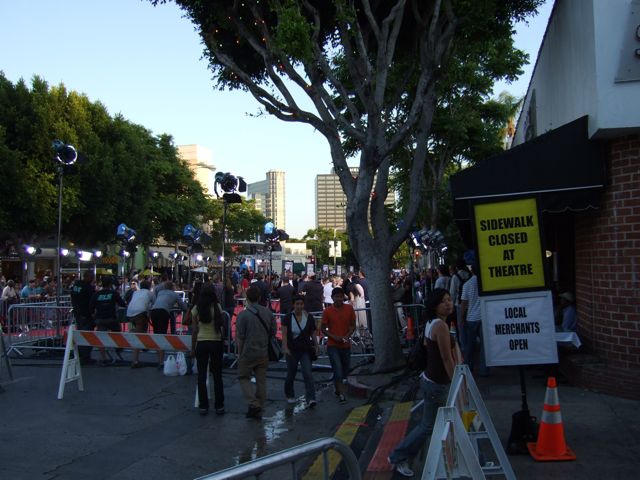
The Get Smart premiere almost blocked my way to the restaurant where I was meeting Professor Postrel for dinner Monday night. I had to go around the block to this semi-open sidewalk.

Mr. Quinto, do you really think viewers will believe that Sylar is Spock?

And then they were all gone. (Click the photos to see larger versions.)
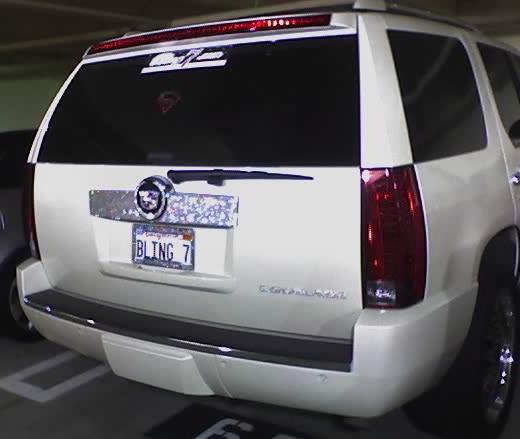
Assuming all the bling isn't meant as an ironic statement, this Escalade I recently saw parked in Westwood is probably owned by someone afraid of being mistaken for his (or her) poorer peers. My latest Atlantic column explains why conspicuous consumption is a sign of social insecurity.
But what explains why the one day I don't tote my camera with me I find the perfect illustration? A parking garage is no place for cell phone photography. You can't even see all the crystals on the Escalade's upper brake light strip.
ADDENDUM: On second thought, this isn't really a good illustration, since crystals on your car (as opposed to the diamonds they're imitating) don't really show much about wealth. They're more about taste--pleasure, rather than meaning.

That's the LAT's photo from the first gay wedding in southern California. Here's another from a nice gallery on LAist:

Neither quite captures what I saw on TV last night: a shot that made me think, "I didn't know Gloria Allred was a lesbian." I'd mistaken the couple's lawyer, who'd made it to the center of the screen, for one of the brides. (She's in the center between the brides at the top photo, on the left next to the crying bride in the second one.) She was even wearing a cream-colored wedding suit just like theirs. Tacky, tacky, tacky. It's their day. Even a publicity-hound lawyer should have the decency to wear something in, say, an attention-deflecting quiet blue.
UPDATE: The Advocate has as many pictures of Allred as it does of the happy couple (3 each, including one with all three of them). This is not just rude. It's bad politics. If you want to get Californians to vote against a state-constitutional amendment to ban same-sex marriage, you should keep the obnoxious leftist lawyers out of sight and highlight the happy families--preferably with kids, mothers-in-laws, grandmas, siblings, etc. joining the celebration.
Dan Weintraub of the SacBee has a clear-eyed take, well worth reading. I could certainly design a much more rational fiscal system than California's, and it wouldn't include Prop. 13, but the politically likely alternatives to the current system--essentially more taxes on everyone and everything--would be much worse. The one thing Dan doesn't mention directly is the anti-development incentives Prop. 13 creates for local governments. (The exception is retail development, which generates sales taxes.)
Matt Yglesias flags another example of the phenomenon I identified in my piece on Obama's glamour (quoting myself): "He attracts supporters who not only disagree with his stated positions but assume he does too." In this instance, as in many others, the issue is free trade. Matt writes:
But Obama's trade-skeptical rhetoric is perfectly consistent with his record. Admittedly, it's a pretty short record. And maybe he doesn't mean what he's saying. Or maybe he does mean it, but could be talked out of it once in the White House. But maybe not! Really, who among us is in any position to say? But he's a charismatic guy, so people see what they want to see.
Obama is a charismatic guy--at least in the stage presence sense of charisma--but it isn't charisma that makes free-traders like the WaPo's Sebastian Mallaby think he's secretly on their side. It's glamour, and the difference has political implications.
Charisma is a personal quality that inspires followers to embrace the charismatic leader's agenda (an agenda that, in the original sense of the word charisma, is seen as divinely inspired.) Glamour, by contrast, encourages the audience to project its own yearnings onto the glamorous figure. So, in this case, Sebastian Mallaby imagines that Obama will find "a way of crawling back from his embarrassing talk of reopening NAFTA." Mallaby maintains his own views about what's good for economic growth; he doesn't defer to Obama's own vision.
When voters motivated by charisma disagree with the leader they've backed, they support him anyway and possibly even change their minds about the right policy course. When voters motivated by glamour disagree, they become disillusioned and angry.
I wrote more on charisma versus glamour here, giving Obama credit for not embodying political charisma. I certainly hope he doesn't.