The hardest economic question is, What comes next? What, in other words, are the new sources of economic value? How can businesses grow and our standard of living rise?
Sometimes the answer is simply more of the same. Growth comes from rolling out existing goods and services to new markets, until there's a chicken in every pot and a car in every garage. This kind of progress may be hard to achieve, but you at least start with a clear notion of what it would look like.
That's why catch-up economies like China today or South Korea in the past can grow so fast. Their businesses don't have to figure out what to make or sell. They know what's possible by looking abroad, and have a reasonable idea of what consumers, local or international, want to buy. Refrigerators and air conditioning are popular; so are shampoo and disposable diapers.
At the economic frontier, the hardest question gets much harder. You no longer have a clear vision of the future. You know neither what's possible nor what people want. You can only guess. Starbucks or FedEx may sound obvious in retrospect, but they were once crazy ideas.
This challenge makes it harder for advanced economies like the U.S. to grow. It also explains a strange cultural phenomenon: our nostalgia for the future.
A half century ago, "the future" seemed specific and tangible. Progress meant either big increases in what we already had—houses, cars and appliances for everybody—or exciting new ways to provide the same broadly defined goods—jet packs, flying cars and superhighways for transportation, nuclear power for electricity, videophones for communication. Either way, progress was something you could easily visualize. Nowadays those mid-century illustrations representing "the future" generate a mixture of amusement and longing, even in people too young to remember the original context.
We still tend to equate progress with engineering projects providing familiar, easily visualized goods. All those new highways, railroads and skyscrapers in China mimic our past, but we see them as the future. Or witness the State of the Union address, in which the president invoked the space race and interstate highway system—the futurism of the mid-20th century—to promote their contemporary equivalents: clean energy, electric cars and high-speed rail. That's progress you can picture.
But at the economic frontier, the big advances rarely look like that. There are occasional headline grabbers, of course, like the Web browser and all the disruptive enterprises that followed from it. Even these are surprises. The president could extol Google and Facebook as examples of American innovation only because they're already everyday experiences. Nobody saw them coming. The same is true of Starbucks and FedEx, hip-hop and Nike, Wal-Mart and Pixar. They aren't the future we imagined.
People who oppose changing the law to permit financial compensation for kidney donors sometimes argue that introducing money might change the social norms that now encourage donation and actually reduce donations.
On Dec. 23, Ronald Herrick gave a kidney to his twin brother. On Dec. 27, he died — 56 years later.
Mr. Herrick, who was 79 when he died last month of heart ailments, was the world's first kidney donor. Despite the experimental nature of the surgery, he recovered fully. His remaining organ expanded to do the work of two.
Back in 1954, a kidney transplant was only conceivable between identical twins like the Herricks. Today, thanks to immunosuppressant drugs, donors and recipients require little more than compatible blood types. With laparoscopic techniques, the largest incision required is just a couple of inches long, allowing a hospital stay of only two or three days.
But cultural norms haven't kept up with medical advances. "People have called me crazy and looked at me like I have two heads," says Diane Zocchia, who gave her cousin a kidney five years ago and works for the National Kidney Registry, a nonprofit group that facilitates living-kidney donation. "When they find out there is no financial gain," says Ms. Zocchia, "they really think you're nuts."
More than 87,000 people are on the national waiting list for kidneys from deceased donors, a number that is growing steadily. In Los Angeles County, the average wait is now more than 10 years. Only living donors can make up the difference, and that requires changing attitudes.
This is a story about artisanal cheese and hand-polished wooden toys, organic spinach and exquisitely smocked baby dresses — the burgeoning small-scale economy so beloved by members of the "creative class." But it's also about another, much-discussed growth industry: the production of political cynicism among formerly idealistic Americans.
The story begins in 2007, an unusually good year for Peapods Natural Toys and Baby Care, in St. Paul, Minn., and many similar mom-and-pop businesses. Frightened by news that toys made in China contained unsafe levels of lead, customers were looking for alternatives to the usual big-box offerings. Just as organic farmers gain market share whenever there's a food-safety panic, the lead scare boosted sales of artisanal children's goods. "People wanted made-in-USA products, and we were the only place in town that had them," says Dan Marshall, the owner of Peapods. Vendors offering organic materials and a personal touch seemed poised to prosper. But the short-term boon soon turned into a long-term disaster. In response to the lead panic, Congress passed the Consumer Product Safety Improvement Act, or CPSIA, by an overwhelming majority. The law mandates third-party testing and detailed labels not only for toys but for every single product aimed at children 12 and under.
"It's everything from shoes to hair bows, Boy Scout patches and bicycles — it's everything," says Mr. Marshall. But few people producing or selling artisanal kids' products even realized that the CPSIA applied to them until months after President George W. Bush had signed it. By then it was too late.
The new issue of Reasoncarries a short item I wrote about politics and glamour. A regular Reason feature, the assignment was to come up with a short, three-item list. It's not online yet, and the published version was a bit truncated for reasons of space, but here's what I originally wrote, complete with links not available on paper.
1. Glamorous political figures are rare. Unlike charisma, glamour isn't a personal quality a politician can possess. It's a product of imagination that requires mystery and distance, which are hard to maintain in a political environment that prizes familiarity and full disclosure. Glamour also tends to dissipate once you're in office and have to take specific positions, thereby disillusioning some of your supporters. See Barack Obama.
2. Glamorous policies are common. As a nonverbal form of rhetoric, glamour is one of the most common ways of selling policies, from single-payer health care to the abolition of the income tax — not to mention countless military actions, perhaps the oldest use of glamour in politics. My favorite recent examples, because of the alluring imagery involved, are high-speed rail and wind energy.
3. Political glamour is most seductive when it's selling systems that promise an escape from complexity and compromise. Whether expressed in full-blown communism, Western European socialism, or American technocracy, the glamour of top-down planning shaped 20th-century politics. F.A. Hayek lamented classical liberalism's lack of similar Utopian inspiration but, in fact, Ayn Rand was masterful in her use of glamour. She knew not only how to tell a romantic story of struggle and triumph but how to create glamorous snapshots that focused her audience's yearning for freedom and fellowship. Hence the persistent, if illusory, appeal of recreating Galt's Gulch in the real world.
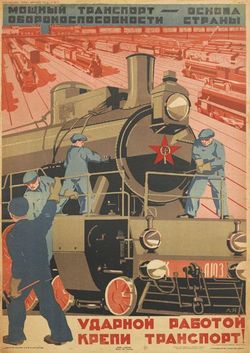
[Soviet propaganda poster "POWERFUL TRANSPORT - THE BASIS FOR DEFENSE CAPABILITY OF THE COUNTRY," 1931, on auction at Swann Galleries February 8, image courtesy of Swann.]
Posted by Virginia Postrel on February 04, 2011 • Comments
As if he'd read my mind (or my blog), Pete Calcagno, my host at the College of Charleston, sent me the video file of my talk today. The version below should work in various formats, including those for mobile devices. (It takes a moment to get started, so please be patient.)
Posted by Virginia Postrel on December 15, 2010 • Comments
In the AIGA's Voice Paul Patton has an interesting article, quoting me, about how luxury car makers are extending good aesthetics to their navigation systems. The opening:
Dragons have begun to appear on our dashboards and sea serpents on our mobile devices. The screens of our navigation units have very quietly, almost without our noticing, begun to acquire decorations like those of ancient maps: fictional elements, like the monsters than once warned sailors against traveling too far, the full-cheeked mythological figures of winds, the elaborate florid geometry of the compass rose.
Most GPS (global positioning system) manufacturers such as Garmin, TomTom and their digital media ilk have made maps abstract again. The perfectly highlighted green and red pushpins that mark the beginning and end of my usual journey suggest huge water tanks along the New Jersey turnpike. Even the most barebones functional maps are decorated with notional, stylized green hills and puffy clouds that garnish the roads on our navigation screens.
Choices among parallel lanes and schematics of freeway exits ahead are often represented by bold rods or ribbons. The design is in the tradition of John Ogilby's coaching maps of Britain, circa 1675, in which each road is depicted independently, like a literal scroll that is being unfurled. These are charming effects. But a new generation of units have brought glitzier effects and something like luxury to the dashboard.
"Luxury vehicles promise to deliver 'the best,' whatever that may mean," says Virginia Postrel, author of The Substance of Style, who is working on a book about glamour. "That means giving drivers not just the most up-to-date technology — something that they can also get in much cheaper cars — but the most beautiful. Elegant displays, which extend sensory perception, contribute to the feeling of mastery."
When I published my WSJ column on the glamour of high-speed rail and wind turbines — which, like most glamour, is more about images, whether photographs or mental pictures, than reality — many rail advocates objected that highways and air travel had also been sold with glamour.
Although not relevant to the distinction between private indulgences (e.g., dresses) and public subsidies at the end of my column, the point is quite true. The "lost glamour of air travel" is a cliché, of course. But highways were equally glamorous in the mid-20th century. They promised swift, smooth travel with never a traffic jam. Unlike passenger rail, which tends to suffer from underuse, both highways and airplanes lost their glamour to popularity.
Thanks to this post on Matt Novak's great PaleoFuture blog, I discovered this vintage bit of highway glamour. (Be sure to check out the restored Magic Highway stills on Matt's blog, as well as my DeepGlamour Q&A with him.)
Posted by Virginia Postrel on December 15, 2010 • Comments
When Robert J. Samuelson published a Newsweekcolumn last month arguing that high-speed rail is "a perfect example of wasteful spending masquerading as a respectable social cause," he cited cost figures and potential ridership to demonstrate that even the rosiest scenarios wouldn't justify the investment. He made a good, rational case — only to have it completely undermined by the evocative photograph the magazine chose to accompany the article.
The picture showed a sleek train bursting through blurred lines of track and scenery, the embodiment of elegant, effortless speed. It was the kind of image that creates longing, the kind of image a bunch of numbers cannot refute. It was beautiful, manipulative and deeply glamorous.
The same is true of photos of wind turbines adorning ads for everything from Aveda's beauty products to MIT's Sloan School of Management. These graceful forms have succeeded the rocket ships and atomic symbols of the 1950s to become the new icons of the technological future. If the island of Wuhu, where games for the Wii console play out, can run on wind power, why can't the real world?
Policy wonks assume the current rage for wind farms and high-speed rail has something to do with efficiently reducing carbon emissions. So they debate load mismatches and ridership figures. These are worthy discussions and address real questions.
But they miss the emotional point.
To their most ardent advocates, and increasingly to the public at large, these technologies aren't just about generating electricity or getting from one city to another. They are symbols of an ideal world, longing disguised as problem solving. You can't counter glamour with statistics.
For future writing, I am still collecting examples of glamorous wind-turbine imagery, particularly when it's used not to represent literal wind farms but to suggest such ideas as innovation, progress, and optimism. If you've seen such examples, please send me an email at vp-at-dynamist.com or comment here.

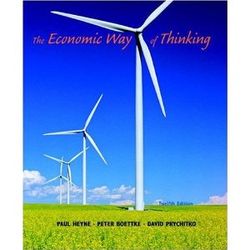
 , an excellent free-market introduction to economics that has little to do with wind turbines.]