In my first column for Bloomberg View, where I'll be appearing every other Friday, I compare "The Oprah Winfrey Show" to two other media phenomena that also debuted in 1986: Spy magazine and the American Girl line of dolls and books. Here's the opening:
In her 25 years hosting her eponymous show, Oprah Winfrey changed lives, most notably her own, but she did not change American culture. Rather, she revived and extended an old American phenomenon: the tradition of middlebrow self-improvement that many observers assumed had died in the anti-authority turmoil of the 1960s. While anything but radical, this achievement was nonetheless remarkable.
To understand its significance, positive and negative, consider two other media institutions that also debuted in 1986. The first is Spy magazine, defunct since 1998. Enormously influential, particularly in New York media circles, Spy pioneered the snobby, snarky cynicism that many writers under 50 still equate with sophistication. Spy did change the culture.
Both Spy and "The Oprah Winfrey Show" sold gossip and personal stories. Both made their audiences feel like members of a club of superior people. Both were self-congratulatory. But the bases for their self-congratulation were, of course, very different. Spy and its audience prided themselves on being wised-up, clever and edgy; Oprah and her audience on being empathetic, optimistic and resilient. If "Oprah" was about uplift, Spy was about putting people in their place.
Winfrey was one of the magazine's earliest targets. A profile in Spy's third issue mocked her weight, her "poodlish starlet's existence," her exuberance and her frank yearning to be rich and famous. Calling her a "binge dreamer," author Bill Zehme compared her to the delusional, self-dramatizing Norma Desmond of "Sunset Boulevard."
I have ended my WSJ column and will be writing for Bloomberg View when it debuts in late May. To receive links to my articles and other info on my work, you can subscribe to my email list by sending an email to [email protected].
Posted by Virginia Postrel on April 24, 2011 • Comments
You can see the other videos by scrolling down the page here.
I think the dynamic described in the talk, and in Colin Campbell's book, is a real one. But I don't believe that all consumption is disillusioning. Although any given artifact may, as Henry Petroski's work on innovation suggests, provide ideas for improvements, that doesn't mean we don't enjoy it. And, of course, some products actually provide even more enjoyment than expected, which may be one reason the iPad is selling so well.
For the past week, I've been complaining that journalists covering possible radiation dangers from Fukushima plant have abandoned the old convention of putting radiation exposures in context (usually by comparing them to chest x-rays). The result is that all "radiation" sounds equally dangerous, and people in Plano, Texas, start stocking up on potassium iodine.
Randall Munroe of the priceless xkcd has put together a serious, and seriously useful, graphic that elegantly supplies an abundance of context. It's too big to reproduce here, so go see it here.
Lastly, remember that while there's a lot of focus on possible worst-case scenarios involving the nuclear plants, the tsunami was an actual disaster that's already killed thousands. Hundreds of thousands more, including my best friend from college, are in shelters with limited access to basic supplies and almost no ability to contact the outside world. If you're not sure how to help, Google's Japan Crisis Resource page is a good place to start.
Posted by Virginia Postrel on March 20, 2011 • Comments
When Apple introduced the iPad last year, it added a new buzzword to technology marketing. The device, it declared, was not just "revolutionary," a tech-hype cliché, but "magical." Skeptics rolled their eyes, and one Apple fan even started an online petition against such superstitious language.
But the company stuck with the term. When Steve Jobs appeared on stage last week to unveil the iPad 2, which hit stores Friday, he said, "People laughed at us for using the word 'magical,' but, you know what, it's turned out to be magical."
Apple has long had an aura of trend-setting cool, but magic is a bolder — and more provocative — claim. In a promotional video, Jonathan Ive, the company's design chief, explains it this way: "When something exceeds your ability to understand how it works, it sort of becomes magical, and that's exactly what the iPad is." Mr. Ive is paraphrasing the famous pronouncement by Arthur C. Clarke, the science-fiction author and futurist, that "any sufficiently advanced technology is indistinguishable from magic."
So in celebrating the iPad as magical, Apple is bragging that its customers haven't the foggiest idea how the machine works. The iPad is completely opaque. It is a sealed box. You can't see the circuitry or read the software code. You can't even change the battery.
Apple has long had an aura of trend-setting cool, but magic is a bolder — and more provocative — claim. In a promotional video, Jonathan Ive, the company's design chief, explains it this way: "When something exceeds your ability to understand how it works, it sort of becomes magical, and that's exactly what the iPad is." Mr. Ive is paraphrasing the famous pronouncement by Arthur C. Clarke, the science-fiction author and futurist, that "any sufficiently advanced technology is indistinguishable from magic."
So in celebrating the iPad as magical, Apple is bragging that its customers haven't the foggiest idea how the machine works. The iPad is completely opaque. It is a sealed box. You can't see the circuitry or read the software code. You can't even change the battery.
My latest WSJ column takes up a perennial question. Here's the opening:
The Academy Awards show is ridiculous. Guests arrive in broad daylight wearing the most formal of evening gowns. Presenters, including some of the world's most accomplished performers, read their lines with the studied cadence of high-school commencement speakers.
In contrast to the Super Bowl, a beauty pageant or "American Idol," nothing happens on stage that affects the outcome of the competition. The production numbers are just padding. And, of course, the speeches are boring, the show is too long, and comedies never have a chance.
Yet the Oscar ceremony somehow manages to be compelling. In a good year like 2010, its U.S. audience tops 40 million, according to Nielsen Co. In a bad year like 2008, it tops 30 million. By contrast, the recent Grammy ceremony, which offers far better musical numbers, won its week with only 26.7 million viewers.
The Oscar show's appeal can't just be the fun of water-cooler criticism. You can get all the information you need for that from Twitter or the next day's newspaper. You don't need to sit through the awards ceremony.
In fact, as the marketing efforts of the Academy of Motion Picture Arts and Sciences suggest, the glamour of the Oscars lies not in the movies the show ostensibly celebrates, but in the "Oscar moment." Watching the Oscars gives viewers the chance to imagine being singled out before the whole world as special, beloved and really good at their jobs.
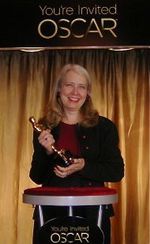
To promote the show, the Academy is giving fans in New York City two different chances to pose holding Oscars, either virtual statues or, at Grand Central Terminal, real ones. There, "the big payoff is that you get to go on stage and have your Oscar moment," says Janet Weiss, the Academy's director of marketing. Some people, she says, even show up in gowns and tuxes.
Read the rest here. That's my photo to the right, taken on Friday in Grand Central.
As you've no doubt noticed, I don't post much here any more. I do a lot of quick, bloggy posting on my Facebook page and on Twitter (@vpostrel and @deepglamour, depending on subject matter). And I still edit a group blog at DeepGlamour.net, which usually has two or three new posts a week.
I write every two weeks in the WSJ's Saturday "Review" section. To receive links to my articles via email send an email to [email protected].
Posted by Virginia Postrel on February 17, 2011 • Comments



 .
.