That's my reaction to the Supreme Court's 5-4 Kelo ruling that it's OK for cities to use eminent domain to take homes and businesses, even in "non-blighted" areas, to turn the property over to other businesses. Once again, I find myself wishing that Douglas Ginsberg hadn't withdrawn as a Supreme Court nominee. His presence would have changed the result in Kelo.
For lots of informed commentary, and good links, see the Volokh Conspiracy.
I agree with Glenn Reynolds, who observes that Kelo may prove analogous to "Bowers v. Hardwick decision, which didn't make new law, but which led to a sea-change in public attitudes." Bowers was the 1986 ruling, also 5-4, that upheld Georgia's criminal statute against private, consensual oral or anal sex. The ruling galvanized efforts to repeal anti-sodomy statutes, to challenge such laws under state constitutions, and, ultimately, to get Hardwick overturned by the U.S. Supreme Court.
Glenn notes that Bowers, unlike Kelo, "was consistent with the law going all the way back." That's not the only difference. Bowers upheld laws that most Americans assumed were essentially symbolic and unenforced. One reason the decision was so shocking was that Mr. Hardwick had actually been arrested in the privacy of his own bedroom, demonstrating that the laws could have real-life consequences. Still, even sodomy law supporters didn't want stricter enforcement. Bowers wasn't going to lead to systematic police sweeps of the nation's bedrooms.
Kelo, by contrast, isn't about cultural symbolism and largely unenforced law. It's about common practices. American cities quite regularly take property from some private parties to give it to other, usually wealthier ones. Now that practice has the Supreme Court's blessing. Kelo could very well lead to much more aggressive use of eminent domain for "economic development." Bowers was offensive, but Kelo is scary.
That's all the more reason to crank up the grassroots activism. Cities can legally bind themselves not to abuse eminent domain. On (of all places) D Magazine's Frontburner blog, a local lawyer points to a charter amendment passed by the citizens of Carrollton, a Dallas suburb, in 1998:
"Provided, however, nothing included above or anywhere in this charter shall authorize the City of Carrollton, or any corporations, agency or entity created by the City, or pursuant to the City's approval and authorization, to institute and exercise the power of eminent domain to acquire private or public property if the purpose of the acquisition is the promotion of economic development for a private business enterprise which business enterprise would own any right, title, or interest in the property so acquired." (Emphasis added.)
The Institute for Justice, which brought the Kelo case, is organizing grassroots efforts via its Castle Coalition. (Steve and I are donors to IJ and this site is running the Castle Coalition's Blogad without charge.) From their site:
Right now, there is a tremendous momentum against this abuse of power, and we ask each of you to begin organizing to change the law in your city or county or state. The Castle Coalition will help you write the language, but now is the time to start organizing your friends and neighbors. Your local government will tell you there's nothing to worry about, that it would never use eminent domain, or that it's only as a "last resort." Don't believe a word of it. Your only protection is a change in the law (or good state court rulings, which is what the Institute for Justice is working on).
While Kelo rightly sparks the immediate demand for political action, motivated by a visceral sense of injustice, over the long run a lot of intellectual work needs to be done. Kelo is the logical result of the argument that spillovers of any sort--in this case, the positive effects of business development--constitute externalities, and that externalities justify government intervention. What's wrong with that argument? If it's fine for air pollution (as I believe it is), why doesn't it apply to refusing to sell your house to a business that would enrich the local area? Why doesn't it apply to offensive speech?
These are not easy questions, and they need to be asked. As political scientist Aaron Wildavsky warned before his untimely death in 1993, "externality" (and even "pollution") is an elastic, socially constructed concept whose application depends on what you like or dislike. If spillovers are all it takes to justify government action, liberalism's most basic freedoms--from freedom of speech to private property--cannot survive.
Looking primarily at negative spillovers, I wrote about the problem in a 1999 Reason editorial and have addressed the problem of aesthetic spillovers in a number of pieces listed here under "Aesthetic Conflict". In his review of The Substance of Style, John Nye also considered the problem of externalities.
Posted by Virginia Postrel on June 27, 2005 • Comments
 It's certainly the touchstone among designers. Every time I go to a design conference, at least one speaker rags on it. I'd hate to be the person--or, more likely, committee--responsible for constructing it. Nobody seems to claim credit but this Google Answers thread suggests some possible culprits.
Posted by Virginia Postrel on June 26, 2005 • Comments
Forbes Digital features an interview with Motorola design honchos Jim Wicks, the company's chief designerk and Peter Pfanner, head of North American design operations. They're most excited about results they don't exactly design:
Get them talking shop, however, and they don't talk about what a phone can do or how many famous people use it (former U.S. Secretary of State Colin Powell was photographed using a RAZR phone), but rather how people react to it. What gets them excited is unwittingly creating a new gesture.
Pfanner fished into a pocket for his own RAZR phone to explain what he meant. With the phone closed, he demonstrated how easy it is to open and close with one hand--flick the top portion up with your thumb and then close it again with the thumb. There's something about the tactile sensation that makes this action something you want to do repeatedly, like a nervous habit.
"I see people opening and closing these phones all the time," Pfanner said. "Seeing people do that with their hands is pretty cool."
My new Motorola phone, alas, is a cheapy and not quite this exciting.
Posted by Virginia Postrel on June 22, 2005 • Comments
Steve Forbes has tough words for the Bush administration's post-9/11 visa policies, which are hurting business (the Forbes concern) and alienating otherwise pro-American foreigners. Here's a bit of the editorial:
The Bush administration is doing the economy long term harm by not reforming our post-9/11 immigration and visa policies. Since the terrorist attacks, foreigners have had to go through considerably more hassle to enter this country. No one is arguing about the mortal necessity of tightening our screening procedures. But it defies belief that this, the most technologically advanced of nations, can't come up with software and hardware to expeditiously assist in determining who should and should not gain entrée.
Despite the weak dollar, the number of visitors from overseas during the past three years is down 23%. International conventions and seminars are not taking place in the U.S. because organizers can't be sure their delegates will be allowed into the country.
More alarmingly, foreign students are increasingly turning to non-U.S. universities. Australia, Canada and other nations have been effectively luring these students by assuring them that if they qualify, they won't have to undergo repeated, humiliating hassles at their borders. By contrast, foreign students now in the U.S. know that when they go home for summer vacation or holidays, their probability of returning to school is no sure thing.
Read the rest here. The visa hassles are no small thing, even for permanent residents and foreign-born citizens whose families want to visit them. "For the first time, I feel like a foreigner in this country," one of Professor Postrel's Indian-born colleagues told us at at recent party. We are needlessly alienating people who enrich our country and culture--and who would otherwise spread pro-American sentiment to their home countries. Bravo to Steve Forbes, for raising an issue most politically active people would prefer to ignore.
Posted by Virginia Postrel on June 21, 2005 • Comments

Toward the end of The Substance of Style, I introduce a theme that will become more and more prominent in the coming years: the re-emergence of a pre-Romantic, or Renaissance, attitude toward the complementarity of art, science, and technology: "The burgeoning demand for aesthetic expertise overturns the cultural assumptions we've inherited from the romantics, who opposed art to technology and feeling to rationality; from the modernists, who treated ornament as crime and commerce as corruption; and from the efficiency experts, who equated function with value and variety with waste. In the age of look and feel, technology and art cooperate."
As if to illustrate this point, Princeton recently held a contest called The Art of Science, inviting students, faculty, and staff "to submit imagery produced in the course of research or incorporating tools and concepts from science." The 55 entries selected for the exibition are now online, and they're impressively diverse and beautiful.
Here, for instance, is one from operations research, a truly unromantic (but really important) discipline.

Check out the whole gallery here.
Posted by Virginia Postrel on June 20, 2005 • Comments
Does a newspaper's editorial page have the legal right to take generally conservative political positions but to eschew language editors believe has Christian overtones or sounds like rproselytizing? Does a conservative editorial page have to include a "Biblical view of homosexuality," or at least not to prevent staffers from writing from an anti-gay point of view?
If you think the easy answer is, "Of course, we have freedom of the press," you aren't be keeping up with employment law. It's an open question, and according to a report in Editor and Publisher, two ex-staffers are suing the Indianapolis Star, alleging religous discrimination on just such grounds. (The Star says it doesn't discriminate.)
I'm blogging with the free wi-fi at Ruby's Inn, near beautiful Bryce Canyon. But I don't expect any more Internet access until Sunday.
Posted by Virginia Postrel on June 16, 2005 • Comments
I'm off to the land of no Internet connections (or at least I don't expect Internet connections) and will resume blogging on Monday.
Posted by Virginia Postrel on June 16, 2005 • Comments
Sometimes the most seemingly obvious connections are the hardest to prove. My NYT column looks at work by Alex Tabbarok (of Marginal Revolution, one of my favorite blogs) and Jon Klick on whether adding police on the street really reduces crime:
"When the terror alert level went up," he recalled in an interview, "you all of a sudden saw zillions of cops around the Capitol and around the Mall."
The pattern gave Professor Klick, now a professor of law and economics at Florida State University, an idea for how to examine a tough social science question: Do more police officers in fact reduce crime?
The answer may seem obvious, but many social scientists have argued that the number of police officers has no effect on crime rates and may even increase them. "If you look at the studies, particularly in the criminology literature, it's either no effect or actually a positive effect," Professor Klick said.
Cities with more police officers have more crime. That is probably because cities with high crime rates hire more officers. But it is hard to separate cause and effect, and, assuming that the officers do deter crime, to figure out how big the effect is.
"We spend a huge amount on police," Alexander Tabarrok, an economist at George Mason University, said in an interview. "So we want to know not simply do police reduce crime, but by how much. Should we have more police?"
He and Professor Klick examine the question in a study published in the April 2005 Journal of Law and Economics, "Using Terror Alert Levels to Estimate the Effect of Police on Crime." (A copy of the article is available at http://mason.gmu.edu/~atabarro/TabarrokPublishedPapers.html.)
To separate cause and effect, researchers need a "natural experiment" - in this case, an event that changes the number of police officers for reasons having nothing to do with the crime rate. The crime rates before and after the change can then be compared.
Read the rest here.
Posted by Virginia Postrel on June 16, 2005 • Comments
Posted by Virginia Postrel on June 14, 2005 • Comments

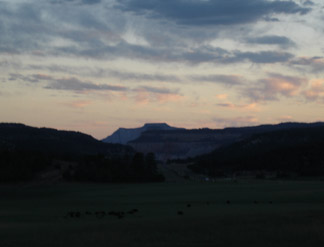
Here's the view from the porch swing where I'm blogging at Zion Mountain Resort. Forty-nine buffalo, including nine calves, roam these 600 acres of fenced meadow. They only come within photo range in the mornings and evenings, so you'll have to use your imagination at the moment.
There's no cell phone service, and very limitedregular phone servic at the resort. But they've got free wi-fi. I'm on vacation with my extended family (parents, brothers, spouses, kids), visiting Zion National Park and Grand Canyon National Park.
Posted by Virginia Postrel on June 13, 2005 • Comments