I must admit that New Orleans has long been my least favorite American city--dirty, inefficient, rundown, corrupt, not very friendly, and way too popular with people organizing conferences. It seemed like a good place for people who wanted to get drunk, eat crustaceans, or listen to jazz, all pursuits of no interest to me.
Nonetheless, I find Katrina's devastation overwhelmingly sad and hard to get my mind around. The idea that a major American city could essentially vanish in a natural disaster is simply hard to accept. But the obituaries are beginning. Here's Robert Parker on TNR and Josh Levin on Slate, both writers with strong ties to the city.
Will a city already struggling to justify its economic existence be rebuilt? Can it be? The debate has started on D Magazine's FrontBurner blog. To summarize: They rebuilt Galveston. But they didn't rebuild Pompeii.
Posted by Virginia Postrel on August 31, 2005 • Comments
InstaPundit has a list of places to send aid.
On TV, I like the Weather Channel's coverage, which also looks good online, including a good use of blogs to solicit and convey information.
Posted by Virginia Postrel on August 30, 2005 • Comments
Almost exactly six years ago, I gave this speech to a regional meeting of the Mont Pelerin Society. The theme of the conference was "creeping socialism." I argued that socialism was not the biggest threat to liberty today and that fighting old, familiar battles was a serious mistake.
Although the speech got thunderous applause, one audience member absolutely hated it and let me know in no uncertain terms. Vaclav Klaus scornfully told me what I was saying was no different from socialism in the guise of a "third way." Socialism was in fact the biggest threat to liberty, and it was wrong (and, his tone suggested, stupid and evil) to suggest otherwise. He wasn't looking for an argument, as far as I could tell, just a chance to put an obscure young lady in her place.
Well, now he's apparently come around--at the Mont Pelerin Society meeting, no less. Turns out old-style socialism is not, in fact, the biggest threat to liberty in the 21st century. Turns out it's not heretical to say we shouldn't fight old battles--at least if you're Vaclav Klaus. Gee.
His analysis isn't as clear as mine (nor can it accommodate Islamicism, which is a virulent form of reactionary stasis). But at least he's finally grasped the general point. Better six years late than never.
Posted by Virginia Postrel on August 30, 2005 • Comments
The WaPost's Peter Carlson marks the 10th anniversary of The Weekly Standard with an jocular article focused on the magazine's contents and influence. He misses, however, one of the Standard's most important effects: Lighting a fire under National Review, which had grown moribund.
Today NR has reclaimed its position as the leading conservative magazine and is far more influential online than either the Standard or the once-mighty New Republic (which is getting lapped online by liberal competitors The Washington Monthly and The American Prospect). Even in the decidedly unprofitable world of think magazines, there's nothing like competition to spur improvements.
Posted by Virginia Postrel on August 30, 2005 • Comments
Jerry Flint of Forbes, who has forgotten more about the auto industry than I'll ever know, offers his assessment of Detroit's current prospects. Read the column for the details. Here's the basic conclusion:
In the good old days, car companies lost money only in bad times. Today, the losses are coming with near-record industry sales every year. The Detroit companies just emptied the inventory bank, but it required huge price cuts over the summer. It's hard to make a big profit that way....
What is happening now is another reminder that GM and Ford won't get more money per car until their vehicles are so desirable that people are willing to pay top dollar and factory capacity is trimmed to match demand for such vehicles.
The leading foreign manufacturers, Toyota Motor (nyse: TM - news - people ), Honda Motor (nyse: HMC - news - people ) and BMW--Chrysler is based in Stuttgart, Germany, but its Chrysler division is American--get higher prices for their cars and trucks and give away much less in incentives. So far, these manufacturers are running most of their plants at high-capacity levels, despite the giveaway prices of the competition.
I do wish he'd written more about Chryler, which he calls "the one bright spot among the traditional 'Big Three,'" and what GM and Ford might learn from it. (That's another column perhaps.) Chrysler is in fact producing distinctive-looking cars, including the gorgeous Crossfire. One of my Dallas neighbors is kind enough to keep a red Crossfire parked in front of our building much of the time, giving us a new kind of public art.
Posted by Virginia Postrel on August 30, 2005 • Comments

Apparently the Postrels aren't the only ones who noticed that Chevrolet shows only the Impala logo, not the car, in its new TV commercials. They might as well come out and say it: HERE'S ANOTHER GENERIC CAR.
Cool logo, though. Very sleek.
Posted by Virginia Postrel on August 28, 2005 • Comments
The WaPost's Philip Pan reports on an extraordinary development in China: a class-action suit by rural villagers forced into abortions and sterilizations. The key argument in the case, which was organized by Chen Guangcheng, a self-taught legal activist, is that these coercive measures violate a 2002 law guaranteeing Chinese citizens "informed choice" in reproductive matters. The country's population-control policies are now supposed to rely on financial incentives, not physical threats and coercion.
The lawsuit is not just a human-rights crusade. It's a crucial test of China's commitment to the rule of law--a commitment that matters greatly to the country's economic development as well as its civil society. Pan's reporting suggests that central-government officials are at least saying the right things. Toward the end of the piece, which is well worth reading in its entirety, he interviews a central-government population-control honcho:
Yu Xuejin, a senior official with the national family planning commission in Beijing, said his office had received complaints about abuses in Linyi and asked provincial authorities to investigate. He said the practices described by the farmers, including forced sterilization and abortion, were "definitely illegal."
Yu emphasized that the central government had led the nation toward more humane family planning practices over the past decade. "If the Linyi complaints are true, or even partly true, it's because local officials do not understand the new demands of the Chinese leadership regarding family planning work," he said.
Yu also applauded the farmers for asserting their rights. If officials in Linyi violated the law, he said, "I support the ordinary people. If they need help, we'll help them find lawyers."
Posted by Virginia Postrel on August 28, 2005 • Comments
On a reporting trip to Detroit last week, I spent a spare hour (or, to judge from the parking ticket I got, a bit longer) at the Detroit Historical Museum. I was there to see a well-mounted exhibit of Supremes costumes from the collection of trio member Mary Wilson.
But while I was there, I naturally checked out the permanent exhibit on Detroit as "Motor City." I may be making too much of a single example, but the contrast between the Detroit exhibit and those I recently visited at the Petersen Automotive Museum in L.A. suggests a lot about what ails the Big Three. The Petersen is full of gorgeous automobiles. In Detroit, there was nary a car in sight. The car buyer barely seemed to exist. Cars had no glamour and no cultural significance. And car companies seemed to operate solely to provide jobs, attract people to Detroit, and spur the union movement. Nothing in the exhibit made you want a car. (The few vehicles on display were decidedly unattractive.)
At the Petersen, by contrast, the history--and there's plenty of it--is about innovation and social transformation. The car is a work of art and a source of personal expression. In California, cars are fun (despite all the traffic). In Detroit, they're drab artifacts of a black-and-white past. To be fair, the Ford and Chrysler museums do have cars on display; I just didn't have time for an extended museum tour. But you have to wonder about a Motor City that doesn't take every opportunity to demonstrate the appeal of cars.
By contrast, the Supremes exhibit, which included lots of Motown Records and civil rights history, not only showed the dresses (arranged on mannequins whose hand gestures were distinctively Supreme) but also played the music. It demonstrated why the Supremes were glamorous and successful. But it was organized by the Rock and Roll Hall of Fame, not the Detroit museum.
Posted by Virginia Postrel on August 28, 2005 • Comments
I recently discovered (thanks to an email from him) that Steve Portigal, who may be most familiar to readers from his frequent comments on Grant McCracken's blog, has his own blog. In a recent post, he called attention to a series of Target ads featuring extraordinarily messy and wire-filled rooms:
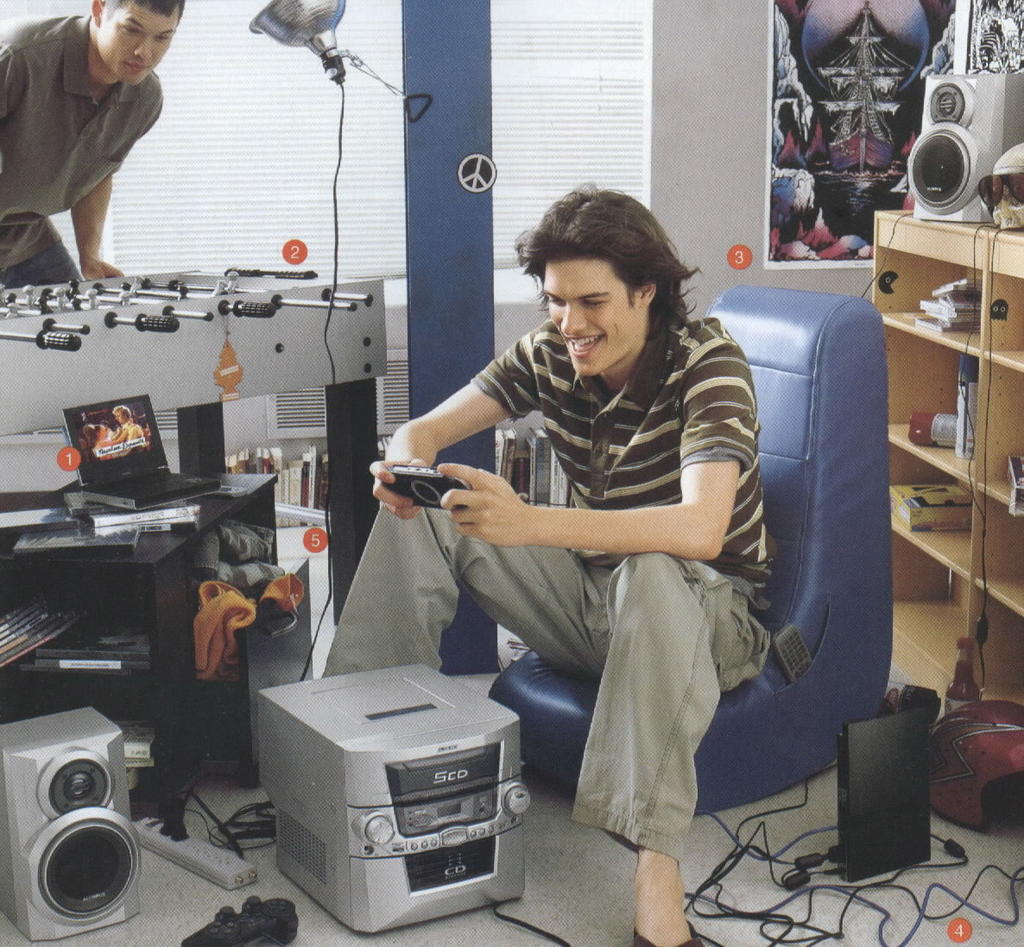
I was amazed to see pictures of messy rooms, where people own lots of stuff, it's messy, askew, and yes indeed, there are wires - cables, cords, the whole real deal.
Sure, the pictures are entirely stylized and sort of hyper-real, but somehow it's relieving to see a significant move away from the more idealized and yes glamourous consumer images that advertising is so fond of.
Whatever happened to wireless glamour? The same thing that tends to happen to every other kind of glamour: We got tired of it, because it was too much work. The grace, mystery, and idealism that give glamour its power aren't terribly compatible with everyday life, at least not the way most Americans want to live it. And when we're furnishing our homes (or our dorm rooms), we often prefer a comfortingly homey mess to glamour's impossible grace.
In his new book, Culture and Consumption II, Grant McCracken includes a chapter delving into the idea of "homeyness." (The short lead-in to this extended essay hilariously describes Grant's adventures as a guest on Oprah.) The ideas are too complex to summarize, but suffice it to say that homeyness is a desirable quality to many people and that it includes a lot of personal clutter:
Objects are homey when they have a personal significance for the owner (e.g., gifts, crafts, trophies, mementos, family heirlooms). A homemade ashtray assembled from shells collected on a summer holiday by the children served one family as a reminder of an important time and place in the history of the family and was therefore considered especially homey. Objects can also be homey when they are informal or playful in character (e.g., the novelty ashtray, a pillow in the shape of a football, a pillow with verse in needlepoint). Plants and flowers are objects that contribute to the homeyness of a room. Some objects are homey because they support or contain decorative objects (e.g., wooden hutches and what-nots)....Pictures of relatives, pets, and possessions are also homey. Paintings of certain kinds can have a homey character, especially sentimental treatments of landscapes or seascapes. Books in quantity can "furnish" a room and ggive it a homey character....
Respondents used a very particular set of adjectives to describe "homeyness." A favorite characterization of the homey place was to say that it looked "as though someone lived there." The terms "informal," "comfortable," "cozy," "relaxed," "secure," "unique," "old," "rich," "warm," "humble," "welcoming," "accommodating," "lived in," "country kitchenish" were all used as glosses...
The enemies of homeyness...were easily characterized. One respondent described an ornately formal living room as "cluttered up with a whole lot of fancy stuff" and therefore unhomey. The terms used to characterize unhomey homes were "pretentious," "formal," "stark," "elegant," "cold," "daunting," "sterile," "showpiece," "reserved," "controlled," "decorated," "modern," and even "Scandinavian."
Target is selling homeyness--of a youthful, technological sort--in those wire-filled ads. Glamour is the enemy of homeyness, so there's no need to hide the wires. (Just don't think about how you'd manage to walk across the room.)
Posted by Virginia Postrel on August 18, 2005 • Comments
The WaPost's Ariana Eunjung Cha reports on how Best Buy is tailoring the environment and service at particularly stores to appeal to specific types of customers. It's yet another sign that one-best-way store environments, like lowest-common-denominator products, just aren't as valuable--or aren't as competitive--as they once were.
Big chain stores used to be among the most egalitarian of places. They were aimed at the average person, the generic "shopper," without conscious regard to background, race, religion or sex. That is changing as computer databases have allowed corporations to gather an unparalleled amount of data about their customers. Many retailers, like Best Buy, are analyzing the data to figure out which customers are the most profitable -- and the least -- and to adjust their policies accordingly....
inspired by Columbia University Professor Larry Selden's book, "Angel Customers and Demon Customers," Best Buy chief executive Bradbury H. Anderson is on a mission to reinvent how the company thinks about its customers. Best Buy has pared some less desirable shoppers from its mailing lists and has tightened up its return policy to prevent abuse. At the same time, it has begun to woo a roster of shopper profiles, each given a name: Buzz (the young tech enthusiast), Barry (the wealthy professional man), Ray (the family man) and, especially, Jill.
Based on analyses of databases of purchases, local census numbers, surveys of customers and targeted focus groups, Best Buy last fall started converting its 67 California stores to cater to one or more of those segments of its shopping population. It plans to roll out a similar redesign at its 660 stores nationwide -- including about 15 in the Washington area -- over the next three years. The Best Buys in the Springfield Mall, the Fairlakes shopping center and Potomac Mills, for instance, are being transformed into stores for Barrys, featuring leather couches where one might imagine enjoying a drink and a cigar while watching a large-screen TV hooked up to a high-end sound system.
The Santa Rosa Best Buy, Store #120, is a Jill store.
Pink, red and white balloons festoon the entrance. TVs play "The Incredibles." There is an expanded selection of home appliances as well as new displays stocked with Hello Kitty, Barbie and SpongeBob SquarePants electronic equipment. Nooks are set up to look like dorms or recreation rooms where mom and the children can play with the latest high-tech gadgets at their leisure. Best Buy has new express checkout lines for the Jills; store managers say anyone can use them, but if you are not escorted by a special service representative they can be easy to miss. The music over the loudspeakers has been turned down a notch and is usually a selection of Jill's favorites, such as James Taylor and Mariah Carey.
Cha's piece is a good read. Don't rely on the excerpt. Read the whole thing.
Posted by Virginia Postrel on August 18, 2005 • Comments