 What's the value of a logo once the organization it symbolized no longer exists? What does it mean? Graphic designer Michael Bierut considers the preservation questions raised by the demise of the AT&T logo (a.k.a. the Death Star), a touchstone among designers.
Posted by Virginia Postrel on November 01, 2005 • Comments
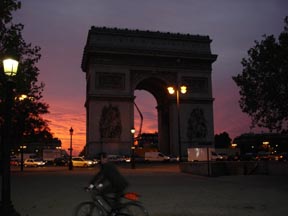 Why was the sun rising as I walked to my Paris conference at 8:15 in the morning? I wondered. Thanks to Jim Lindgren, I now know the answer. In a "fall back" post on the Volokh Conspiracy, he explained:
It is pleasant traveling in France in the summer, which based on longitude should be on Greenwich time along with England, but instead is an hour ahead of London; the sun often goes down after 9:30pm. In effect, France and Spain are on double Daylight Saving Time in the summer and single Daylight Saving Time in the winter.
Peter Galison's book Einstein's Clocks, Poincare's Maps: Empires of Time details the intense Anglo-French rivalries over where to draw the time-establishing prime meridian.
Posted by Virginia Postrel on November 01, 2005 • Comments
D Magazine publisher Wick Allison says rumors are flying that Harriet Miers might run for mayor of Dallas. Sounds crazy to me, but Wick claims "she would be inundated with campaign donations."
Posted by Virginia Postrel on November 01, 2005 • Comments
The complete DVD set of Buffy the Vampire Slayer will be out in two weeks. Amazon is taking advanced orders.
In other Buffy news, I've enjoyed dipping into Why Buffy Matters, a book of literary criticism.
Posted by Virginia Postrel on November 01, 2005 • Comments
On my recent visit to London, I was struck by the difference between U.S. security procedures and British ones. In London, you are videotaped--and told you are being videotaped--everywhere. But you can walk into a crowded train station or an art museum filled with tourists and priceless treasures without showing anyone the contents of your bag. Even airport security is much more casual than the ritualistic shoe stripping and computer segregation of U.S. airports. I'm not convinced that either surveillance or routine search does much to prevent terrorist attacks. But, while less avoidable (at least in theory), the British way is certainly less intrusive. I'd rather be watched than searched.
Posted by Virginia Postrel on October 30, 2005 • Comments
I landed back in the USA from London to find CNN reporting that Harriet Miers has withdrawn. The Democrats' congressional leadership, no doubt to be joined by a few conservative interest groups, is spinning this as a victory for the "radical right." But the truth is obvious: It's simply a victory for high hiring standards. The corollary to the "Ginsburg principle" is that a Supreme Court nominee had better be as recognizably qualified as Ruth Bader Ginsburg.
Posted by Virginia Postrel on October 27, 2005 • Comments
As regular readers know, I've written an extraordinary amount about Bush's nomination of Harriet Miers to the Supreme Court. Early on, my primary purpose was reportorial--to use my locational advantage to provide information and context for people outside of Dallas. But the more I learned, the more appalled I became.
For whatever reason, the president has picked a woman who not only has no constitutional or judicial experience but even in her business practice has demonstrated no interest in the law as anything other than a source of billable hours. At 60 years old, she appears never to have had a substantive conversation about law or policy with any friend. She comes from a closed and cronyish legal and business culture and appears to have gotten ahead through a combination of networking, nose-to-the-grindstone diligence, and willingness to do her law firm's management, rather than legal, work.
Her selection is an insult to women, to evangelical Christians, and to corporate lawyers. Is this really the best these groups have to offer to U.S. Supreme Court?
Unlike some social conservatives, my concerns are not results-oriented. As a matter of policy, I am perfectly happy to have abortion legal, with some restrictions, and actively support gay marriage. If there were any evidence (other than my friend Hugh Hewitt's imaginings) that Harriet Miers shared Richard Epstein's views on affirmative action, I'd give her a pass on that. (Now there' a line of questioning for the Judiciary Committee: Would you agree with Richard Epstein on affirmative action? Does she even know who he is or what he says?)
But the Supreme Court is not a legislature, in which the standard for a justice is whether he or she will "vote right." Supreme Court decisions set precedents beyond the case at hand, and they do that through the arguments they make--the very sort of logic and rhetoric Miers shows absolutely no interest in or competence for. Being the president's friend and lawyer, like being of the right sex and religion, does not by itself meet the requirements of the job.
At the invitation of David Frum, I have joined the advisory board of Americans for Better Justice, a group of people who have supported President Bush but who do not support this nomination. ABJ's website has more information about the organization, which will be running TV ads asking the president to withdraw the nomination, and what citizens can do to let the Senate and president know that America deserves better.
My previous posts on the Miers nomination, in reverse chronological order, are here, here, here, here, here, here, here, here, here, here, here, here, here, and here.
Posted by Virginia Postrel on October 24, 2005 • Comments
Bush is expected to announce shortly that he will name Ben Bernanke to succeed Alan Greenspan--a very difficult job, but one for whom Bernanke, who is best known as an advocate of "inflation targeting," seems to me the best choice. Here's a column I wrote on a speech he gave in 2003, with a link to the text.
UPDATE: There's lots more on Marginal Revolution.
Posted by Virginia Postrel on October 24, 2005 • Comments
Why are the French blowing up world trade talks with their refusal to cut agricultural subsidies? This International Herald Tribune article suggests that the answer is mostly cultural: the French affection for "the 'terroir,' the mythical landscape of farms and the men and women who tend to them."
Perhaps, but the terroir does more than support its own myth. It makes Paris Paris--the metropolis in a rural country. Already under the influence of Eugen Weber's fiesty France: Fin de Siècle, which draws a stark contrast between city and countryside at that time, I flew into Paris for the first time last week. Where was the city? I wondered. The pilot said was were just 15 minutes from landing, but we were over the boondocks. Even the Greenville-Spartanburg airport, which lies between those two South Carolina cities, isn't in such rural territory. Something weird--or at least weird to an American--is clearly going on.
Posted by Virginia Postrel on October 23, 2005 • Comments
They're celebrating the 200th anniversary of the Battle of Trafalgar today, not far from my hotel. Crowds were already gathering this morning, when I visited the National Gallery and National Portrait Gallery in Trafalgar Square. I was in Paris last week, where they weren't celebrating.
Posted by Virginia Postrel on October 23, 2005 • Comments