Atlantic Business
A new Atlantic site (technically a channel, or subset of the main site), edited by Megan McArdle. Check it out.
A new Atlantic site (technically a channel, or subset of the main site), edited by Megan McArdle. Check it out.
Chester Arthur, Calvin Coolidge, and Barack Obama.
As part of The Atlantic's State of the Union lineup, I chatted via instant messaging with Shannon Brownlee, author of Overtreated: Why Too Much Medicine Is Making Us Sicker and Poorer
VIRGINIA POSTREL: However you pay for it, the cost of health care won't go away. The fundamental question is the one you started with: Where do we get the incentives and feedback we're used to in other industries? I don't want to overemphasize this, but one problem is simply that patients expect health care to be free to them. Why don't I pay my primary care physician like I pay my hairdresser or plumber and save insurance for very expensive, unexpected events like cancer? (I'm ignoring the issue of chronic disease, which is a serious one, for the moment.)
SHANNON BROWNLEE: Returning to your previous comment about patients shopping around, I can only think that people who argue that the ill should be able to control their own care can't possibly know any really sick people. In particular, they can't possibly know anybody with a complex, chronic illness — which is, of course, just the kind of patient who is costing us the most money.
VIRGINIA POSTREL: People don't necessarily want their primary care physician coordinating their care. In fact they hate it when HMOs make them gatekeepers. But they want SOMEONE coordinating. Maybe we need more use of the role you see with transplant coordinators for kidney transplants — a highly organized physician's assistant (at least when I was a donor) who makes sure everyone gets what they need and the patient stays in the loop.
SHANNON BROWNLEE: I think that's a perfectly reasonable model — pay out of pocket for primary care, either on a per visit basis or per month, and then have catastrophic care. There are a couple of problems with this model, however. 1) A lot of people don't have the money to pay for frequent visits to their PCP. 2) Patients aren't particularly rational about the way they decide what's needed and what isn't. Probably a better model is the capitated, per month payment.
"We can save the banks as institutions and restart lending without a massive transfer of money from taxpayers to investors and bankers, and here is how."
A must read. [Via Greg Mankiw.]
UPDATE: More advice from the indispensible Luigi, with Alberto Alessina.
Rick Warren to Aretha Franklin.

On the other hand, their wares are unprofessional-looking germ carriers.
They're back, thanks to a collapse in ticket sales. When I flew Southwest to and from San Jose last week, I had three seats to myself, even though in one case I was the very last person on the plane.
Be careful what you wish for--empty planes, lower credit card balances, less shopping. You just might get it.
[Cross-posted from DeepGlamour.net]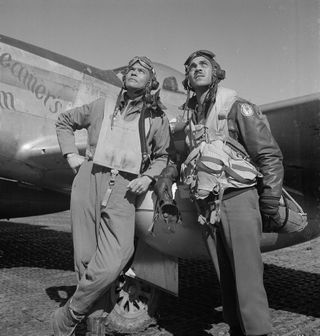 With the Tuskegee Airmen headed to the inauguration, let's take a moment to remember what they looked like when they were young and glamorous--and, of course, just how subversive that glamour was. The airmen were not just warriors but aviators, the epitome of masculine modernity: brave and daring, yes, but also masters of complex machines, with all the discipline and intelligence that implied. Their very existence refuted the ideology of white supremacy.
In April 1945, the Airmen were photographed by Toni Frissell, a noted fashion and society photographer (she did the photos at Jack and Jackie's wedding). Frissell knew glamour and, unlike many of her contemporaries, she didn't need a studio or heavy retouching to create it. Her photos of couples cuddling in the park are as appealing as her shots of models on the steps of the Jefferson Memorial. And she loved natural light.
Frissell was the ideal photographer to capture the Tuskegee Airmen for posterity. As this DG slideshow illustrates, she captured the glamour--and dignity--of these young men, whether posed looking skyward, working on engines, listening to briefings, playing cards, or receiving "escape kits" of cyanide. And, presumably for hometown newspapers, she noted their names and hometowns, which are included in the slideshow captions.
Not all the aviators will make it to the inauguration, of course. Many, indeed, never made it home from the war--something I was reminded of when Googling Ronald Reeves, the Blair Underwood lookalike in a few of the photos.
I'm looking for someone who can help me move this blog from an ancient version of MovableType to the current edition with minimal trauma. If this sounds like a job for you, please send me an email at vp-at-dynamist.com, giving some background and info on what you'd charge. Thanks.
UPDATE: Rand Simberg advises me that upgrading MT is a nightmare. He recommends Word Press. We use Typepad for Deep Glamour. I'd be happy to go with either, but I need someone who can make the transition without losing the look and feel of the page.