What Do We Get for the Money?
The SacBee's Dan Weintraub has a good column on California's ongoing fiscal mess and the need for performance-based budgeting.
The SacBee's Dan Weintraub has a good column on California's ongoing fiscal mess and the need for performance-based budgeting.
A too-short, but significant article from Foreign Policy. I certainly hope he's right. (Via Lynne Kiesling, who applies the idea to the electrical grid.)
Overlawyered's Walter Olson reveals the secret to boosting traffic in this short piece by Alex Beam. (And it isn't Britney Spears.)
A disturbing account by impersonation-victim Matthew Herper of Forbes.com:
For months somebody (I don't know who) has been running a Facebook profile that bears my name, my personal information and several photos of me.
An old high school friend had connected with the faker, instead of me. Several of the people with whom fake Matt is friends also appeared to be fakes, including a copycat of Vertex Pharmaceuticals founder and chief executive Joshua Boger. (Boger has a real Facebook profile but isn't friends with me. He declined to comment on the fakesters.) I couldn't see this Fake Matt's profile myself, even by searching for my name.
This pretender was one of 100 impersonators of scientists, journalists and science policy wonks uncovered by Lucas Laursen, a reporter at Nature, the scientific journal. Most of the people who were copied are somehow linked to the biotech industry, and many are linked to the especially controversial field of embryonic stem cell research. Ruth McKernan, chief scientific officer of Pfizer's regenerative medicine unit is on the list; so was University of Wisconsin bioethicist Alta Charo, whose thinking about stem cells has been hugely influential. (See the Nature article.)
Read the whole thing. (The Nature article is, unfortunately, seriously gated.) Facebook, like many Internet sites, runs partly on technology but largely on trust. Erode that trust and people won't use it.
Also, I have been wondering for a long time whether the Norma McCorvey on my long and eclectic FB friends list is the real woman from Roe v. Wade or an impersonator. Either way, she's claiming she just had to reset her password.
Nick Gillespie and Matt Welch evaluate Barack Obama's First 100 Days and find it wanting.
From an outsider's perspective, I completely agree with this assessment. Portfolio worked--for a while--as an advertising vehicle, but it never gave readers a reason to care. And from what little I know from the inside, the stuff about editing the life (and glamour) out of articles is entirely true. Newspaper training isn't the ideal background for magazine editors.
The NYT's Green Inc. blog reports on lighting designer Howard Brandston's objections to bans on incandescent bulbs. It's a good Q&A but a couple of years too late, since Congress slipped a light bulb ban, effective in 2012, into the 2007 energy bill. Anyone who'd talked to lighting professionals, as I did for this 2003 article, would have known the problems with such (to quote the Dell exec) "total utilitarian, speed-and-specs" approaches to lighting.
Two years ago--which means four years after the publication of The Substance of Style
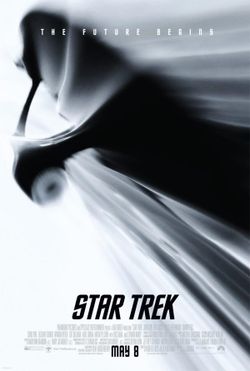 Paramount recently released the poster for the new Star Trek movie, opening May 8. The black and white composition and almost abstract suggestion of speed make an interesting contrast to the clear forms and primary colors of the original show.
Long-time DG readers may remember this quotation, comparing James Bond and Mr. Spock, from Jeff Greenwald's 1999 book Future Perfect: How Star Trek Conquered Planet Earth
Read the rest--and more interesting posts, by me and others--at DeepGlamour.net.
My latest Atlantic column considers how the Fed's misunderstanding of the "Great Moderation" may have fed asset bubbles, leading to what Professor Postrel calls the Current Unpleasantness. An excerpt:
But containing inflation and eliminating, or noticeably dampening, economic downturns are two entirely different things. Congratulating policy makers for "the virtual disappearance of the business cycle" oversteps the evidence and encourages the hubris that fostered the current crisis and could make recovery more difficult. The conventional explanation for the Great Moderation gives too much credit to easily identifiable economic policy makers—"I feel the contribution of good policy cannot be overstated," said Romer—and too little to all those anonymous managers and workers whose everyday actions get summarized in the aggregate statistics that Fed economists watch so closely.
Research published in journals like the American Economic Review, dating back to a 2000 article by Margaret McConnell of the New York Fed and Gabriel Perez-Quiros of the European Central Bank, tells a different story. This line of research says that good Fed policy was necessary but not sufficient, that the business cycle never disappeared, and that most of the Great Moderation emerged not from deliberate government policy but from changes in business practices that occurred for competitive reasons having nothing to do with macroeconomic goals.
It's a fairly complex piece, so please read the whole thing.