In Sunday's NYTBR, I review Chris Anderson's new book, Free: The Future of a Radical Price . Here's the opening:
Fifteen years ago — before Google or Wikipedia or blogging or Craigslist or podcasts or YouTube — the technology investor and pundit Esther Dyson wrote an article analyzing the business of "creative content" in a future where the Internet made distribution essentially free. "Creators will have to fight to attract attention and get paid," she predicted. Enforcing copyrights won't be enough, because creators "will operate in an increasingly competitive marketplace where much of the intellectual property is distributed free and suppliers explode in number. . . . The problem for owners of content is that they will be competing with free or almost-free content."
That future is today, and it is the subject of Free: The Future of a Radical Price by Chris Anderson, the editor in chief of Wired and the author of The Long Tail Despite its subtitle, the book is less about the future than the present and recent past, which Anderson surveys in a cheerful, can-do voice. "People are making lots of money charging nothing," he writes. "Not nothing for everything, but nothing for enough that we have essentially created an economy as big as a good-sized country around the price of $0.00."
Driving the trend are the steeply declining prices of three essential technologies: computing power, digital storage and transmission capacity. Reproducing and delivering digital content — words, music, software, pictures, video — has now fulfilled the prophecy once made about electricity. It has become too cheap to meter. "Whatever it costs YouTube to stream a video today will cost half as much in a year," Anderson writes. "The trend lines that determine the cost of doing business online all point the same way: to zero. No wonder the prices online all go the same way."
More precisely, the marginal cost of digital products, or the cost of delivering one additional copy, is approaching zero. The fixed cost of producing the first copy, however, may be as high as ever. All those servers and transmission lines, as cheap as they may be per gigabyte, require large initial investments. The articles still have to be written, the songs recorded, the movies made. The crucial business question, then, is how you cover those fixed costs. As many an airline bankruptcy demonstrates, it can be extremely hard to survive in a business with high fixed costs, low marginal costs and relatively easy entry. As long as serving one new customer costs next to nothing, the competition to attract as many customers as possible will drive prices toward zero. And zero doesn't pay the bills.
Read the whole thing. Unlike the typical journalist's review, this one isn't just a tantrum.
Posted by Virginia Postrel on July 10, 2009 • Comments
More than 80,000 patients are now on the national waiting list for kidney transplants, a number that has increased by about 20,000 since I first started tracking this issue in 2006. The list does not have to exist. It is an outcome of bad policy and complacent institutions. My magnum opus on ending the list is now up at TheAtlantic.com. Please read it and spread the word.
Posted by Virginia Postrel on July 10, 2009 • Comments
But they're still incredibly high, even by L.A. standards.
Posted by Virginia Postrel on July 09, 2009 • Comments
Though anything but plush, California's prisons are scandalously expensive, thanks largely to the bipartisan clout of the prison guards' union. The SacBee's Dan Walters reports:
It is, by a very wide margin, the costliest prison system among the largest states, with a per-inmate cost that prison officials tag at around $45,000 a year, roughly what it costs to send a youngster to one of the more prestigious private universities.
The average among the nation's 10 most populous states, according to one recent calculation, is $27,237 per year per inmate, including states with substantially higher incarceration rates, such as Texas. Therefore, prisons consume a much-higher portion of California's general fund budget than those of other states — more than 10 percent.
The other nine states' prison costs range from less than 4 percent of their general fund budgets (Florida) to 8.2 percent (Michigan) with an average of about 6 percent. Or to put it another way, were California spending an average amount on its felons, it would be spending about $4 billion less each year.
Given the state's financial collapse, Walters concludes that Schwarzenegger is right to endorse privatization: "If it's time to get serious about cutting our prison costs, private management could scarcely be worse than what we have now."
Mark Kleiman is always good for some creative ideas on producing better, cheaper criminal justice. And he's hardly some kind of Republican tool.
Posted by Virginia Postrel on July 07, 2009 • Comments
Jonah Goldberg puts the WaPost's salon scandal in context:
Perhaps what really offends is the flier's truth in advertising. If the Post didn't try to charge for attendance, most journalists, politicians and lobbyists would have leaped at the chance to attend. That's the way things used to work for Weymouth's grandmother, Katharine Graham, who hosted Washington's most famous high-powered salon for decades.
Of course, that was when newspapers were hugely profitable and money was the tawdriest medium of exchange. That's what makes all the outrage so quaint. It's like passengers on the Titanic refusing to leave their cabins before the steward lays out their evening clothes. Some things just aren't done.
And before Kay Graham was hosting those salons, Ben Bradlee was kickin' it with JFK.
Posted by Virginia Postrel on July 06, 2009 • Comments
 Naomi Wolf's Harper's Bazaar essay on Angelina Jolie has attracted contemptuous comment. "An absurd, overwrought, swooning love letter," Willa Paskin called it on DoubleX. Paskin's disgust recalls Ron Rosenbaum's condemnation of Tom Junod's 2007 Esquire profile of the actress, which worked a strained and inappropriate post-9/11 angle.
Unlike Paskin, I do not regard Wolf as "a serious feminist and thinker." She's a feminist, certainly, but neither serious nor a thinker. She is an emoter, whose work typically generalizes from her narcissistic neediness to "the female experience." It is usually an intellectually frivolous approach.
But this time it works brilliantly, though not in the way Wolf intends.
Read the rest at DeepGlamour.
Posted by Virginia Postrel on June 19, 2009 • Comments

Courtesy of Flickr user .faramarz, who has many, bloodier photos from the protests.
[Cross posted from DeepGlamour]
Posted by Virginia Postrel on June 15, 2009 • Comments
In 1898, Nym Crinkle (the pen name of Andrew C. Wheeler) made the following prediction for a century hence. He was only 20 years or so off the mark:
Every person of fairly good education and of restless mind writes a book. As a rule, it is a superficial book, but it swells the bulk and it indicated the cerebral unrest that is trying to express itself. We have arrived at a condition in which more books are printed than the world can read. This is true not only of books that are not worth reading, but it is true of the books that are. All this I take to be the result of an intellectual affranchisement that is new, and of a dissemination of knowledge instead of concentration of culture. Everybody wants to say something. But it is slowly growing upon the world that everybody has not got something to say. Therefore one may even at this moment detect the causes which will produce reaction. In 100 years there will not be so many books printed, but there will be more said. That seems to me to be inevitable.
[Via PaleoFuture]
Posted by Virginia Postrel on June 14, 2009 • Comments
The search is on.
Posted by Virginia Postrel on June 09, 2009 • Comments
[Cross posted from DeepGlamour.net]
The malls are empty, and retailers are crying for customers. American women are getting heavier by the day. Yet stores like Ann Taylor and Bloomingdale's, and lines including Liz Claiborne and Ellen Tracy, are slashing their plus-size offerings — turning away potential sales and generating angry denunciations of "sizeism." What's going on?
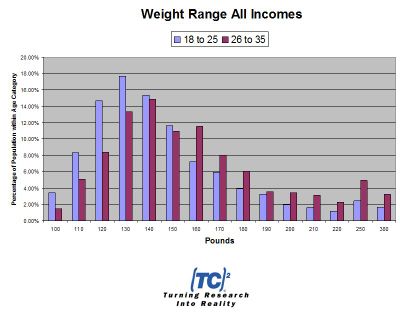
As I explain in this article on Double X, the new women-oriented spinoff of Slate, there's a perfectly rational explanation that doesn't require an animus toward larger women. It does require graphs to explain, however, and The Washington Post, owner of Double X and Slate, has saddled the ladies with a design that can't handle more than one graphic per article, let alone multiple bar charts.
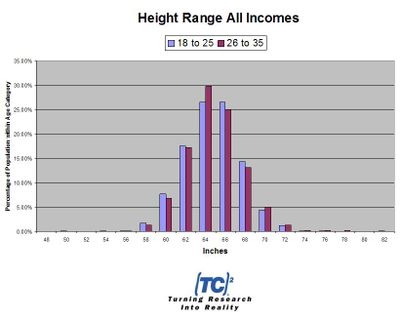
Here at DG, however, we have an ace technical and design staff. So here are the missing pictures, courtesy of David Bruner at TC[2]. (Click to see the full-size version.)

Height, by contrast, looks more like a bell curve.
Here are weights for the same two age groups:
Read the article here.
Posted by Virginia Postrel on June 09, 2009 • Comments