Talking THE POWER OF GLAMOUR with Glenn Reynolds
Glenn Reynolds of Instapundit fame interviewed me about The Power of Glamour
Glenn Reynolds of Instapundit fame interviewed me about The Power of Glamour
Tyler Cowen on Marginal Revolution has a
brief but glowing post about The Power of Glamour
I believe this is her best and most compelling book. It is wonderfully researched, very well written, the topic is understudied yet of universal import, and the accompanying visuals are striking.
He highlights the distinction I draw between glamour and charisma, which I also discussed in DeepGlamour posts here and here.
I'll be speaking about "The Power of Glamour" (and signing
The Power of Glamour
Check out the Calendar for other upcoming events.
Check out this brief, image-laden interview with me talking about my new book, The Power of Glamour: Longing and the Art of Visual Persuasion

Unfortunately, Islamist terrorism doesn't need Rolling Stone to make it glamorous. |
No sooner had Rolling Stone put Boston Marathon bombing suspect Dzhokhar Tsarnaev on its cover, looking doe-eyed and rock-star disheveled, than critics denounced the editors for "glamorizing terrorism."
"The cover of Rolling Stone is meant for glorifying rock stars, icons, and heroes NOT murderers!" protested a typical reader in the article's online comments thread. Boston Mayor Thomas Menino decried the magazine for its "celebrity treatment" of Tsarnaev and for sending the "terrible message that destruction gains fame for killers and their 'causes.'"
Unfortunately, Islamist terrorism doesn't need Rolling Stone to make it glamorous. For the right audience, apparently including Tsarnaev, it already is. Understanding the nature of that glamour could offer clues to discouraging future terrorists. But first we have to acknowledge that terrorist glamour exists.
The novelist Salman Rushdie recognized the connection in a 2006 interview. "Terror is glamour--not only, but also," he said, arguing that many terrorists "are influenced by the misdirected image of a kind of magic ... The suicide bomber's imagination leads him to believe in a brilliant act of heroism, when in fact he is simply blowing himself up pointlessly and taking other people's lives."
The interviewer was flabbergasted, but Rushdie was correct. Glamour is about much more than celebrity, sex appeal or shiny dresses. It's a product of imagination--and a powerful form of persuasion.
Glamour gives its audience the feeling of "if only"--if only I could belong to that group, wear that dress, drive that car, date that person, live in that house. If only I could be like that. By embodying our longings in a specific image or idea, glamour convinces us, if only for a moment, that the life we yearn for exists. That dream can motivate real-world action, whether that means taking a resort vacation, moving to a new city, starting a band or planting a bomb with visions of martyrdom. What we find glamorous helps define who we are and who we may become.
Janet Reitman's Rolling Stone story on Tsarnaev points to several sources of glamour that have nothing to do with celebrity: the allure of military action, utopian causes and a lost homeland and identity. All these things speak to desires that go deeper than fame. "It is not uncommon for young Chechen men to romanticize jihad," Reitman writes, describing "abundant Chechen jihadist videos online" that show fighters from the Caucasus who "look like grizzled Navy SEALs, humping through the woods in camouflage and bandannas."
To be a jihadi warrior, these images suggest, is to be a man. Martial glamour is as ancient as Achilles. It promises prowess, courage, camaraderie and historical importance. It offers a way to matter. The West once recognized the pull of martial glamour--before the carnage of World War I, the glamour of battle was a common and positive phrase--but it ignores at its peril the spell's enduring draw, especially for those who feel powerless and insignificant.
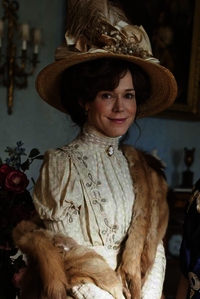 Rose Selfridge as portrayed by Frances O'Connor in "Mr. Selfridge" |
 by Lindy Woodhead. One thing that becomes clear when you read the book is that, aside from its eponymous protagonist and his family, the show's characters are fictional--composites in a few cases like Lady Mae, completely made-up in most. The show is drama, not history. That's fine, except when the fictional version is more boring than the real one.
One of the show's most tedious plot lines is the flirtation Rose Selfridge, Harry's long-suffering wife, has with a bohemian painter she meets at the National Gallery. Rose, we're led to believe, used to paint before she got married and gave up art for domesticity. Her artist beau paints her portrait, showing her at the easel, with her hair flowing down her bare shoulders. It's a cliched bit of art-versus-commerce, bohemianism-versus-domesticity--far less original than Rose's real story.
Before she married Selfridge, Rose wasn't a dilettante painter. She was a successful real estate developer.
Woodhead explains:
His bride-to-be has been described as a "Chicago debutante." She was indeed a debutante when a teenager, but by the time she met Harry she was nearly thirty and had spent several years working as a successful property developer. Rosalie had learned her craft from her father, the property investor Frank Buckingham, who was also a member of the exclusive Chicago Club. Mr Buckingham had died in the early 1880s, leaving his twenty-three-year-old daughter enough money to venture into development herself. In partnership with her brother-in-law, Frank Chandler, Rosalie bought land on Harper Avenue in Hyde Park, then a rural outpost of the city. This was no small venture. Rosalie planned and oversaw the building of forty-two villas and "artists' cottages," the villas each with a forty-five- or fifty-foot frontage and a driveway to reach the stabling at the rear. It was an enlightened development, including a business block with a drugstore, a family grocery store, a café, a reading room and even a public hall for lectures and concerts. The houses looked out on the park lagoons and lake, with the east side of the development being built sixty feet away from the railroad tracks, which the railroad company was expected to landscape in harmony with the general plan. The architect for the development was Solon S. Beman, the designer of the famous "Pullman model town," where George Pullman corraled his employees. But Rosalie's villas were not intended for factory workers. They were elegant, spacious, middle-class homes in what was the area's first planned community. Miss Buckingham was no giddy debutante.
The real Harry Selfridge married a visionary businesswoman with an executive temperament, not a self-effacing frustrated artist. Now that has potential for drama.
In my latest Bloomberg View column, I use the new PBS show Mr. Selfridge (preview video above) as an excuse to delve into the history of department stores--which, like the history of consumption in general, gets short shrift in both scholarship and popular culture. Here's an excerpt:
like railroads and telegraphs, the department stores of the late 19th and early 20th century were socially and economically transformative institutions. They pioneered innovations ranging from inventory control and installment credit to ventilation systems, electric lighting and steel construction, along with new merchandising and advertising techniques. They brought together goods from all over the world and lit up city streets with their window displays. They significantly changed the role of women, giving them new career opportunities and respectable places to meet in public. They popularized bicycles, cosmetics, ready-to-wear clothing and electrical appliances. They even invented the ladies' room.
In their day, the stores were also the settings for popular theater. "In the 19th and early 20th century, there were dozens of plays and movies that were set in department stores and explored them," says Erika Rappaport, a historian at the University of California, Santa Barbara, who studies consumer culture in 19th-century Britain. "Society was thinking about them."
When department stores were new, people understood that they were significant institutions -- liberating in the eyes of some, threatening or corrupting to others, but obviously important. Nowadays, we treat shopping as silly stuff. "When I tell people I've written on shopping, I still get giggles," says Rappaport, whose 2000 book Shopping for Pleasure
describes the development of retailing in London's West End, focusing particularly on women shoppers. "People are uncomfortable: 'that's not real history.'"
But ignoring consumer culture produces a bizarre mental picture of the Industrial Revolution that features textile factories but includes no one buying or selling clothes. By downplaying the pleasures of newly inexpensive goods and the shops that sold them, the production-only version of history also misses the everyday meaning of a rising standard of living -- the satisfaction, for instance, of having multiple outfits, or even a variety of hat trimmings, that allow you to express your mood or personality.
"The appeal just of the stuff is a really major part of all of this, and that of course is only made possible by manufacturing," says Linda M. Scott, a professor at Oxford's Said Business School and the author of Fresh Lipstick
, a history of the relationship between feminism and the American beauty and fashion economy. In researching the book, Scott says she was surprised to discover just how important the desire for cash to spend on consumer goods was in drawing young women out of domestic service and into factories. "Even middle-class girls who weren't supposed to work would talk, in interviews and letters, about envying the working-class girls," she says. "Because if you couldn't work you could only get the stuff you wanted by manipulating a man."
Read the rest here.
The Design Criticism program at the School of Visual Arts in New York recently invited me to give a lecture, followed by a lively Q&A period. Here's the video.
Virginia Postrel, "Meaning and Value in Commercial Culture" from D-Crit on Vimeo.
I think it works.
While doing research in issues of Vogue from 1974, I found this familiar-seeming ad for a "luxury fabric from the 21st Century."
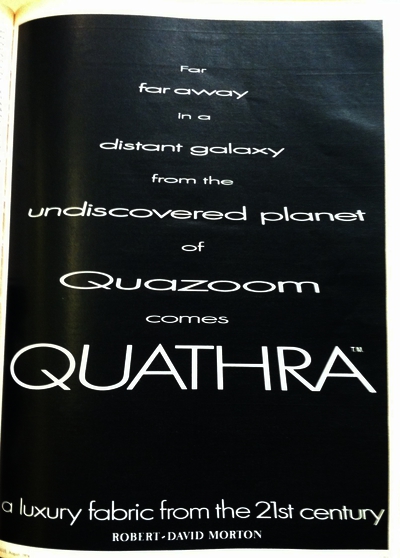 From the August 1974 issue of Vogue, three years before the debut of Star Wars |